

Wearing Paraíba Jewelry with Confidence
A Paraíba tourmaline brings a color that shapes the entire look. This guide shows how its glow relates to clothing, other gemstones and metals.
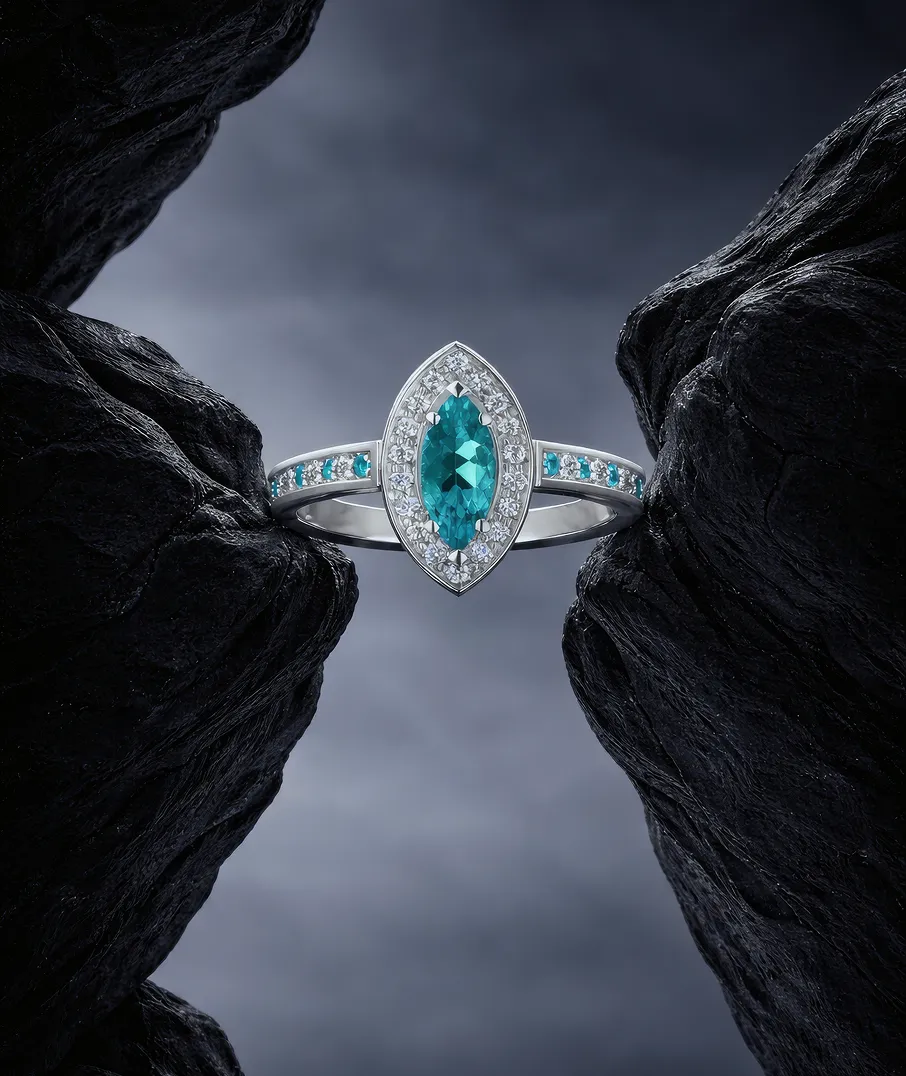
Paraíba jewelry looks assured when a single piece sets the color and everything else gives it room. Calm clothing in white, black, gray or navy, colorless diamonds as companions and a metal that suits the tone let the blue take effect. Several large Paraíba pieces worn at once, by contrast, compete with one another.
At a glance
- Basic rule
- One piece sets the color, the rest accompanies it
- Color range
- Violetish blue, blue, greenish blue to green
- Calm companions
- Colorless diamonds, white and dark clothing
- Cool look
- White gold and platinum
- Warm look
- Rose gold, copper in the alloy gives the rose tone
- Everyday wear
- Earrings and pendants, rings with a protective setting
What style means for Paraíba jewelry
With Paraíba tourmaline, style begins with one insight: the color is already the statement. GIA describes the color range as an intense violetish blue, greenish blue or blue, caused by copper. Such a color draws the eye, even in small stones. Wearing it with confidence therefore does not mean showing as much as possible, but leaving room for the stone. A single ring or a pair of earrings can carry an entire look.

The second part is intention. Paraíba jewelry looks assured when it is clear that the color was chosen: matched to clothing, occasion and the other pieces. It looks uncertain when it is simply added, next to other colors, other metals and other accents. This does not concern the value of the stones but the order of the whole. Once this order is settled, Paraíba can be worn in everyday life as well as in the evening.
One piece sets the color
The most reliable rule is this: one Paraíba piece stands at the center, and the other jewelry defers to it. A ring with a glowing stone suits simple diamond or gold studs. A necklace with Paraíba tourmalines suits a slim ring without a colored stone. Two large Paraíba pieces worn at once divide the attention, and the blue loses strength because the eye jumps between them.
One exception is the parure, an ensemble designed as a unit: earrings, a pendant or necklace and a ring with matched stones. Here the effect comes precisely from repetition. The prerequisite is that all stones match in hue. According to GIA, Paraíba tourmalines are mostly cut individually and rarely exceed one carat, so a parure of well-matched stones remains the exception rather than the rule.
Colors that support the blue
Clothing is the background of the jewelry. Calm colors let the Paraíba blue show most clearly: white and cream bring freshness, black and charcoal intensify the glow, navy and gray create a cool, composed impression. Strong colors near the stone, such as orange, yellow or a vivid green, compete with it. Patterns look restless when they sit in the same field of view as earrings or a necklace.
| Background | Effect of the Paraíba | Suited to |
|---|---|---|
| White, cream | Fresh, summery, bright | Daytime, outdoor celebrations |
| Black, charcoal | Glowing, almost electric | Evening, formal occasions |
| Navy, gray | Cool, composed, calm | Work, daytime |
| Camel, sand | Warm, with contrast to the blue | Daytime, ideally with rose gold |
| Strong colors | Competition for attention | Only with small stones |
Observations on the effect, not fixed rules. Skin tone and light change the picture.
Metal as temperature
The metal sets the temperature of the jewelry. GIA pairs cool colored stones such as blue sapphire or tanzanite with white gold, and warm colored stones with yellow and rose gold. For Paraíba tourmaline this means: white gold and platinum create a clear, cool look in which the blue appears pure. According to the World Gold Council, rose gold results from copper in the alloy and sets a warm counterpoint to the blue.

Anyone who mostly wears yellow gold need not forgo Paraíba. A Paraíba piece in white gold can be worn deliberately as a counter-accent, while a piece in rose gold mediates between the two. It becomes difficult when three metal colors come together on the same arm or hand without recognizable order. The guide to the setting for Paraíba tourmaline covers the choice of metal in detail, and the glossary entry on 18k (750) gold explains the basics.
Paraíba alongside other gemstones
Colorless diamonds are the natural companions. Their sparkle does not compete with the color but gives it a bright frame. Against their bright luster, the blue appears more saturated. Combinations with other colored stones are more demanding. A rubellite forms a clear contrast with its warm red, while an emerald lies close to the Paraíba in green and can make it look duller.
Other blue stones next to a Paraíba tourmaline are delicate. Aquamarine looks pale beside it, blue sapphire dark and heavy. The eye compares shades of blue directly, and usually one of the two loses. Anyone who wishes to wear several colored stones should place them in separate zones: Paraíba at the ear, another stone on the hand. This way each color has its place, and none has to assert itself. More on contrast in the comparison Paraíba or rubellite as an earring.
Day, evening and everyday
For daytime, smaller stones and calm forms are suitable: stud earrings, a pendant on a fine chain, a ring with a protected setting. In the evening, drop earrings, necklaces and rings with a diamond halo come into their own, because artificial light intensifies the sparkle of the diamonds and the glow of the Paraíba. For special occasions the same basic rule applies as in everyday life: one piece sets the color. In the evening it may simply be larger.
The type of jewelry also determines durability. According to GIA, tourmaline reaches 7 to 7.5 on the Mohs scale, and its toughness is considered fair. GIA recommends earrings and necklaces for less tough stones, because they strike hard surfaces less often. A Paraíba ring for every day needs a protective setting, such as a bezel setting. It is taken off for sports, gardening or housework.
Typical style mistakes
- Wearing several large Paraíba pieces at once that were not designed as an ensemble.
- Combining Paraíba with other shades of blue that dampen its glow.
- Boldly patterned clothing directly beneath a necklace or earrings.
- Three metal colors without order on one hand.
- Wearing a ring with an openly set Paraíba in daily life without care.
A subtle mistake concerns light. Colored stones look different under different light sources, and a Paraíba tourmaline is no exception. A stone that glows by the window can appear different in the subdued room light of an evening. Anyone choosing a piece for a particular occasion should therefore also view it under similar light, not only in a bright showroom or on a screen.
Designing a piece of your own
Vikar Ahmed calls Paraíba tourmaline the heart of the house and makes Paraíba jewelry as one-of-a-kind pieces, set in 18 karat gold, platinum, and with diamonds. If you are looking for a piece that matches your own style, it can be created in three steps: design with the in-house designers, three-dimensional visualization, and realization in the in-house atelier. For Paraíba, Vikar Ahmed prefers platinum or 18 karat white gold; in yellow gold the stone looks warmer and often greener. According to his advice, it is better to take Paraíba jewelry off for sports and housework.
It helps to bring what you already wear to the conversation: rings, watches, preferred metal colors. This way a Paraíba piece can be designed to fit into the existing collection rather than compete with it. How long production takes depends on the design, the stone and the work involved, so mention any fixed date right away in your inquiry. The guide The path to Paraíba jewelry describes the process from the first conversation to the finished piece.
Frequently asked questions
Can Paraíba jewelry be worn every day?
Yes, in suitable forms. Earrings and pendants are well protected in daily life. A ring needs a setting that secures the edges, because tourmaline reaches only 7 to 7.5 on the Mohs scale. The jewelry should be taken off for sports and rough work.
Which clothing colors go with Paraíba tourmalines?
Calm colors let the blue show most strongly: white, cream, black, gray and navy. Warm sand tones set a contrast that works especially well with rose gold. Strong colors and patterns near the stone distract from its glow.
Can Paraíba jewelry be combined with yellow gold?
Yes, if it is done deliberately. A Paraíba piece in white gold can be worn as a cool counter-accent to yellow gold. Rose gold mediates between the two. It only becomes restless when many metal colors come together without order.
How many Paraíba pieces should be worn at once?
As a rule, one that sets the color. Other jewelry accompanies it, such as colorless diamonds or simple gold. The exception is a parure, whose parts were designed from the outset as an ensemble with matched stones.
Which gemstones go alongside a Paraíba tourmaline?
Colorless diamonds almost always work, because they frame the color rather than compete with it. A rubellite forms a clear, warm contrast. Other blue stones such as aquamarine or sapphire often look pale or heavy beside it and are better worn elsewhere.
Does a Paraíba tourmaline look different under artificial light?
Yes, as with all colored stones, the impression depends on the light source. A stone can look different in daylight than in the warm light of a restaurant. Anyone who plans to wear a piece mainly in the evening should therefore also view it under evening light before deciding.
Private consultation
How a Paraíba piece suits your style becomes clear when the stone, the metal and your existing pieces lie side by side. Vikar Ahmed advises by appointment in the house's showroom in Idar-Oberstein, and virtually on request. Request an appointment for a private consultation.
Further reading
- Paraíba jewelry at a glance
- Paraíba necklace or pendant
- Paraíba earrings that stay timeless
- Glossary: High Jewelry
- Glossary: Collier
Sources
- GIA: Tourmaline Description, accessed 2026-11-17
- GIA: Tourmaline Quality Factors, accessed 2026-11-17
- GIA: Tourmaline Care and Cleaning, accessed 2026-11-17
- GIA 4Cs: White, Yellow and Rose Gold Engagement Rings, accessed 2026-11-17
- GIA 4Cs: Complete Guide to Engagement Ring Settings, accessed 2026-11-17
- GIA 4Cs: More than the Mohs Scale, Gem Durability, accessed 2026-11-17
- World Gold Council: About gold jewellery, accessed 2026-11-17
- Vikar Ahmed: Paraíba, accessed 2026-11-16

A personal conversation starts here.
At the showroom in Idar-Oberstein or by video. Vikar Ahmed discusses your ideas, stones and designs with you and answers your questions calmly and in confidence.


Thank you for your request.
Your request will be handled with the utmost attention and discretion. Vikar Ahmed will get back to you.
Your details
Request
–
Occasion
–
Consultation
–
Contact
–
In the meantime
Insights: What is a Paraíba tourmaline? · Engagement ring to your own design: how does it work?
Confidential and without obligation
Back to the pagePrivate consultation
A personal conversation starts here.
- Time for your questions, wishes and ideas
- In the showroom in Idar-Oberstein or by video
- Confidential, discreet and without obligation
Vikar Ahmed · Hauptstraße 111 · 55743 Idar-Oberstein, Germany