

The Rubellite Heart Ring: Stone, Cut, and Setting
A heart of red tourmaline feels personal at once. For it to convince in its craftsmanship as well, color, outline, and setting must work together.

A good rubellite heart ring combines a stone of strong, even color with a symmetrical heart cut that has a clear cleft and a defined point. The length-to-width ratio is close to 1 to 1. Because the point is the most vulnerable spot, it needs a protective setting, such as a V-prong, a bezel setting, or a halo of small diamonds.
At a glance
- Rubellite
- Tourmaline in pink, red, purplish red, orangy red, or brownish red
- Cause of color
- Manganese as a trace element
- Hardness
- 7 to 7.5 on the Mohs scale
- Toughness
- Moderate, rated “fair” by GIA
- Heart shape
- Length to width about 1 to 1 up to 1 to 1.2
- Most delicate spot
- The point of the heart
- Cleaning
- Lukewarm soapy water, no ultrasonic, no steam
Two decisions: the stone and the shape
A rubellite heart ring rests on two decisions that should be examined separately. The first concerns the stone: rubellite is the trade name for tourmalines in pink, red, purplish red, orangy red, or brownish red. According to the Gemological Institute of America, GIA for short, their color is due to manganese. Part of the trade uses the name only for strongly red stones and simply calls lighter tones pink tourmaline.
The second decision concerns the shape. The heart cut is a fancy shape, meaning any shape other than the round brilliant. It demands a strong feel for symmetry from the cutter, because even small deviations between the two halves are noticeable. A beautiful rubellite in an uneven heart looks weaker than a somewhat lighter stone in a cleanly cut outline. Only the two together create the image you see on the finger.
Color comes first
In rubellite, color is the most important value factor. According to GIA, the hue and depth of color of tourmaline can approach those of ruby and pink sapphire. Sought-after stones have a red that is evenly distributed over the entire surface, without zones that tip into brownish or grayish. A stone that is too dark loses brilliance in the ring, and one that is too light quickly looks pale in a heart cut, because the shape offers little depth.
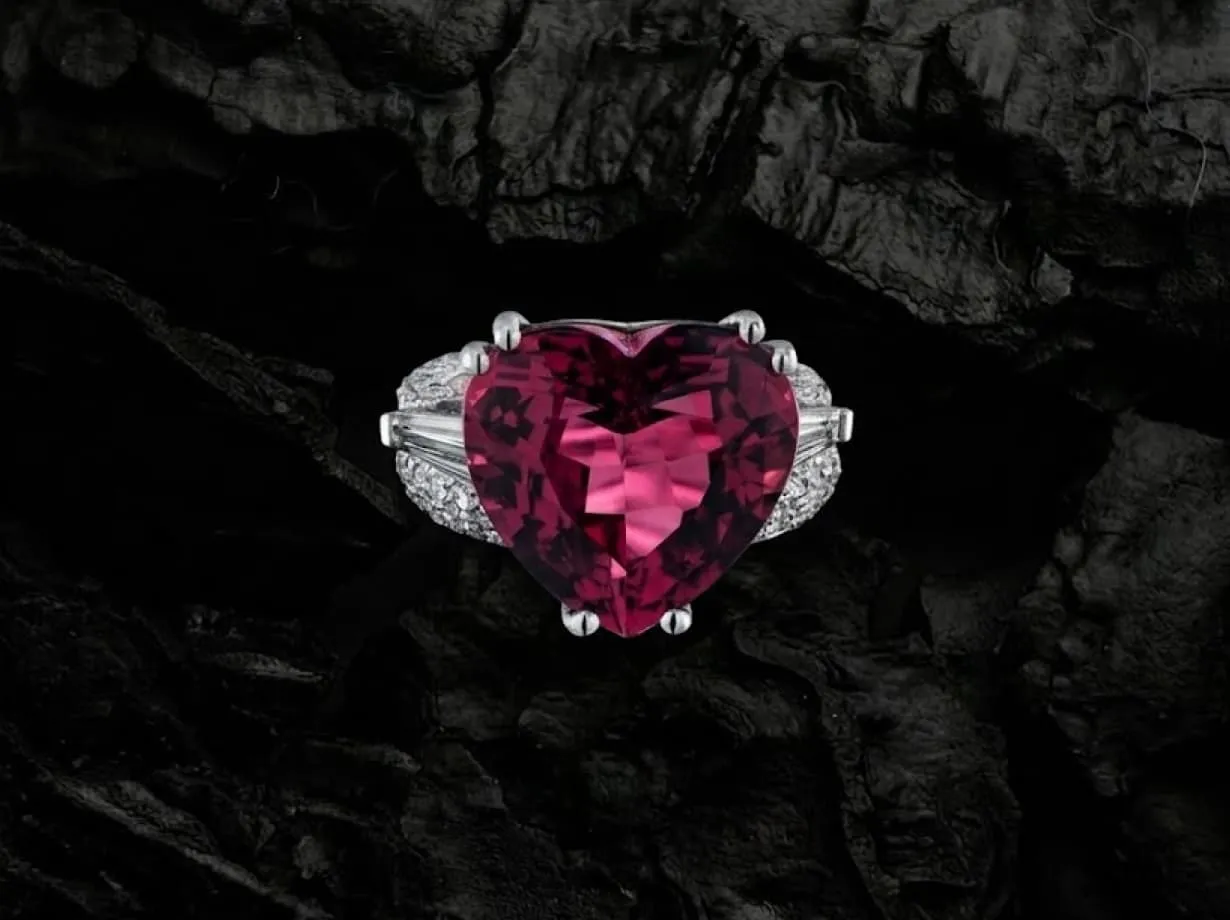
Tourmaline is strongly pleochroic. This means it shows different colors in different viewing directions, and one of them is usually noticeably darker. The cutter therefore deliberately orients the table, the large upper facet, in relation to the long axis of the crystal. If it lies perpendicular to it, a light rough stone becomes darker. If it lies parallel, a dark rough stone becomes lighter. A well-oriented heart shows its best color from above.
Good to know
Always look at the color in daylight and in warm artificial light. Many rubellites look slightly different under the two types of light. The ring is worn in both.
Inclusions: what is normal in rubellite
According to GIA, pink and red tourmalines quite often have inclusions that are visible to the naked eye. The trade generally accepts them when the color is strong. Inclusions that reach the surface are more critical: they reduce luster and can weaken durability. For experienced collectors, color remains the decisive factor as long as the inclusions are not distracting in size and number.
With the heart cut, one more point comes into play. For heart-shaped diamonds, GIA points out that clarity characteristics are easier to see in this shape, and advises checking the point specifically for inclusions. The same logic applies to rubellite: an inclusion directly at the point or in the cleft is noticeable and lies at a spot that takes knocks in everyday wear. More on this in the guide on clarity in rubellite.
How to recognize a well-cut heart
A heart should consist of two equal halves. GIA recommends imagining a line through the middle and comparing both sides from the cleft over the curves to the point. The cleft, the V-shaped indentation at the top, should be clearly defined. The two curves, called lobes, should run evenly into the cleft. If the lobes are pointed or the flanks very flat, the heart looks more like an arrowhead.
| Feature | Well cut | Problematic |
|---|---|---|
| Halves | Equal in size and shape | One side wider or higher |
| Cleft | Clearly defined, centered | Shallow, off-center, or barely visible |
| Lobes | Evenly rounded | Pointed, angular, or uneven |
| Point | Defined, without inclusion | Blunt, indistinct, or with an inclusion |
| Length to width | About 1 to 1 up to 1 to 1.2 | Noticeably elongated or compressed |
Criteria based on GIA's guidance on heart-shaped stones. Whether the proportions please is ultimately decided by the eye.
For a symmetrical heart, GIA gives a length-to-width ratio of 1 to 1 up to 1 to 1.2. It is not unusual for a heart to be slightly wider than it is long. In small stones, the heart shape is difficult to recognize: for diamonds, GIA names a threshold of about half a carat. Below that, the stone quickly looks simply roundish in the ring.
Setting: protecting the point
According to GIA, the point is the most vulnerable spot of a heart-shaped stone. In rubellite, this weighs more heavily than in diamond. Tourmaline reaches 7 to 7.5 on the Mohs scale, diamond 10. GIA rates its toughness, meaning its resistance to knocks, as only moderate. The setting must therefore enclose the point, secure the cleft, and set the stone low enough that it does not strike edges in everyday wear.
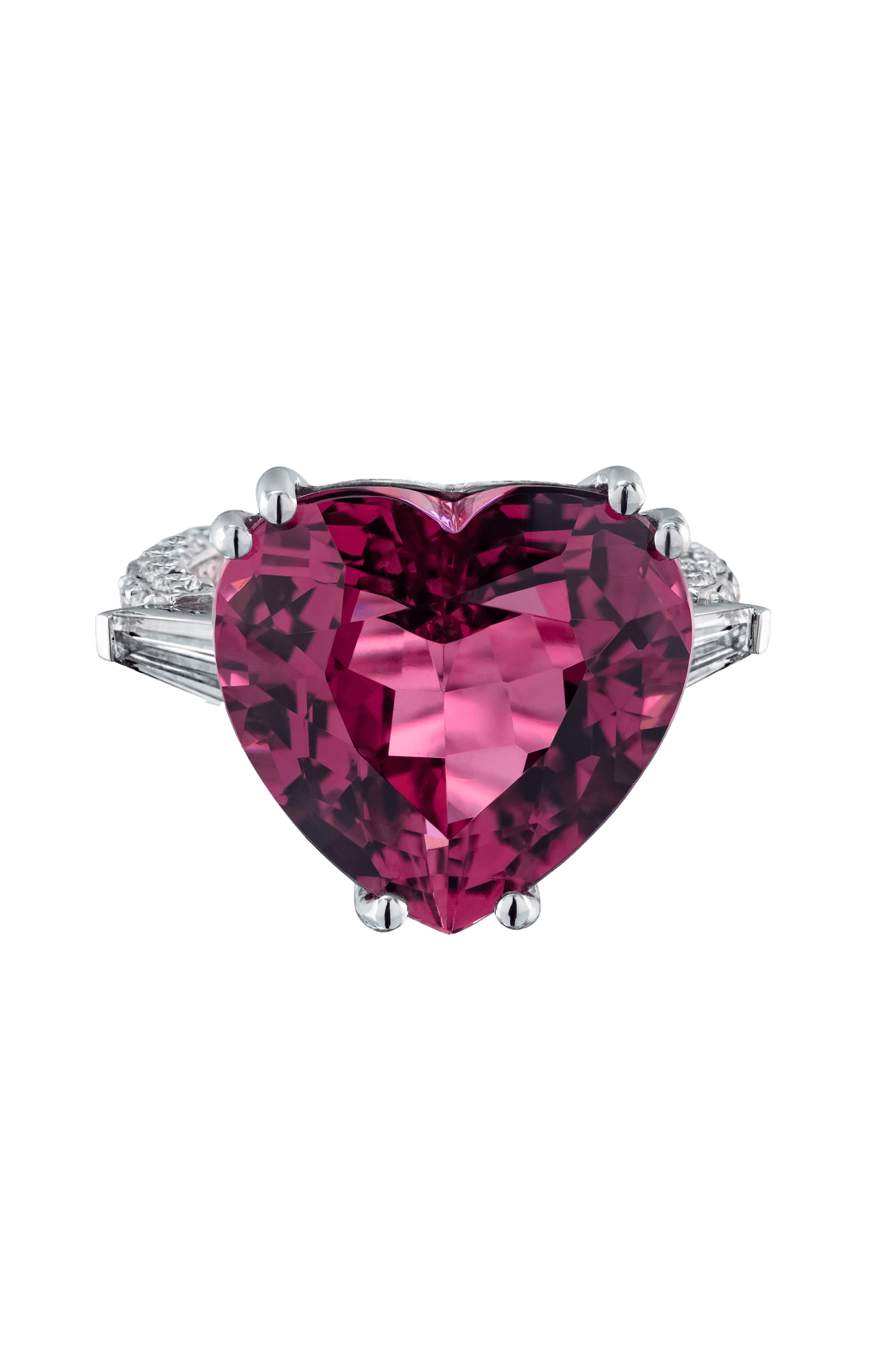
- V-prong: a V-shaped prong grips the point. GIA names it for heart, pear, and marquise shapes.
- Bezel setting: a smooth metal rim around the entire stone protects all edges best.
- Halo of small diamonds: it frames the outline and shields the point.
- Three prongs: in small hearts, according to GIA, they preserve the shape better than many prongs.
- A prong in the cleft holds the stone at the top without obscuring the outline.
Each solution changes the look. A bezel setting protects best, but takes away some of the heart's lightness. Prongs let more light into the stone and leave the outline free, but must be checked regularly. The guide on setting a rubellite shows which type of setting suits which stone. The glossary explains the basic form under prong setting.
Rubellite and diamonds in the same ring
A heart ring with rubellite and diamonds combines two very different materials. The diamond is harder, the rubellite brings the color. A halo of small diamonds around the heart has two tasks: according to GIA, it makes the center stone look larger and at the same time protects the point. GIA also points out, however, that halo rings need more care, because the many small stones must sit securely.
Balance is important. If the diamonds are too large or too numerous, their sparkle competes with the color of the rubellite. A narrow halo or individual diamonds on the shank keep the red at the center. The metal also plays a part. White gold sets a cool frame, rose gold a warm one. The guide on rubellite or pink diamond compares how rubellite behaves next to a pink diamond.
Typical mistakes with a heart ring
- Judging the stone by weight alone: color and symmetry shape the heart more than an extra tenth of a carat.
- Choosing a very small stone: below about half a carat, the heart shape is barely recognizable.
- Leaving the point exposed: without a V-prong, bezel, or halo, the most vulnerable spot is unprotected.
- Overlooking an inclusion at the point or cleft: there it is noticeable and weakens the stone.
- Checking color under only one type of light: rubellites change their effect between daylight and artificial light.
Another mistake concerns treatment. According to GIA, heating and irradiation are the most important treatments for tourmaline. Heated colors are considered permanent. Irradiated colors can fade under heat or strong light. Any treatment must be disclosed when a stone is passed on. Anyone who values a stone without treatment will find the differences in the guide on untreated rubellite.
Wear and care
Tourmaline is stable in light and is not attacked by common chemicals. It is sensitive to heat: strong heat can change the color, and rapid temperature changes can cause fractures. GIA does not recommend ultrasonic and steam cleaners. A rubellite heart ring is best cleaned with lukewarm soapy water and a soft brush. It should be taken off for gardening, sports, or heavy lifting.
A goldsmith should check the prongs at regular intervals, especially the one at the point. Vikar Ahmed recommends having settings checked about every two years. A loosened prong is the most common risk for a set colored gemstone. Anyone who owns a rubellite and would like to have it newly set as a heart ring will find guidance in the guide on having an existing rubellite set.
A heart ring as a one-of-a-kind piece
Vikar Ahmed works with rubellite in the house's pieces. A heart ring is created there in three steps: design, three-dimensional visualization with CAD, and realization as a one-of-a-kind piece in the in-house atelier in Idar-Oberstein. With rubellite, Vikar Ahmed accepts fine inclusions as long as they do not dull the brilliance of the color, and a precise cut matters just as much. The visualization makes it possible to check how the V-prong, halo, and shank support the outline of the heart before production. If you would like to compare several rubellites or heart shapes at the appointment, it is best to say so in your request.
Frequently asked questions
Which heart-shaped rubellite rings can I compare with other colored gemstone rings in Kirn?
Rings only become comparable by the same criteria: color under the same light, symmetry of the heart, visible inclusions, and protection of the point. Vikar Ahmed has no location in Kirn, and consultations take place in the showroom in Idar-Oberstein by appointment. More under jeweler for Kirn.
How do you compare heart-shaped rubellite rings fairly?
Place the rings side by side and examine color, outline, cleft, and point with a loupe. Vikar Ahmed has no location in Birkenfeld and advises in the showroom in Idar-Oberstein by appointment, and virtually on request. Directions under jeweler for Birkenfeld.
Is rubellite hard enough for a ring?
Yes, with a suitable setting. Tourmaline reaches 7 to 7.5 on the Mohs scale, making it more scratch-resistant than many gemstones used in jewelry. Its toughness, however, is only moderate. A rubellite in a ring therefore needs protected edges and should be taken off for rough work.
Why does rubellite often have visible inclusions?
Red and pink tourmalines often grow with inclusions that are visible to the naked eye. The trade accepts them when the color is strong. They become critical when they reach the surface or lie at an exposed spot such as the point of a heart.
Which setting best protects the point of a heart-shaped stone?
A bezel setting, a metal rim around the entire stone, offers the strongest protection. Anyone who wants more light in the stone chooses a V-prong, which grips only the point. A halo of small diamonds additionally shields the point, but needs regular checks.
What length-to-width ratio should a heart-shaped stone have?
For a symmetrical heart, GIA gives 1 to 1 up to 1 to 1.2. A heart may also be slightly wider than it is long. Noticeably elongated stones quickly look like a pear, while strongly compressed ones lose their clear contour.
Is rubellite related to ruby?
No. Rubellite is a tourmaline, while ruby belongs to the corundum family. Both can show a similar red, but they differ in hardness, formation, and assessment. You will find the comparison in the guide on rubellite or ruby.
Private consultation
Whether your heart should glow in strong red or light pink, and which setting carries the point, is best clarified with the stone in hand. Vikar Ahmed advises in the showroom in Idar-Oberstein by appointment or in a virtual appointment. Request an appointment for a private consultation.
Further reading
- Gemstone: Rubellite
- Which cut suits rubellite
- Setting for a rubellite
- Glossary: Treatment of gemstones
- Bespoke: from design to one-of-a-kind piece
Sources
- GIA: Tourmaline Description, accessed 2026-11-17
- GIA: Tourmaline Quality Factors, accessed 2026-11-17
- GIA: Tourmaline Care and Cleaning, accessed 2026-11-17
- GIA 4Cs: The Heart-Shaped Engagement Ring, accessed 2026-11-17
- GIA 4Cs: Tips for Purchasing Fancy Cut Diamonds, accessed 2026-11-17
- GIA 4Cs: Complete Guide to Engagement Ring Settings, accessed 2026-11-17
- GIA 4Cs: The Mohs Scale, accessed 2026-11-17
- Vikar Ahmed: Collections, accessed 2026-11-16
- Vikar Ahmed: Bespoke, Designprozess, accessed 2026-11-16
A personal conversation starts here.
At the showroom in Idar-Oberstein or by video. Vikar Ahmed discusses your ideas, stones and designs with you and answers your questions calmly and in confidence.





Thank you for your request.
Your request will be handled with the utmost attention and discretion. Vikar Ahmed will get back to you.
Your details
Request
–
Occasion
–
Consultation
–
Contact
–
In the meantime
Insights: What is a Paraíba tourmaline? · Engagement ring to your own design: how does it work?
Confidential and without obligation
Back to the pagePrivate consultation
A personal conversation starts here.
- Time for your questions, wishes and ideas
- In the showroom in Idar-Oberstein or by video
- Confidential, discreet and without obligation
Vikar Ahmed · Hauptstraße 111 · 55743 Idar-Oberstein, Germany