

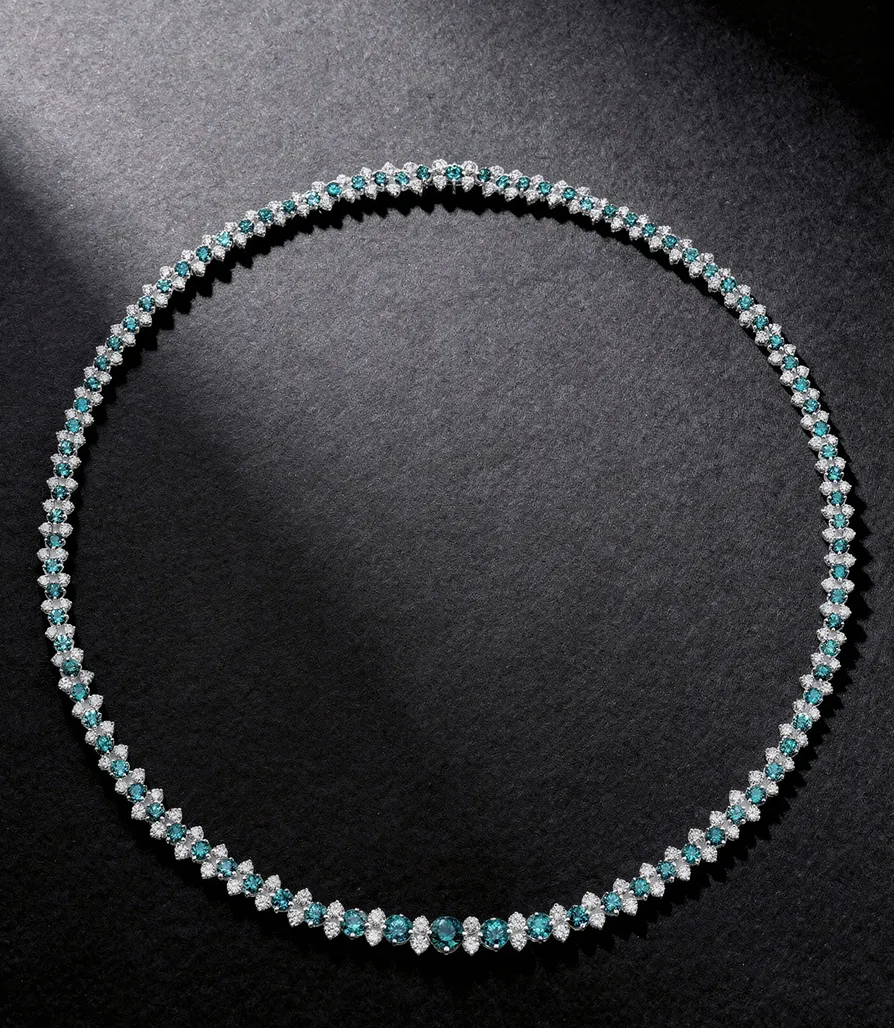
In a Fancy Yellow diamond pendant, color determines value more than clarity or cut. The stronger and purer the yellow, the rarer the stone. Yellow gold beneath the stone deepens lighter tones, while white metal sets off strong colors. A laboratory report should confirm whether the color is natural, because yellow diamonds are also treated.
At a glance
- Cause of color
- Traces of nitrogen in the crystal lattice
- When it counts as fancy
- Color stronger than the D-to-Z range
- Color grades for yellow
- Fancy Light, Fancy, Fancy Intense, Fancy Vivid, Fancy Dark, Fancy Deep
- Main value factor
- Color, ahead of clarity, cut, and weight
- Possible treatments
- HPHT, irradiation with heating, coating
- Laboratory report
- States color grade and color origin, natural or treated
What makes a yellow diamond a Fancy Yellow
Yellow diamonds owe their color to traces of nitrogen that are incorporated into the crystal lattice during growth and absorb blue light. A slight yellow tint is common in diamonds and is graded on the D-to-Z scale. Only when the color is stronger than this range is the stone considered a colored diamond under the GIA classification, known in the trade as a Fancy Color Diamond.

In the trade, strongly yellow stones are often called canary. According to GIA, this is a trade term, not a grade. Technically, laboratories distinguish by how the nitrogen sits in the lattice. Stones with isolated nitrogen atoms, type Ib, are regarded in the industry as the true canaries and are comparatively rare. In a GIA study of 500 stones, isolated nitrogen was the cause of color in 13.2 percent of the samples.
The color grades and what they mean
GIA grades colored diamonds in steps of increasing color strength. For yellow stones, grading usually begins at Fancy Light, because lighter tones still fall on the D-to-Z scale. Fancy Intense and Fancy Vivid are usually valued more highly. Fancy Dark and Fancy Deep describe darker tones, not simply more color. How color is described is explained in detail on the page Fancy Color Diamond.
| Color grade | Appearance | Classification |
|---|---|---|
| Fancy Light | Delicate, clearly visible yellow | Entry into the fancy range for yellow |
| Fancy | Clear yellow of medium strength | Middle grade |
| Fancy Intense | Strong, saturated yellow | Among the more sought-after grades |
| Fancy Vivid | Very strong and pure | Considered the most coveted grade |
| Fancy Dark, Fancy Deep | Darker tone, rich depth | Grades the darker tone |
Grades according to the GIA system for colored diamonds.
Besides strength, the purity of the hue matters. According to GIA, a pure yellow is rarer and more sought after than a brownish or greenish one. A slight orange tone can add warmth. According to GIA, yellow is the second most common fancy color. Yellow and brown stones are the most common colored diamonds and usually less valuable than rarer colors. If you prefer an orange tone, the guide to orange diamonds has more.
Yellow or colorless in a pendant
A colorless diamond works through brilliance and fire, a yellow one through its color. For colored diamonds, color is the dominant value factor according to GIA. Clarity plays a smaller role, as long as inclusions neither cloud the color nor compromise durability. In a pendant, worn close to the face, a strong yellow often stands out from a greater distance than the sparkle of a colorless stone of the same size.
For collectors, the choice depends on what they are looking for. A colorless stone is graded by the 4Cs and is easy to place. A yellow stone with a high color grade is rarer, and its value rises sharply with color strength and size. Large colored diamonds are rarer than small ones. Many connoisseurs combine both: a yellow center stone surrounded by colorless diamonds that emphasize the yellow through contrast. More on the grading system in the Glossary: 4Cs.
Cut and metal enhance the color
The cut influences how much color a yellow diamond shows. According to GIA, fancy shapes such as radiant, cushion, and emerald cut retain more body color than the round brilliant. The radiant can even make lighter stones from the D-to-Z scale appear yellow face-up. For a pendant, this is a design decision: an elongated stone emphasizes the line of the chain, a cushion appears soft and compact.

The metal of the setting affects the color. According to GIA, a setting or setting base of yellow gold beneath the stone makes the yellow appear deeper and warmer. Yellow or rose gold supports light grades such as Fancy Light and Fancy. White gold or platinum can make light stones appear paler, but sets off strong grades such as Fancy Intense and Fancy Vivid through contrast. More on the metal in the Glossary: 18k (750) gold.
Good to know
Once the stone is set, the metal can distort its color. GIA recommends confirming the color grade of mounted yellow diamonds through an independent laboratory report that describes the body color independently of the setting.
Natural or treated
Yellow color can also be produced artificially in diamonds. GIA names high-pressure, high-temperature treatment, HPHT for short, irradiation followed by heating, and coatings. HPHT is considered permanent. Irradiated stones are sensitive to heat, and their color can change during repairs. Coatings are not permanent and can suffer from heat, chemicals, and scratches. Treated yellows often look strikingly saturated and somewhat cooler or greenish.
Such treatments often cannot be detected with the eye or a loupe. The authors of a GIA study therefore recommend having all colored diamonds tested by a laboratory for the origin of their color. The GIA report for colored diamonds states, in addition to color grade, weight, and clarity, whether the color is natural or treated. How such a report is structured is explained in the Glossary: GIA report.
From stone to pendant, to your own design
In a pendant made to your own design, the stone comes first. Its color grade and shape determine which metal and setting make sense. Then come the size and proportion of the pendant, the bail, and the chain. Whether a pendant or a ring suits your stone better is explored in the comparison Pendant or ring.
- Examine the stoneHave the color grade and color origin confirmed by a laboratory report.
- Choose the metalYellow gold for light grades, white gold or platinum as contrast for strong colors.
- Design the settingCheck prongs or bezel, height, and accent stones in the 3D design.
- Bail and chainPlan the bail so that the pendant hangs straight and does not turn.
Natural colored diamonds from rose and pink to yellow, including the grades Fancy Intense and Fancy Vivid, are a focus for Vikar Ahmed, and the house does not work with lab-grown diamonds. Reports on diamonds come almost exclusively from GIA, and in exceptional cases from HRD Antwerp. Bespoke pieces are created in three steps: design by in-house designers, visualization with CAD and realization as a one-of-a-kind piece in the in-house atelier in Idar-Oberstein.
Frequently asked questions
Who makes a Fancy Yellow diamond pendant to my own design?
A house with its own design and its own production that works with colored diamonds and confirms the color origin through a laboratory report. Vikar Ahmed makes bespoke pieces in Idar-Oberstein and works with natural Fancy Yellow diamonds in the pieces shown. Custom projects are reviewed on request.
Fancy Yellow or colorless diamond in a pendant: which is more interesting for collectors?
That depends on the goal. A colorless stone can be clearly placed by the 4Cs. A Fancy Yellow is interesting when color strength and purity of hue are high, since Fancy Intense and Fancy Vivid are considered sought after. For collectors, a report confirming natural color origin is indispensable for yellow stones.
Does a Fancy Yellow diamond pendant look more exceptional than one with a colorless diamond?
It looks different. The yellow stone stands out through its color, the colorless one through its sparkle. At the neck, where the stone is usually seen from some distance, color carries further than brilliance. A halo of colorless diamonds around the yellow stone combines both effects.
As a collector, I am looking for a pendant with natural Fancy Yellow diamonds in white gold. Which jeweler in Trier has something like this?
Vikar Ahmed has no location in Trier and offers consultations in Idar-Oberstein, see Jeweler for Trier. For collectors, what matters most is that the natural color origin is documented. White gold suits strong grades such as Fancy Intense or Fancy Vivid particularly well, because it brings out the color through contrast.
How can I tell whether the yellow color of a diamond is natural?
Only through a laboratory. Treatments such as irradiation followed by heating often cannot be detected by standard gemological means alone. A report for colored diamonds, from GIA for example, states the color origin. A strikingly saturated, slightly greenish yellow can indicate treatment, but it is not proof.
Which metal suits a yellow diamond in a pendant?
For light grades such as Fancy Light or Fancy, yellow or rose gold is a good choice, because it enhances the warmth. Strong grades such as Fancy Intense or Fancy Vivid often look livelier in white gold or platinum through contrast. Another option is to make only the setting base beneath the stone in yellow gold.
Private consultation
Which color grade and which metal suit your pendant is best discussed with the stone and design in view. Vikar Ahmed offers consultations by appointment in the showroom in Idar-Oberstein or virtually, and treats every inquiry with discretion. Request a private consultation.
Further reading
- Glossary: Fancy Color Diamond
- Gemstone: Fancy Color Diamond
- Orange diamonds
- Pendant or ring
- Glossary: GIA report
Sources
- GIA 4Cs: Yellow Diamond Buying Guide, accessed 2026-11-17
- GIA: When is a colored diamond a fancy color diamond?, accessed 2026-11-17
- GIA: Fancy Color Diamond Quality Factors, accessed 2026-11-17
- GIA: Fancy Color Diamond Description, accessed 2026-11-17
- Gems & Gemology, Summer 2020: Naturally Colored Yellow and Orange Gem Diamonds, accessed 2026-11-17
- GIA 4Cs: Diamond Treatments and What They Mean to You, accessed 2026-11-17
- Vikar Ahmed: Collections, accessed 2026-11-17
- Vikar Ahmed: Bespoke, accessed 2026-11-17

A personal conversation starts here.
At the showroom in Idar-Oberstein or by video. Vikar Ahmed discusses your ideas, stones and designs with you and answers your questions calmly and in confidence.


Thank you for your request.
Your request will be handled with the utmost attention and discretion. Vikar Ahmed will get back to you.
Your details
Request
–
Occasion
–
Consultation
–
Contact
–
In the meantime
Insights: What is a Paraíba tourmaline? · Engagement ring to your own design: how does it work?
Confidential and without obligation
Back to the pagePrivate consultation
A personal conversation starts here.
- Time for your questions, wishes and ideas
- In the showroom in Idar-Oberstein or by video
- Confidential, discreet and without obligation
Vikar Ahmed · Hauptstraße 111 · 55743 Idar-Oberstein, Germany