

Understanding Orange Diamonds
Orange is among the rarest colors a diamond can take on naturally. What the color terms mean and what matters in a piece of jewelry.
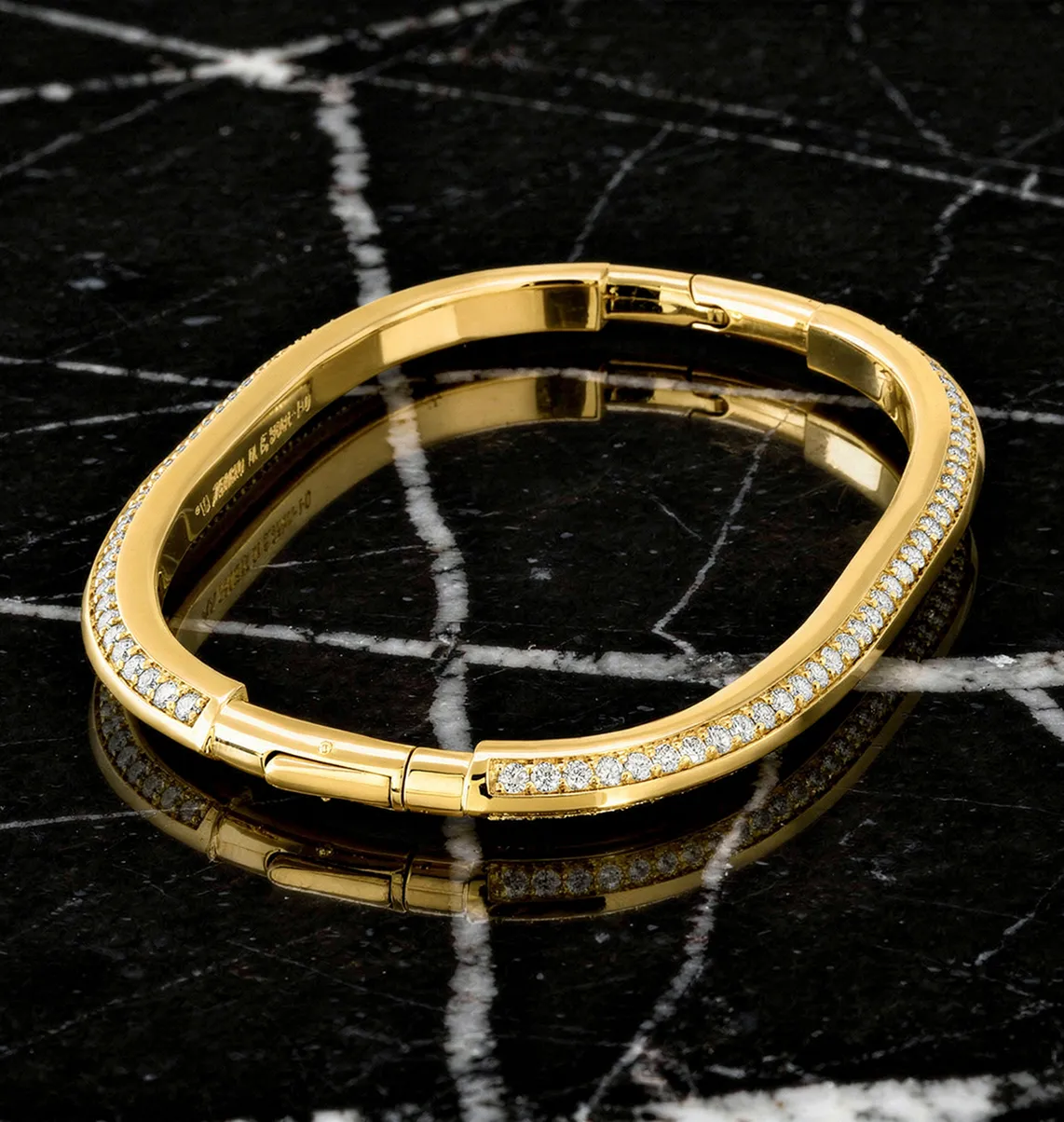
Orange diamonds are colored diamonds whose value depends above all on their color. Pure, unmodified orange is extremely rare, and most stones show secondary hues of yellow or brown. Only a laboratory report can establish whether the color is natural. Rose gold intensifies the warm tone, while white gold sets it off with a cool contrast.
At a glance
- Most important value factor
- Color, followed by clarity and weight
- Pure orange
- 0.05 percent of stones in a large GIA analysis
- More common
- Orange with yellow or brown as a secondary hue
- Causes of color
- Mainly isolated nitrogen and an absorption band at 480 nm
- Laboratory-grown
- HPHT diamonds are mostly yellow to orange
- Mohs hardness
- 10, like every diamond
What makes a diamond orange
A diamond turns orange when it absorbs light up into the yellow and orange region of the spectrum. The Gemological Institute of America, GIA for short, names two main causes. The most common is isolated nitrogen in the crystal lattice. The second is an absorption band at 480 nanometers, a weakening of light at exactly this point in the spectrum. According to GIA, this band is responsible for around 86 percent of the color in stones of pure orange.

In practice this means that orange is not a separate type of diamond, but the result of rare lattice defects. The same causes more often produce yellow or brown. This is why orange diamonds almost always lie in a transitional zone between these colors. The glossary explains how a Fancy Color Diamond generally differs from colorless stones. This page covers the particular features of the color orange.
Pure orange is the exception
In the color distribution of the yellow and orange diamonds that GIA analyzed for a study, stones of pure, unmodified orange accounted for only 0.05 percent. In ten years, the laboratory saw fewer than 200 such stones. Mixtures are more common: combinations of orange and yellow made up around 6 percent, brownish orange around 1 percent. According to GIA's general classification, red, green, purple, and orange are among the rarest diamond colors of all.
These figures explain why the description in the report carries so much weight. A stone with the modifier “brownish” or “yellowish” is not a poor stone. It does, however, belong to a considerably larger group than a stone described as orange without a secondary hue. When comparing two stones, read the complete color description first, and only then discuss size and clarity.
What terms such as Orangy Brown mean
Colored diamonds are described by hue, tone, and saturation. In the report, the main hue comes at the end of the description, with secondary hues before it. “Orangy Brown” is therefore a brown stone with an orange component, and “Brownish Orange” an orange stone with a brown component. The order determines which color predominates. In addition, there is a grade for the strength of color, such as Fancy, Fancy Intense, or Fancy Vivid. According to GIA, the intense and vivid grades are the rarest.
| Description | Main color | Effect in jewelry |
|---|---|---|
| Orange | Orange without secondary hue | Clear and luminous, very rare |
| Yellowish Orange | Orange with a yellow component | Lighter and sunnier |
| Brownish Orange | Orange with a brown component | Warmer, more muted, toward copper |
| Orangy Brown | Brown with an orange component | Cognac to amber tone, calm |
| Orangy Yellow | Yellow with an orange component | Golden yellow with a warm undertone |
Reading according to GIA's color description system. The main color always comes at the end of the description.
Orange or colorless in a custom pendant
The choice between an orange and a colorless diamond is not a question of better or worse. With colorless stones, cut and light return, meaning sparkle and brightness, are what count. With colored diamonds, according to GIA, color is the dominant value factor. A pendant with an orange stone therefore lives from the depth and evenness of its tone, a pendant with a colorless stone from brilliance.
A pendant usually hangs close to the face and is seen from a little distance. Color carries further over this distance than fine sparkle. A strongly orange stone can therefore be smaller and still have presence. A colorless diamond appears more restrained and can be combined with more clothing. Anyone who wants to combine both frames a colored center stone with small colorless diamonds.
As for shape: in the GIA analysis, yellow and orange diamonds were most frequently cut as cushions (33 percent) and as rectangles with cut corners (19 percent). Such shapes keep the color within the stone. According to GIA, mixed cuts such as the radiant can intensify the yellow tone of light diamonds. The round brilliant, by contrast, relies on light return and is the classic choice for colorless stones.
Rose gold or white gold
The metal changes how warm an orange diamond appears. According to the World Gold Council, rose gold gets its tone from copper in the alloy. Its color is close to that of the stone and intensifies orange and brown. An Orangy Brown appears soft and harmonious in it. White gold contains white metals such as palladium and is usually rhodium-plated, meaning coated with a thin, bright layer of rhodium. It sets the stone off with a cool contrast and lets it glow more strongly.

A proven solution is the combination: the prongs around the colored stone in rose gold, so that nothing cool is reflected into the color, and the rest of the ring in white gold. In both cases, the 750 stamp means that the alloy consists of 75 percent fine gold. More on this under 18k (750) gold. The guide on a bracelet with orange fancy color diamonds describes how metal and color work together in bracelets.
Natural, treated, or laboratory-grown
With orange diamonds, the question of where the color comes from is particularly important. GIA writes that yellow and yellowish orange diamonds are easy to grow in the laboratory using the high-pressure, high-temperature process, HPHT for short, and that most HPHT diamonds turn out yellow to orange. Natural stones can also be turned orange or brown through strong irradiation followed by heating.
This cannot be distinguished by eye. A report on a colored diamond states, alongside the color description, the origin of the color, meaning natural or treated, and identifies laboratory-grown stones. Without this information, an orange diamond cannot be meaningfully assessed. The glossary entry on the GIA report explains what a GIA report contains in detail.
Good to know
According to GIA, gentle heating can temporarily make the tone of diamonds with the 480 nm band more orange. The change is temporary.
Typical mistakes with orange diamonds
- Overlooking the main color: Orangy Brown is a brown stone, Brownish Orange an orange one.
- Weighting clarity as with colorless diamonds, even though color determines the value.
- Assessing a stone without information on the origin of its color.
- Matching several stones by their reports instead of side by side under the same light.
- Choosing the metal last, even though it clearly changes the impression of color.
An example of the fourth point: two stones with the same description can look different side by side, because the grades of the color description cover ranges. For a ring with side stones or a bracelet, direct comparison is therefore what counts. Daylight, warm artificial light, and the position on the skin each reveal different aspects of the same stone. A judgment made under only one light source can easily mislead.
Orange diamonds at Vikar Ahmed
The pieces shown by Vikar Ahmed include natural fancy color diamonds in several colors, among them Orangy-Brown, worked in 18k (750) white gold and rose gold. A piece of jewelry with such a stone is created at the house in three steps: design by in-house designers, three-dimensional visualization, and realization as a one-of-a-kind piece in the in-house atelier. The visualization makes it possible to check how stone, metal, and setting work together.
Vikar Ahmed does not work with lab-grown diamonds, and the house has diamonds graded almost exclusively by GIA. Only the report records whether the color is natural. For a comparison between colored and colorless diamonds, the pages on diamond and Fancy Color Diamond are worth a look. Anyone planning a ring with a colored center stone will find further guidance in the guide on a ring with a Fancy Pink Diamond.
Frequently asked questions
Which High Jewelry rings show orange diamonds to best effect in rose gold or white gold?
Rings in which the colored stone is set openly and shows enough surface, for example as a cushion cut or a rectangle with cut corners. Rose gold deepens the warm tone, while white gold makes it appear stronger through contrast. A halo of small colorless diamonds further emphasizes the color.
Orange diamond or colorless diamond for a custom pendant?
That depends on the effect you want. An orange diamond relies on color that carries even from a distance, and it is very rare in a pure tone. A colorless diamond relies on sparkle and can be combined more versatilely. The two are assessed by different standards, so their reports cannot be compared directly.
Are orange-brown fancy diamonds worthwhile in a bracelet compared with colorless diamonds?
They are worthwhile if a warm, calm color tone is desired. Orange-brown stones are more common than pure orange, but in a row they look very harmonious, especially in rose gold. Colorless diamonds sparkle more strongly. What matters is that all stones in the bracelet are evenly matched and that their color is documented as natural.
How can I tell whether the color of an orange diamond is natural?
Only from a laboratory report. GIA points out that laboratory-grown HPHT diamonds are mostly yellow to orange, and that natural stones can turn orange through irradiation and heating. The report on a colored diamond states the origin of the color.
How important is clarity in an orange diamond?
Less important than in colorless stones. According to GIA, color determines the value of colored diamonds. Inclusions should not endanger durability and should not be distracting to the naked eye. A stone of strong, pure orange with slight inclusions is usually rarer than a very clean stone with a pale tone.
Is an orange diamond suitable for an everyday ring?
Yes. With a hardness of 10 on the Mohs scale, a colored diamond is just as scratch-resistant as a colorless one. A setting that protects the corners of a cushion or rectangular cut keeps it secure even against knocks. It is cleaned like any diamond, provided the report does not state a treatment.
Private consultation
Whether an orange or a colorless diamond suits your design is best seen with the stone in hand and in a conversation about the effect you want. Vikar Ahmed advises in the showroom in Idar-Oberstein by appointment, and virtually on request. Request an appointment for a private consultation.
Further reading
- Glossary: Fancy Color Diamond
- Bracelet with orange fancy color diamonds
- Gemstone: Fancy Color Diamond
- Ring with a Fancy Pink Diamond
- Glossary: 18k (750) gold
Sources
- GIA, Gems & Gemology: Naturally Colored Yellow and Orange Gem Diamonds (Sommer 2020), accessed 2026-11-17
- GIA: Fancy Color Diamond Quality Factors, accessed 2026-11-17
- GIA: Fancy Color Diamond Description, accessed 2026-11-17
- GIA 4Cs: Mohs-Skala der Härte, accessed 2026-11-17
- World Gold Council: About Gold Jewellery, accessed 2026-11-17
- Vikar Ahmed: Collections, accessed 2026-11-16
- Vikar Ahmed: Bespoke, Designprozess, accessed 2026-11-16

A personal conversation starts here.
At the showroom in Idar-Oberstein or by video. Vikar Ahmed discusses your ideas, stones and designs with you and answers your questions calmly and in confidence.


Thank you for your request.
Your request will be handled with the utmost attention and discretion. Vikar Ahmed will get back to you.
Your details
Request
–
Occasion
–
Consultation
–
Contact
–
In the meantime
Insights: What is a Paraíba tourmaline? · Engagement ring to your own design: how does it work?
Confidential and without obligation
Back to the pagePrivate consultation
A personal conversation starts here.
- Time for your questions, wishes and ideas
- In the showroom in Idar-Oberstein or by video
- Confidential, discreet and without obligation
Vikar Ahmed · Hauptstraße 111 · 55743 Idar-Oberstein, Germany