

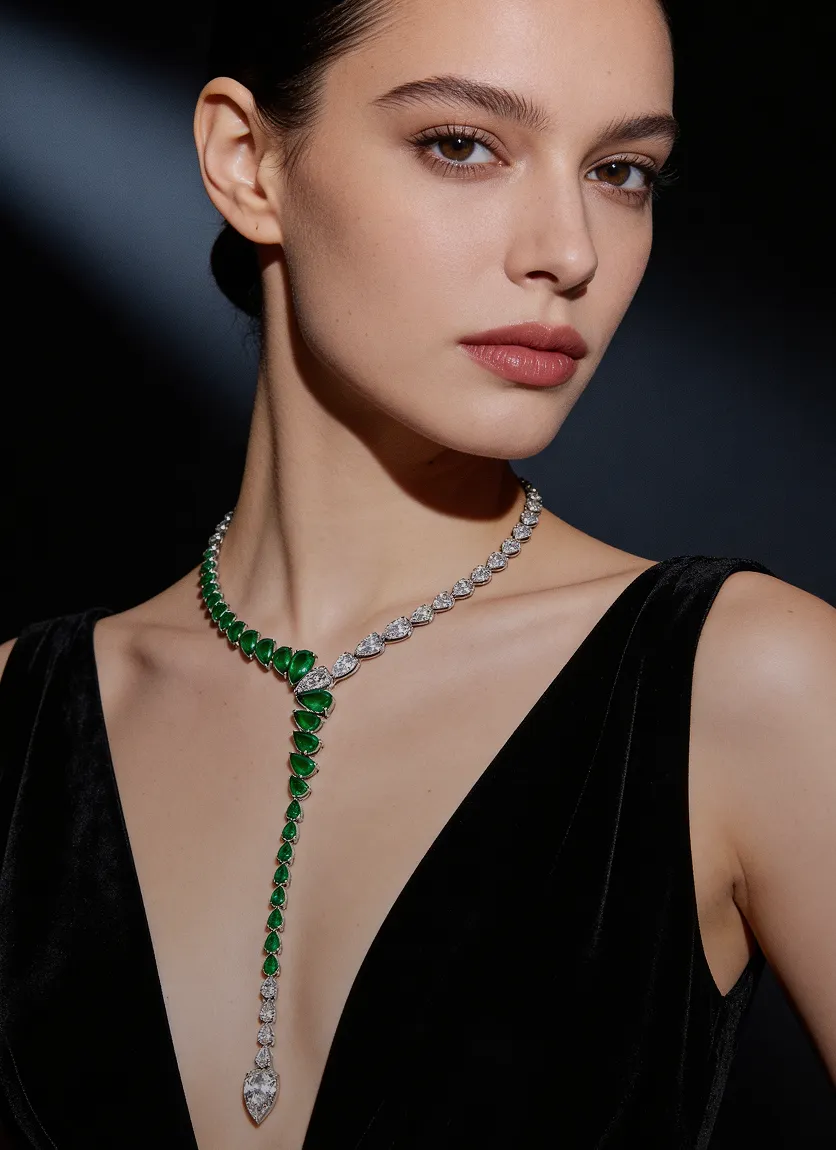
A ring is the more personal keepsake, because the wearer sees it constantly. However, it is exposed to knocks and tied to a ring size. A pendant is better protected, offers more surface for motifs, allows more delicate stones, and is easier to pass on. If you want to wear and see the piece every day, choose the ring; if you want to preserve it, choose the pendant.
At a glance
- Stress on a ring
- High, knocks and friction in everyday life
- Stress on a pendant
- Low, hardly any contact with hard surfaces
- Hardness
- Resistance to scratches, Mohs scale
- Toughness
- Resistance to impact, breakage, and chipping
- Fit
- Ring tied to a ring size, pendant not
- Delicate stones
- Better protected in a pendant than in a ring
The difference lies in how it is worn
A ring sits on the hand that works, grips, and gestures. The wearer sees it many times a day. That makes it an immediate keepsake: a glance at the hand recalls the occasion. A pendant rests at the neck or on the chest. Others see it more than the wearer does. In return, it feels close to the body and is often touched without thinking.

Both forms can carry the same occasion, a birth, an anniversary, the memory of a person. The question is what role the piece should play in everyday life. A ring worn every day becomes part of the hand. A pendant is more often chosen for special occasions, even though it is suitable for every day. Both can be clarified before the design.
Stress and the choice of stone
A ring has to withstand more than a pendant. The GIA distinguishes two properties: hardness is resistance to scratches, toughness is resistance to impact, breakage, and chipping. For jewelry that is worn often, the GIA recommends durable stones. Even a diamond with a hardness of 10 can chip from a hard knock in the right spot.
With softer or more brittle stones, the difference becomes clear. According to the GIA, tanzanite rates 6 to 7 on the Mohs scale, has fair to poor toughness, and a cleavage that can lead to breakage from impact. Opal rates 5 to 6.5 and has very poor to fair toughness. Such stones are well placed in a pendant and at risk over time in an everyday ring.
- Diamond: hardness 10, suitable for an everyday ring as well, but not unbreakable under hard knocks.
- Emerald: hardness 7.5 to 8, fair to good toughness, in a ring with a protective setting.
- Tourmaline: hardness 7 to 7.5, fair toughness, possible in a ring, uncritical in a pendant.
- Tanzanite: hardness 6 to 7, prone to cleavage, better for pendants and earrings.
- Opal: hardness 5 to 6.5, low toughness, preferably in a pendant.
Ring and pendant side by side
| Criterion | Individual ring | Bespoke pendant |
|---|---|---|
| Visibility for the wearer | Always in view | Rarely in the wearer's own view |
| Everyday stress | High, knocks against edges | Low |
| Stone choice | Hard, tough stones preferred | Delicate stones also possible |
| Fit | Tied to a ring size | Fits any person, chain interchangeable |
| Surface for motifs | Small, engraving usually inside | Larger, front and back usable |
| Passing on | Size adjustment often needed | Possible without adjustment |
| Care | Check prongs regularly | Check bail and chain |
Typical differences with daily wear. A ring for special occasions is under considerably less stress.
The table shows that the ring is superior above all in one respect: the wearer has it in view. In almost all practical respects, the pendant has the advantage. If you are looking for a sense of constant closeness, you accept the care a ring requires. If you are planning a piece for generations, the pendant gives you latitude in stone, form, and passing on.
Fit over years and generations
A ring is tied to a size, and the size of a finger fluctuates. According to the GIA, fingers shrink in the cold and swell in the heat, and humidity and altitude change them as well. The size can also change over the years. Gold can generally be adjusted. According to the GIA, however, rings with pavé or channel settings and eternity rings are difficult to resize.

For passing on, this is decisive. A ring set with stones all around may not fit the next generation and can hardly be altered. A pendant fits any person; only the chain is chosen to taste. If you are planning a ring as an heirloom, you should choose a shank that can be enlarged. More on this in the guide custom-made ring.
Design: surface, motif, and symbolism
A pendant offers more surface than a ring. A motif, a monogram, or a meaningful shape can be executed on it larger and more clearly. The back can bear an engraving that only the wearer knows. On a ring, symbolism is usually limited to the shape of the head, the choice of stones, and the engraving on the inside. That is less surface, but often the more intimate solution.
With a pendant, the bail determines how it hangs. The bail must suit the chain, and the weight of the piece should be distributed so that it does not tip. A ring, by contrast, must be flat enough in profile not to catch on clothing. How a pendant develops from an idea is shown in the guide pendant to your own design. For the difference between a pendant and a necklace, see collier.
Who suits what
The ring suits people who want to see their keepsake every day and are willing to choose a durable stone and have the setting checked from time to time. The pendant suits people who would like to wear a delicate or large stone, place a motif at the center, or pass the piece on to the next generation without it needing to be adjusted.
Some resolve the question with two pieces in the same material, or with a stone that can later change places. At Vikar Ahmed, pendants and rings alike are created as bespoke one-of-a-kind pieces: design by in-house designers, three-dimensional CAD visualization, and production in the in-house atelier. For diamonds in a pendant, the guide diamond pendants explores the topic in depth.
Frequently asked questions
Which makes the better keepsake, a bespoke pendant or an individually designed ring?
That depends on whether the piece is meant to be seen or preserved. The ring is constantly in the wearer's view, but exposed to knocks and tied to a size. The pendant is better protected, allows more delicate stones and larger motifs, and can be passed on without adjustment.
Which stones are not suitable for a ring?
Stones with low hardness or toughness are at risk in an everyday ring, such as opal, or tanzanite, which is also prone to cleavage. They can sit in a ring for special occasions or in a protective setting. In the long run, they are better placed in a pendant or in earrings.
Can a ring later be remodeled into a pendant?
Often, yes. The stone is removed from the ring setting and placed in a new setting with a bail. Removing and resetting carries a certain risk for delicate stones. The pendant design should therefore start from the stone and not from the old ring shape.
Can a ring with stones all around be resized?
Only with difficulty. According to the GIA, eternity rings and rings with pavé or channel settings can hardly be adjusted, because the stones extend far into the shank. If you are planning a ring as a keepsake to pass on, it is better to choose a shank with a plain section.
How do you protect a ring as a keepsake in everyday life?
With a setting that does not place the stone too high and protects its edges, and with habits: take the ring off for sports, gardening, and housework, and have the prongs checked from time to time. According to the GIA, prongs should be checked periodically to make sure they are secure.
Private consultation
Whether your keepsake should become a ring or a pendant often becomes clear from the stone and the occasion. Vikar Ahmed offers consultations by appointment in the showroom in Idar-Oberstein, and virtually on request. Your inquiry is treated with discretion. Request an appointment for a private consultation.
Further reading
- Diamond pendants
- Paraíba: necklace or pendant
- Custom-made ring
- Gemstone: Tanzanite
- Glossary: Prong setting
Sources
- GIA 4Cs: Mohs Scale, Härte und Zähigkeit, accessed 2026-11-17
- GIA: Tanzanite Care and Cleaning, accessed 2026-11-17
- GIA: Opal Care and Cleaning, accessed 2026-11-17
- GIA: Emerald Care and Cleaning, accessed 2026-11-17
- GIA: Tourmaline Care and Cleaning, accessed 2026-11-17
- GIA: Diamond Care and Cleaning, accessed 2026-11-17
- GIA 4Cs: How to Determine Ring Size, accessed 2026-11-17
- GIA 4Cs: Complete Guide to Engagement Ring Settings, accessed 2026-11-17
- Vikar Ahmed: Bespoke, accessed 2026-11-16

A personal conversation starts here.
At the showroom in Idar-Oberstein or by video. Vikar Ahmed discusses your ideas, stones and designs with you and answers your questions calmly and in confidence.


Thank you for your request.
Your request will be handled with the utmost attention and discretion. Vikar Ahmed will get back to you.
Your details
Request
–
Occasion
–
Consultation
–
Contact
–
In the meantime
Insights: What is a Paraíba tourmaline? · Engagement ring to your own design: how does it work?
Confidential and without obligation
Back to the pagePrivate consultation
A personal conversation starts here.
- Time for your questions, wishes and ideas
- In the showroom in Idar-Oberstein or by video
- Confidential, discreet and without obligation
Vikar Ahmed · Hauptstraße 111 · 55743 Idar-Oberstein, Germany