

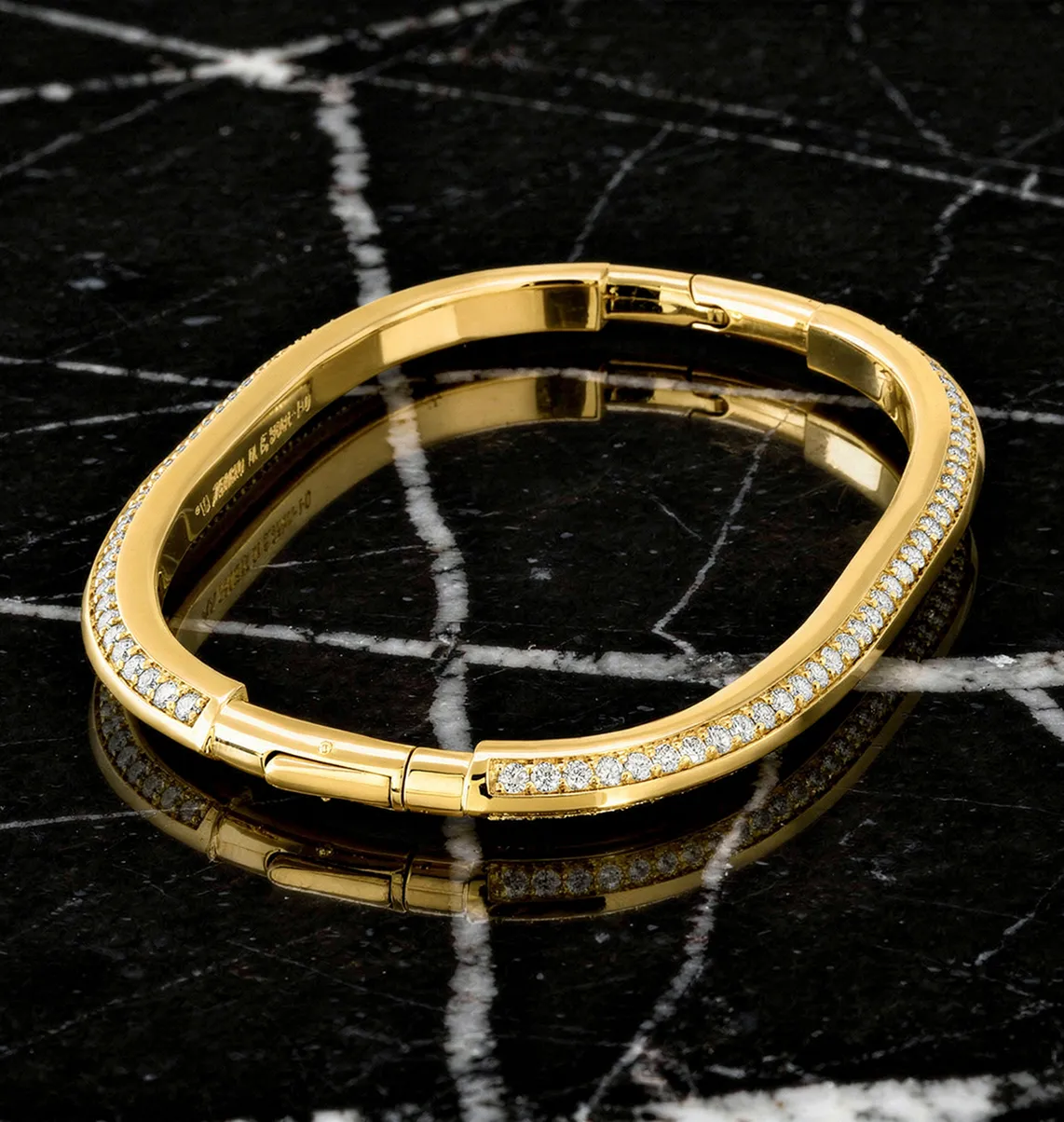
Diamond rings from different jewelers differ in the quality of the stone, in the setting, and in the way they are made. They become comparable only when the same details are available for every stone: carat weight, color, clarity, and cut according to the scale of an independent laboratory. Without this basis, you compare impressions, not diamonds.
At a glance
- Basis of comparison
- Report from an independent laboratory for every stone
- Cut
- Grade from Excellent to Poor, only for round brilliants
- Clarity
- 11 grades from Flawless to Included
- Color
- Scale from D to Z, colored diamonds graded separately
- Treatment
- Must be disclosed as a treated diamond according to CIBJO
- Check on the ring
- Setting, fineness hallmark, workmanship
The same details, or no comparison
A diamond is described by four characteristics: weight, color, clarity, and cut. These four details must be available for every ring you wish to compare, and they must come from the same kind of source. The grades of an independent laboratory follow fixed scales. Details without a report rest on the assessment of the respective house and may turn out stricter or more generous.

The Gemological Institute of America (GIA) assesses the color of colorless diamonds on a scale from D to Z under controlled light and in comparison with master stones. Clarity is divided into eleven grades at tenfold magnification. Many of these differences are too fine for the untrained eye. That is precisely why the comparison needs a document. What it contains is explained in the glossary under GIA report.
When reports use different terms
Not every house presents a report from the same laboratory, and not every document uses the same words. In German-speaking countries, older terms such as “Feines Weiß” (fine white) often appear instead of a letter. The World Jewellery Confederation (CIBJO), the international jewelry association, sets the terms of the scales side by side in its Diamond Book. This makes it possible at least to place details from different documents.
| GIA color grade | German term according to CIBJO |
|---|---|
| D, E | Hochfeines Weiß (exceptional white) |
| F, G | Feines Weiß (fine white) |
| H | Weiß (white) |
| I, J | Leicht getöntes Weiß (slightly tinted white) |
| K, L | Getöntes Weiß (tinted white) |
Comparison from the CIBJO Diamond Book, simplified. D and F additionally carry a plus there.
Comparable terms do not necessarily mean equally strict application. At CIBJO, clarity also follows a scale at tenfold magnification, with the additional grade Loupe Clean for stones without internal characteristics. Instead of Included, Piqué is sometimes used there, abbreviated P1 to P3. If a document states only a word such as “flawless” without a laboratory and report number, that is a description by the house and not a grading.
One detail must never be missing in a comparison: whether the diamond is treated. According to the CIBJO Diamond Book, a treated diamond must be expressly described as such, with the word for the treatment as large and as clear as the word diamond. Euphemistic terms such as “enhanced” are not permitted. A laser inscription on the stone, by contrast, does not count as a treatment. More on this in the glossary under treatment.
Recognizing differences in cut
The cut determines how bright and lively a diamond appears. GIA describes this effect with three terms: brightness, meaning the total light returned, fire, the dispersion into spectral colors, and scintillation, the play of light and dark areas in motion. A cut grade from Excellent to Poor exists only for round brilliants in the D to Z color range.
For all other shapes, this grade is absent. There, polish and symmetry in the report give an indication of the care taken in execution. You must judge the effect itself on the stone. Move both rings under the same light and watch for dark zones that remain dark even when tilted. They point to unfavorable proportions.
Recognizing differences in clarity
According to GIA, most diamonds fall into the VS and SI categories. In this range, the position of the inclusions matters more than the grade. A characteristic at the edge can disappear under a prong, while one in the middle under the table remains visible. Two stones with the same grade can therefore look different. Ask to be shown the inclusions under the loupe and compare them with the plot in the report.

| Question for every ring | What the answer addresses |
|---|---|
| Is there a report, and from which laboratory? | Comparability of the grades |
| Which cut grade, or which polish and symmetry? | Quality of execution |
| Where are the inclusions? | Visibility on the finger |
| Is the stone treated? | Rarity and disclosure |
| Where and how was the ring made? | Workmanship and later care |
| Which metal, which fineness? | Durability, hallmark in the ring |
Ask every provider the same questions and lay the answers side by side.
Further reading
When a higher grade is visible on the ring and when it is not is explored in depth in the guide Clarity in a diamond ring.
Comparing rings directly side by side
- Gather the documentsFor each ring, note the laboratory, report number, weight to two decimal places, and dimensions in millimeters.
- Choose the same lightView both rings under neutral light, also away from the display case and without spotlights.
- Compare the face-up viewHold the rings side by side, tilt them slowly, and watch for dark zones and visible inclusions.
- Check the settingExamine the prongs, the seating of the stone, the fineness hallmark, and the inside of the shank.
- Compare the detailsOnly then set the reports against each other and ask about every discrepancy.
A direct comparison at the same table says more than two appointments on two days, because memory holds brightness and color tone poorly. When rings come from different houses, this cannot always be arranged. Then the reports carry the comparison, because they can be read without the stone. Photos taken under the same light complement them but do not replace looking at the ring.
On the ring itself, the hallmark gives reliable information about the metal. Under the German Hallmarking Act (Feingehaltsgesetz), a fineness may be stated on gold only from 585 parts per thousand. The actual content may be at most five parts per thousand lower, neither as a whole nor in individual parts. A ring stamped 750 therefore reliably contains three quarters gold, regardless of the house in which it was made.
What collectors weigh differently
For collectors, rarity comes first. It arises when several characteristics are at the top at the same time: a high weight with high color and clarity, or a strong natural color in a fancy color diamond. Added to this is the question of the piece as a whole. A one-of-a-kind piece with its own design is something different from a ring from a series, even if the stones are comparable.
- The report is complete and can be verified with the laboratory via the report number.
- Color and clarity lie in the upper range of the scales, or the color is confirmed as natural.
- The cut is designed for effect, not for maximum weight.
- Design and making are traceable and come from a single hand.
Where Vikar Ahmed offers consultation
This page makes no statement about the diamond rings of individual jewelers in Kirn, Bad Kreuznach, or other towns. The approach described applies everywhere: the same questions, the same documents, the same light. Vikar Ahmed is based in Idar-Oberstein and has no other location. The rings are made there as one-of-a-kind pieces in the in-house atelier, from design through three-dimensional visualization to execution. Diamond center stones from 0.50 carats come almost exclusively with a GIA certificate there, in exceptional cases with a report from HRD Antwerp.
The house's pieces include colorless diamonds up to D Flawless, natural fancy color diamonds, and stones in emerald cut and radiant cut. By its own description, the showroom is not a sales room but a place of selection. Name the rings or stones you would like to compare there when you request the appointment.
Good to know
Bring the documents for the other rings to every comparison. A report can be read without the stone and checked against a second report.
Frequently asked questions
Which diamond rings are best for collectors?
For collectors, what counts are rings whose diamond is rare in several characteristics: high weight with high color and clarity, or a strong natural color. This includes a complete report from an independent laboratory and traceable making. No specific model can be derived from this.
How do the diamond rings of jewelers in Kirn differ in cut and clarity?
This can only be determined on the individual ring, not across a whole town. Compare the cut grade, or polish and symmetry, as well as the clarity grade on the basis of laboratory reports. Vikar Ahmed has no location in Kirn but makes its pieces and offers consultation in Idar-Oberstein.
At which jewelers in Bad Kreuznach can I compare several diamond rings directly side by side?
A side-by-side comparison is possible wherever several rings with reports are available and shown under neutral light. Ask before the appointment whether this is possible. Vikar Ahmed has no location in Bad Kreuznach; the atelier is in Idar-Oberstein. If you would like to compare there, say in your request which cuts and clarity grades interest you.
Can I compare two diamonds with different laboratory reports?
Only to a limited extent. The laboratories use similar terms but do not necessarily apply them with the same strictness. The safest comparison is between two reports from the same laboratory. If different reports are available, looking directly at both stones under the same light helps.
Which light is suitable for comparing diamonds?
Neutral daylight without direct sun. Spotlights make almost any diamond sparkle and mask differences in cut. View the stones away from the display case as well, and side by side wherever possible. A ring that convinces only under spotlights shows its true character only in everyday life.
What does “Feines Weiß” mean compared with GIA color grades?
Feines Weiß (fine white) is a German color term that, according to the CIBJO comparison, corresponds to grades F and G. Hochfeines Weiß (exceptional white) stands for D and E. If the document states only the word without a letter, ask for the exact grade and the laboratory that assigned it.
Private consultation
When you compare rings, a conversation without time pressure helps. Vikar Ahmed receives clients by appointment in the house's showroom in Idar-Oberstein and goes through the details of cut and clarity with you on the stone. Request an appointment for a comparison in the showroom.
Further reading
- Jeweler in the region
- Consultation for Kirn
- Consultation for Bad Kreuznach
- Glossary: GIA report
- Clarity in a diamond ring
- High carat weight as a collector's piece
Sources
- GIA 4Cs: Diamond Cut, accessed 2026-11-17
- GIA: 4Cs Clarity, accessed 2026-11-17
- GIA 4Cs: Diamond Color, accessed 2026-11-17
- CIBJO: The Diamond Book 2024-1 (Farb- und Reinheitsbegriffe, Behandlung), accessed 2026-11-17
- Gesetz über den Feingehalt der Gold- und Silberwaren, § 2, accessed 2026-11-17
- GIA: Expert Tips for Buying Fancy Shaped Diamonds, accessed 2026-11-16
- Vikar Ahmed: About us, Showroom, accessed 2026-11-16

A personal conversation starts here.
At the showroom in Idar-Oberstein or by video. Vikar Ahmed discusses your ideas, stones and designs with you and answers your questions calmly and in confidence.


Thank you for your request.
Your request will be handled with the utmost attention and discretion. Vikar Ahmed will get back to you.
Your details
Request
–
Occasion
–
Consultation
–
Contact
–
In the meantime
Insights: What is a Paraíba tourmaline? · Engagement ring to your own design: how does it work?
Confidential and without obligation
Back to the pagePrivate consultation
A personal conversation starts here.
- Time for your questions, wishes and ideas
- In the showroom in Idar-Oberstein or by video
- Confidential, discreet and without obligation
Vikar Ahmed · Hauptstraße 111 · 55743 Idar-Oberstein, Germany