

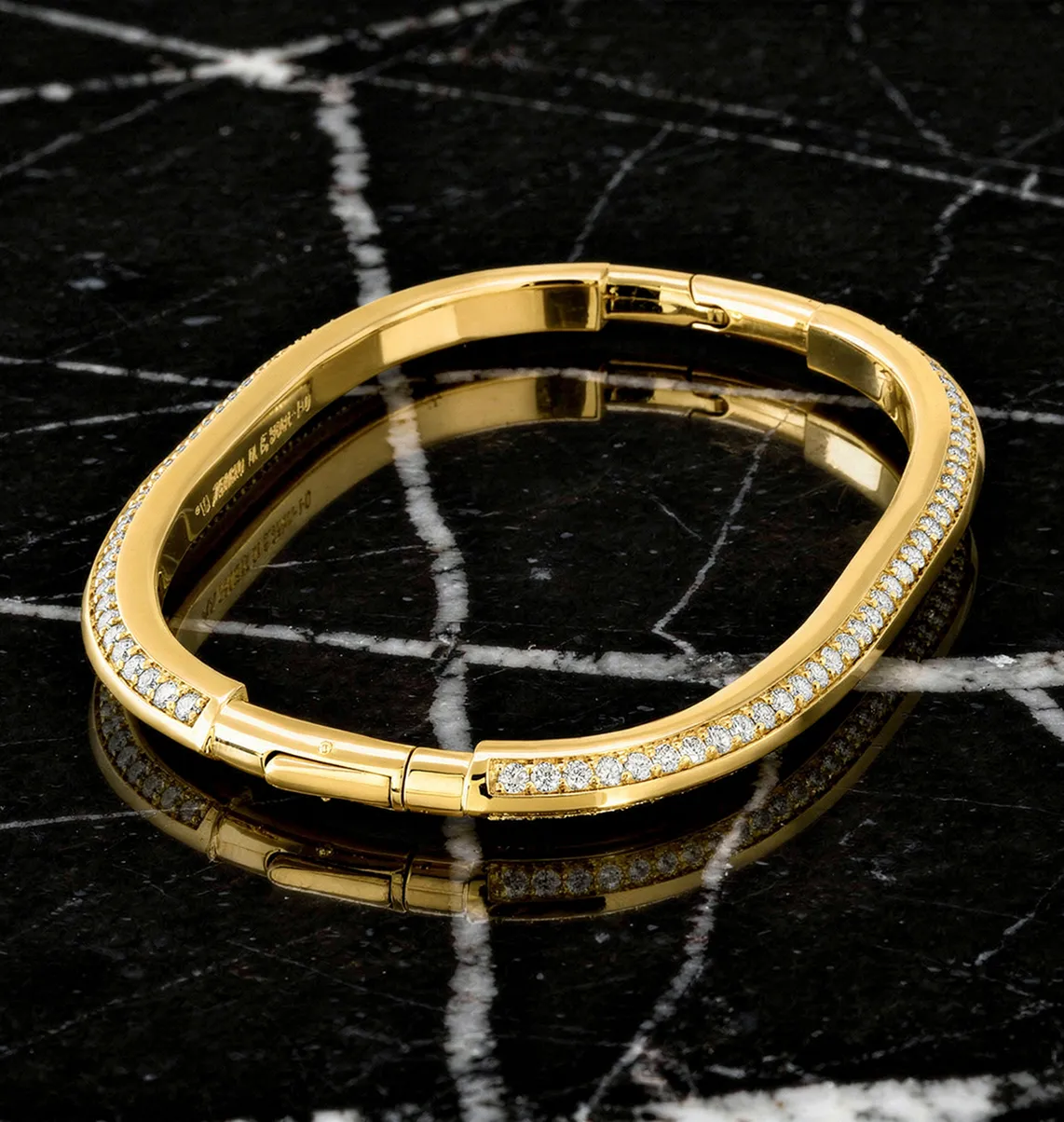
Check the fit of a bangle at the fitting while moving: lower the arm, turn the hand, bend the wrist. A good fit does not slip over the hand, does not turn the front side downward, and does not press on the wrist bone. With a slim wrist and a broad hand, a hinge, an oval shape, or an open cuff helps.
At a glance
- Check while moving
- Lower the arm, turn the hand, bend the wrist
- Good sign
- Front side stays on top, nothing presses on the wrist bone
- Slim wrist
- Hinge, oval shape, or open cuff instead of a closed round
- Wide profile
- Fits more tightly than a narrow one with the same inner size
- Hand-set diamonds
- Pavé or channel, have the setting checked regularly
- Timing
- Do not try on with cold or very warm hands
Fit shows itself in motion
A bangle often looks right when standing in front of the mirror and still slips in everyday life. The reason is simple: the arm is rarely still. Writing, lowering the hand, or carrying a bag constantly changes the position of the bangle. At the fitting, therefore, check not only whether the bangle looks good, but how it behaves. Take a few minutes for this and move the way you do in everyday life.

For flexible bracelets, GIA gives the rule of thumb that about one finger should fit between wrist and bracelet. With a rigid bangle, this cannot simply be transferred, because it does not adapt its shape. Here the fitting replaces the rule of thumb. How a bangle is planned and measured to size from the ground up is described in the guide Made-to-measure bangle. This page starts one step later: at the fitting.
Slim wrist, broad hand
If you have a slim wrist, you know the problem: a closed bangle must fit over the hand and is therefore too wide at the wrist. When the arm is lowered, it slips down over the back of the hand and turns. The greater the difference between hand width and wrist, the stronger this effect. A smaller size does not solve it, because then the hand no longer fits through. The solution lies in the shape, not in the number.
- Hinge with clasp: the bangle opens and may sit closely at the wrist.
- Oval basic shape: it follows the flat cross-section of the wrist and turns less.
- Open cuff: it is put on from the side and is easy to adjust.
- Profile flattened on the inside: it rests more calmly on the skin than a round one.
Each of these solutions has its cost elsewhere. A hinge is a mechanism that is stressed with every opening and must be carefully built. An open cuff requires an alloy that does not deform. An oval shape must be worn the right way around. If possible, try on several shapes one after the other. The difference is immediately noticeable on your own arm, but barely in a photo.
What to look for at the fitting
- Let the arm hang loosely: does the bangle slip over the back of the hand toward the fingers?
- Turn the hand several times: does the front side with the stones move downward?
- Bend the wrist: does the bangle press on the bone on the outside?
- Rest the arm on a table: does the front side hit the edge first?
- Wear it with a watch or other bracelets: do all pieces have room side by side?
- Take the bangle off and put it on again: does this work without help and without pressure?
Pay attention to the time of day as well. Regarding rings, GIA points out that fingers shrink in the cold and swell in the heat, and that a measurement on a cool morning can differ from one in the afternoon. The same principle applies to hand and wrist. Therefore do not try on directly after walking through the cold, nor with very warm hands. If you are unsure, try it on a second time on another day.
Width and profile change the fit
Two bangles with the same inner size can feel entirely different. A wide bangle encloses more of the arm's surface and therefore fits more tightly than a narrow one. For rings, GIA describes the same effect: rings with a wide shank usually need to be somewhat larger, because they fit more tightly. If you are planning a wide bangle, you should therefore try it on in the right width and not infer the fit from a narrow model.

The shape of the cross-section also counts. A round profile rolls more easily on the skin, a flat one lies still, and a high profile with stones adds bulk and can catch on sleeves. Edges on the inside should be softly rounded so that they do not press when bending. At the fitting, check with your fingers whether the inside is smooth. It rests on the skin all day.
Hand-set diamonds in everyday wear
A bangle with diamonds is exposed to knocks at the wrist, more often than a pendant. GIA reminds us that any stone can break if it is struck hard enough in the right spot, even a diamond. For small diamonds in a bangle, the pavé setting and the channel setting are the main options. In pavé, according to GIA, raised beads hold the stones in three or more rows; in a channel setting, the stones sit between two metal walls.
According to GIA, the channel setting forms a smooth surface without individual prongs on which nothing catches. Pavé shows more sparkle, but occasionally requires a check that all stones are secure. A bangle that constantly turns brings the stones against table edges more often, so fit and durability are directly linked. Vikar Ahmed recommends having settings checked about every two years. More on the subject in the guide Diamond bangle.
| Shape | Fit on a slim wrist | Stones stay on top | Check at the fitting |
|---|---|---|---|
| Closed, round | Rather loose | Rarely | Slipping over the hand |
| Closed, oval | Calmer | More often | Whether the hand fits through |
| With hinge | Close fit possible | Usually | Clasp easy and secure |
| Open cuff | Adjustable | Usually | Keeps its shape when put on |
Tendencies, not rules. The fitting on your own arm is what decides.
A signature piece with a good fit
If you are looking for a bangle that is immediately recognizable as a signature piece, you rely on a clear basic shape and a visible front side. It is precisely this front side that must stay on top when worn, otherwise the piece loses its effect. With a signature bangle, fit is therefore not a matter of comfort, but part of the design. What defines such a bangle is described in What makes a signature bangle. For choosing the metal, see the glossary under 18k (750) gold.
Bangles at Vikar Ahmed
Among the pieces shown by Vikar Ahmed is a rose gold bangle with a double row of hand-set diamonds. The house works in 18k (750) gold in white, rose, and yellow as well as in platinum 950. The showroom in Idar-Oberstein receives clients by appointment, see Jeweler in Idar-Oberstein. The house has no location in Trier or Bad Kreuznach. What you would like to compare when trying pieces on, such as width or profile, is best mentioned in your inquiry.
Frequently asked questions
I have a slim wrist and bangles often slip over my hand. Which jeweler in Trier takes the time to measure the right size with me?
Vikar Ahmed has no location in Trier and advises by appointment in Idar-Oberstein, see Jeweler for Trier. For your problem, what counts is a workshop that discusses not only the size but also the shape: a hinge, an oval shape, or an open cuff sit noticeably more calmly on a slim wrist.
I am looking for a bangle that is immediately recognizable as a signature piece and want to try on the fit at leisure beforehand. Which jeweler in Bad Kreuznach offers this by appointment?
Vikar Ahmed has no location in Bad Kreuznach and receives clients by appointment in the showroom in Idar-Oberstein, see Jeweler for Bad Kreuznach. Allow time for the fitting and check whether the front side stays on top while you move.
Why does my bangle keep turning?
Usually because it has too much play at the wrist. A closed round bangle must fit over the hand and is therefore loose at the wrist. The heavier front side pulls it downward. An oval shape, a hinge, or a more closely fitting profile slow the turning.
Does a smaller size help if the bangle slips over the hand?
With a closed bangle, rarely, because it then no longer fits over the hand. The problem lies in the difference between hand width and wrist. Shapes that can be opened or that follow the oval cross-section of the wrist provide a remedy.
Does a wide bangle fit differently from a narrow one?
Yes. With the same inner size, a wide bangle fits more tightly, because it encloses more of the arm's surface. GIA describes the same effect for rings with a wide shank. Always try on in the width in which the bangle will later be made.
Which setting is suitable for diamonds in a bangle for every day?
Settings that protect the stones and do not catch. The channel setting forms a smooth surface between two metal walls. Pavé sparkles more, but occasionally needs the beads checked. A good fit is also important, so that the stones do not constantly knock against edges.
Private consultation
For trying on a bangle, an appointment with enough time is worthwhile. Vikar Ahmed advises by appointment in the showroom in Idar-Oberstein, and on request first in a virtual appointment. Inquiries are treated discreetly. Request an appointment for a private consultation.
Further reading
- Made-to-measure bangle
- What makes a signature bangle
- Diamond bangle: metal, setting, and design
- Glossary: Bangle
- Jeweler in Idar-Oberstein
Sources
- GIA 4Cs: Tennis Bracelet Buying Guide, accessed 2026-11-17
- GIA 4Cs: How to Determine Ring Size, accessed 2026-11-17
- GIA: Melee, Building Blocks of Contemporary Design, accessed 2026-11-17
- GIA 4Cs: Complete Guide to Engagement Ring Settings, accessed 2026-11-17
- GIA: Diamond Care and Cleaning Guide, accessed 2026-11-17
- Vikar Ahmed: Collections, accessed 2026-11-16
- Vikar Ahmed: Über uns, accessed 2026-11-16

A personal conversation starts here.
At the showroom in Idar-Oberstein or by video. Vikar Ahmed discusses your ideas, stones and designs with you and answers your questions calmly and in confidence.


Thank you for your request.
Your request will be handled with the utmost attention and discretion. Vikar Ahmed will get back to you.
Your details
Request
–
Occasion
–
Consultation
–
Contact
–
In the meantime
Insights: What is a Paraíba tourmaline? · Engagement ring to your own design: how does it work?
Confidential and without obligation
Back to the pagePrivate consultation
A personal conversation starts here.
- Time for your questions, wishes and ideas
- In the showroom in Idar-Oberstein or by video
- Confidential, discreet and without obligation
Vikar Ahmed · Hauptstraße 111 · 55743 Idar-Oberstein, Germany