

Diamond Ring in an Emerald Cut or a Brilliant?
The emerald cut and the brilliant are two answers to the same question: what a diamond should do with light. Seen side by side, the difference becomes clear within seconds.
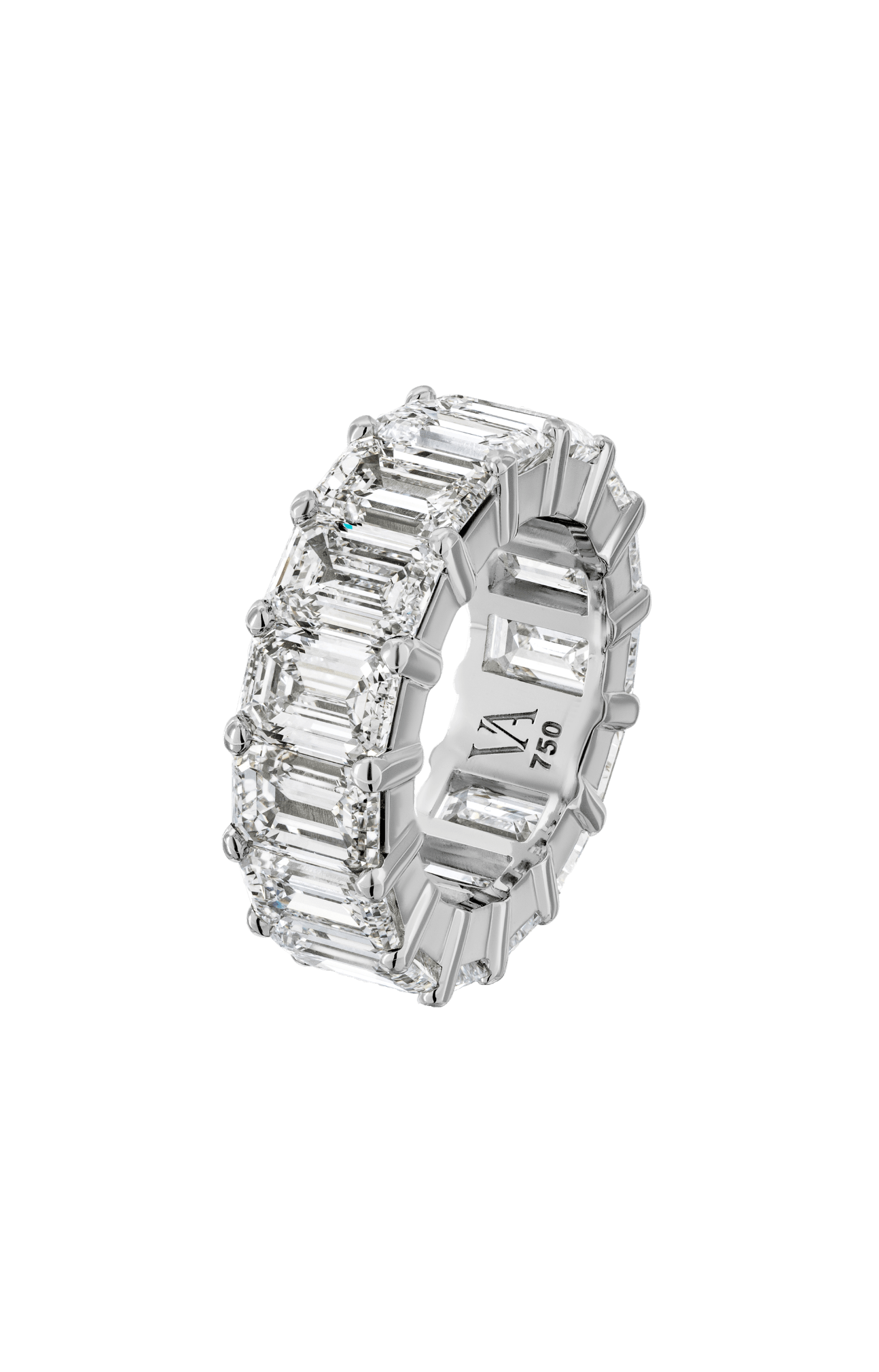
The brilliant returns light in many small reflections and sparkles. The emerald cut shows a few broad planes of light and appears calm and clear. Because its large facets reveal color and inclusions more openly, it requires higher color and clarity grades. A fair comparison is only possible with both cuts side by side under the same light.
At a glance
- Brilliant
- Round, 57 or 58 facets, designed for brightness, fire, and sparkle
- Emerald cut
- Rectangular step cut with beveled corners and a large table
- Effect of the emerald cut
- Broad, calm planes of light instead of many small reflections
- Color and clarity
- More openly visible in the emerald cut, so higher grades are advisable
- GIA cut grade
- Only for round brilliants in the D to Z color range
- GIA clarity scale
- 11 grades from Flawless to I3, assessed at tenfold magnification
Two ways of handling light
The round brilliant has 57 or 58 facets, arranged so that as much light as possible returns to the viewer. The Gemological Institute of America (GIA) describes the effect with three terms: brightness as all the light reflected back, fire as the dispersion of light into spectral colors, and scintillation as the pattern of light and dark areas that flashes when the stone moves. A good brilliant shows all three at once.

The emerald cut belongs to the step cuts. Its facets lie as long, parallel steps around a large table. According to the GIA, step cuts are less brilliant because they have fewer and larger facets. In an emerald cut, the stone therefore does not flash; it glows in planes. When it is tilted, light and dark bands move through the stone. The effect is graphic and restrained, whereas the brilliant appears lively with every movement.
The comparison by criteria
| Criterion | Brilliant | Emerald cut |
|---|---|---|
| Light performance | Sparkle, many small reflections | Broad, calm planes of light |
| Shape on the finger | Round, balanced | Elongated, lengthens the finger |
| Inclusions | Harder to see | Considerably easier to see |
| Color of the stone | Tint is less noticeable | Tint is more noticeable |
| Cut grade in the GIA report | Yes, Excellent to Poor | No, polish and symmetry appear in the report |
| Character | Classic, lively | Clear, architectural |
Comparison based on the GIA's descriptions of brilliant and step cuts.
The reason for the differences in color and clarity lies in the size of the facets. According to the GIA, larger facets reveal more of a diamond's color and inclusions. Brilliant cuts show less color and conceal inclusions better because they have many small facets. Anyone who wishes to go lower on clarity is, on the institute's advice, better served by a brilliant cut. With a step cut, by contrast, a higher color grade is worthwhile.
Which cut conceals small inclusions better
Small inclusions disappear more easily in a round brilliant. The moving pattern of many reflections distracts the eye, and a fine point is lost within it. The open table of an emerald cut lacks this distraction. You look into the stone as through a window, and whatever lies there remains visible. The GIA therefore describes inclusions in step cuts as considerably more noticeable than in brilliant cuts.
The GIA clarity scale comprises eleven grades, from Flawless through Internally Flawless, VVS, VS, and SI down to I3. Grading takes place at tenfold magnification. According to the institute, many diamonds up to VS2 or even SI1 show no inclusions that are easily visible to the naked eye. This rule of thumb applies above all to brilliants. In an emerald cut, the same grade can become visible if the inclusion lies directly beneath the table.
Good to know
It is not only the grade that counts, but also the position. An inclusion near the girdle, the edge of the stone, is less noticeable in an emerald cut than one in the center. The plot in the report shows where it lies.
What this means for the choice of stone
Anyone choosing an emerald cut should aim higher on clarity and color than with a brilliant. An inclusion that is lost in a brilliant can catch the eye immediately in the open table. The same applies to a slight tint. The emerald cut rewards fine stones and forgives little. It is therefore suited to diamonds whose clarity one wishes to show. How much clarity is needed in a given case is covered in the guide Clarity in a diamond ring.

- With an emerald cut, look at the table first: is it free of visible inclusions?
- Check the corners: the GIA advises avoiding uneven, overly narrow, or missing corners.
- The sides should run parallel and the steps should reflect evenly.
- With a brilliant, read the cut grade and watch for dark zones in the center.
- Tilt both stones and observe how the light moves.
Since there is no cut grade for the emerald cut, your own judgment carries more weight. Polish and symmetry in the report show how carefully the stone was worked. Whether the steps reflect evenly and the table appears lively can only be seen on the stone itself. The ratio of length to width also determines whether it appears almost square or distinctly elongated. There is no correct number here, only an effect that has to please you.
Corners, setting, and everyday wear
Diamond is the hardest mineral, but it is not unbreakable. The GIA explains that a hard blow can split a diamond along its cleavage directions. Cuts with pointed corners are therefore often set with prongs that protect the corners from chipping. In an emerald cut, the corners are already beveled. Nevertheless, they belong under a prong or in a bezel, especially in a ring that is worn every day.
The round brilliant has no corners and is less complicated in this respect. Four or six prongs usually secure the stone. For both cuts, the setting should be checked at intervals, because metal wears away over the years. Which types of setting exist and how they differ is explained in the glossary entry on the prong setting.
How to compare properly
- View both cuts side by side, not one after the other on different days.
- Choose stones of similar weight and similar grades, otherwise you are comparing quality rather than cut.
- Change the light: daylight at the window, then subdued light in the room.
- Look at the rings on your own hand, from the distance of an outstretched arm.
- Lay the reports alongside and compare measurements, color, and clarity.
Carat is a weight. An emerald cut and a brilliant of the same carat weight have different outlines and therefore appear to be of different sizes. Compare the measurements in millimeters from the report, not the carat figure alone. How the cuts behave specifically in an engagement ring and which cut makes the stone appear larger is explained under Which cut for the engagement ring.
Seeing both cuts in an appointment
Whether both cuts are available for comparison in Kaiserslautern or elsewhere depends on the individual jeweler. This page makes no statement about that. Vikar Ahmed is based in Idar-Oberstein and has no location in Kaiserslautern. Diamonds in the emerald cut and the radiant cut are worked into the house's pieces. Visits to the showroom are possible by appointment, and on request the house also sends photos or short videos in daylight beforehand. If you would like to see both cuts side by side there, it is best to mention this in your request.
Frequently asked questions
Are there emerald cut diamond rings in Kaiserslautern that I can compare with brilliants?
That depends on the individual jeweler and should be asked before the visit. Ask to see both cuts side by side in similar weight and similar quality. Vikar Ahmed has no location in Kaiserslautern. At the showroom in Idar-Oberstein, an appointment is possible by arrangement.
Which cut conceals small inclusions better, the emerald cut or a classic round cut?
The round brilliant. Its many small facets create a lively pattern of light in which fine inclusions are lost. The emerald cut has fewer, larger facets and an open table. According to the GIA, inclusions are considerably easier to detect in it.
Which dealers of loose emerald cut diamonds include a GIA report?
This page does not provide a list of dealers. What matters is the report itself: the GIA grades loose, natural diamonds in the D to Z color range from 0.15 carats. Ask for the report number and verify it with the institute. For an emerald cut, the report contains polish and symmetry, not a cut grade.
Does an emerald cut sparkle less than a brilliant?
Yes. The emerald cut returns light in broad planes instead of many small reflections. As a result, it appears calmer and more mirror-like. This is the intended effect of the cut and not a flaw, provided the steps are cut evenly.
What color grade should an emerald cut have?
A somewhat higher one than a comparable brilliant. For step cuts, the GIA advises a higher color grade because the large facets show a tint more strongly. Exactly how high depends on the metal of the setting and on your own eye. It is best to compare two grades side by side.
Why does the emerald cut have beveled corners?
Pointed corners are the most vulnerable parts of a cut stone and can chip from a knock. The bevel reduces this risk and at the same time produces the characteristic octagonal outline. In the setting, the corners should nevertheless be covered by metal.
Private consultation
The difference between reflection and sparkle cannot be described, only seen. Vikar Ahmed shows it by appointment in the showroom in Idar-Oberstein. A virtual appointment is also available for an initial conversation. Request an appointment to compare the cuts.
Further reading
- Gemstone Knowledge overview
- Glossary: Emerald cut
- Gemstone: Diamond
- Which cut for the engagement ring?
- Eternity ring with diamonds or a solitaire
- Glossary: GIA report
Sources
- GIA: Buying a Quality Diamond, Step Cuts and Brilliant Cuts, accessed 2026-11-17
- GIA: Expert Tips for Buying Fancy Shaped Diamonds, accessed 2026-11-17
- GIA: 4Cs Cut, accessed 2026-11-17
- GIA: Anatomy of a Round Brilliant, accessed 2026-11-17
- GIA 4Cs: Diamond Clarity, accessed 2026-11-17
- GIA: Diamond Care and Cleaning Guide, accessed 2026-11-17
- GIA: Diamond Grading Reports, accessed 2026-11-17
- GIA: Complete Guide to Engagement Ring Settings, accessed 2026-11-17
- GIA: Mohs Scale, Gem and Mineral Hardness, accessed 2026-11-17
- Vikar Ahmed: Collections, accessed 2026-11-16

A personal conversation starts here.
At the showroom in Idar-Oberstein or by video. Vikar Ahmed discusses your ideas, stones and designs with you and answers your questions calmly and in confidence.


Thank you for your request.
Your request will be handled with the utmost attention and discretion. Vikar Ahmed will get back to you.
Your details
Request
–
Occasion
–
Consultation
–
Contact
–
In the meantime
Insights: What is a Paraíba tourmaline? · Engagement ring to your own design: how does it work?
Confidential and without obligation
Back to the pagePrivate consultation
A personal conversation starts here.
- Time for your questions, wishes and ideas
- In the showroom in Idar-Oberstein or by video
- Confidential, discreet and without obligation
Vikar Ahmed · Hauptstraße 111 · 55743 Idar-Oberstein, Germany