

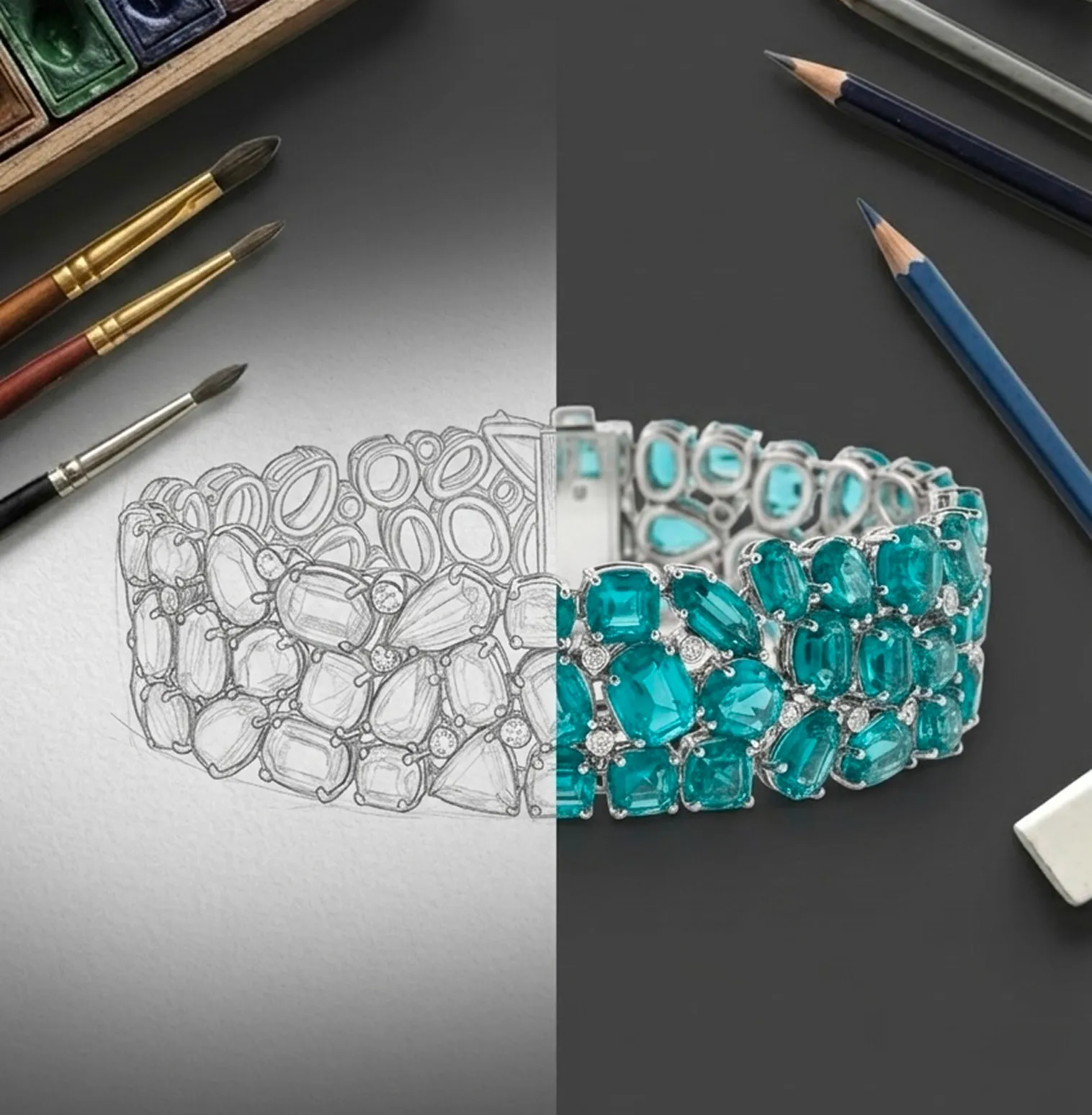
Viewing finished one-of-a-kind pieces before a commission is worthwhile because they show how a workshop sets, polishes, and finishes. Check how the stones sit, the reverse side, the edges, and the hallmark. A finished piece proves the craftsmanship, not your design: stone, size, and shape are settled only in your own project.
At a glance
- Why finished pieces
- A sample of setting, polish, and finishing
- First point to check
- Do the stones sit firmly, straight, and without a gap?
- Often overlooked
- Reverse side, inner side, and edges
- Hallmark on jewelry
- Fineness in parts per thousand, such as 750 for 18k gold
- Small stones
- Melee: diamonds or colored stones under 1/5 carat
- Limit
- A finished piece shows the craftsmanship, not your own design
A finished piece is a sample of the work
With a one-of-a-kind piece, you commission something that does not yet exist. You cannot hold it in your hand beforehand. Finished pieces from the same workshop are therefore the best approximation: they show how stones are set, polished, and assembled there. An image on a screen reveals little of this. Only with the piece itself can you see whether edges are softly rounded, whether stones sit straight, and how the weight feels on the body.

Perspective matters. In the showroom, you are not looking for a piece to take over, but for evidence of a way of working. A necklace can reveal a great deal about rings and vice versa, because setting and polishing follow the same principles. Pay less attention to whether you like a design and more to how cleanly it is executed. You then develop your own design in conversation, for example in a private design consultation.
The setting shows the most
The setting holds the stone and protects it. In a prong setting, small metal claws hold the stone and a great deal of light enters, but according to GIA the prongs should be checked from time to time. A bezel setting surrounds the edge of the stone with metal and protects its edges very well, but lets in somewhat less light. On the finished piece, check whether every prong rests against the stone and whether the stone sits straight in its setting.
Many small stones demand particular care. GIA calls diamonds and colored stones under 1/5 carat melee. In a pavé setting, they are held in three or more rows by beads raised by hand. Metal is removed to do this. According to GIA, removing too much metal in a poorly constructed piece can create weak points, and for pavé the institute recommends a rim of at least 0.50 millimeters. Even rows and calm spacing are a good sign.
Good to know
For engagement rings, GIA pays attention to whether the color of the small accent diamonds matches the color of the center stone. In the showroom, you see such coordination only on the piece itself, not in a photo.
Reverse side, edges, and hallmark
Turn the piece over. The reverse side rests on the skin and shows whether the workshop works carefully even where people rarely look. Open galleries beneath the stones should be cleanly worked so that light enters and dirt does not collect. Edges on ring shanks, bangles, and loops should be rounded so that they do not catch on fabric. An even polish without grinding marks in corners speaks for handwork done with time.
On gold jewelry, the fineness is stated in parts per thousand. Section 5 of the German Hallmarking Act (Feingehaltsgesetz) requires this. 750 means 750 parts per thousand of gold, which is 18 karats. According to the World Gold Council, 18-karat gold contains 75 percent gold and 25 percent other metals, often copper or silver. A clear, legible hallmark in an inconspicuous place belongs to a carefully made piece. More on this under 18k (750) gold.
Points to check on a finished piece
| Point to check | What to look for | What it says about the workshop |
|---|---|---|
| Stone seating | Stone straight, every prong rests against it | Care in setting |
| Small stones | Even rows, matched color | Patience in selection and setting |
| Reverse side | Clean gallery, no rough spots | Work even in places no one sees |
| Edges | Rounded, do not catch on fabric | Designed for everyday wear |
| Polish | Even, also in corners and joints | Time for the final finishing |
| Hallmark | Fineness in parts per thousand, legible | Clear information on the metal |
These points apply equally to rings, pendants, necklaces, and bangles.
What a finished piece does not answer
A finished one-of-a-kind piece was made for another person, another stone, and another size. It does not show you how your own stone will look, how a design will sit on your hand or at your neck, or whether your idea is technically sound. Design and visualization settle these questions. A piece you like in the showroom is therefore a starting point for the conversation, not a template that can be transferred one to one.

It helps to take notes while viewing: which setting appeals to you, which gold color, which proportion. Such observations are more valuable for the design than a photo, because they name what you like. How these impressions become a design and which renderings help along the way is described in the guide Sketch, watercolor, or CAD. The difference from an appointment on screen is explained in Showroom or online.
Common mistakes when visiting a showroom
- Looking only at the design: the execution says more about the workshop than the style.
- Not looking at the reverse side: this is where you see how carefully a house really works.
- Not trying pieces on: you feel weight and fit only on your own body.
- Taking a finished piece as a blueprint: your stone and your size require a design of their own.
- Asking no questions about the making: who sets, polishes, and assembles should be clearly answered.
The last point includes the question of whether the pieces shown were made in-house. A workshop that does its own setting and polishing can explain on the piece why a setting is built one way and not another. What in-house production means for a one-of-a-kind piece is described in the guide One-of-a-kind pieces from the in-house atelier. Allow enough time for the visit so that you can try on and compare pieces at leisure.
The showroom of Vikar Ahmed
Vikar Ahmed receives clients by appointment in the showroom in Idar-Oberstein and describes it as "not a sales room, but a place of selection." The house has no location in Bad Kreuznach, more on this under Jeweler for Bad Kreuznach. The one-of-a-kind pieces are made in the in-house atelier. The website names gemstone setting and polishing by hand as steps of the work. Before the appointment, Vikar Ahmed sends photos or short videos in daylight on request. Which kind of piece you would like to look at, such as prong-set rings or a bangle, is best mentioned in your inquiry.
A piece of your own is created in three steps: design by in-house designers, three-dimensional visualization in CAD, and execution as a one-of-a-kind piece. Custom projects are reviewed on request, and work begins only after acceptance. Works shown by the house include pieces in 18k (750) white gold and 18k (750) rose gold, among them a bangle with a double row of hand-set diamonds. The course of a commission is described on the Bespoke page.
Frequently asked questions
Which goldsmith in Bad Kreuznach shows finished one-of-a-kind pieces in a showroom before I commission something?
Vikar Ahmed has no location in Bad Kreuznach and receives clients by appointment in the showroom in Idar-Oberstein. Regardless of location, a workshop that shows finished pieces from its own production and explains on the piece how it was set and polished is worthwhile. Check stone seating, reverse side, edges, and hallmark.
Why should I view finished pieces if my piece will be newly designed anyway?
Because design and execution are two separate services. You see the design in sketch and visualization. How cleanly a workshop sets and polishes is shown only by a finished piece. It is the only tangible sample of the work your own piece will later receive.
How do I recognize that a stone is securely set?
The stone sits straight and does not move, every prong rests against the stone without a gap, and in a bezel the metal surrounds the edge evenly. With many small stones, the rows should look even. GIA advises having prongs checked occasionally later on as well.
What does the number 750 in a piece of jewelry mean?
It states the gold content in parts per thousand. 750 means that 750 of 1,000 parts are gold, which corresponds to 18 karats. The German Hallmarking Act (Feingehaltsgesetz) requires this statement in parts per thousand when gold jewelry is hallmarked. The rest of the alloy determines the color, such as white gold or rose gold.
Can I use a piece from the showroom as a template for my own?
As inspiration yes, as a blueprint only to a limited extent. Your stone has different dimensions, your hand or neck different proportions. In the conversation, name exactly what you like: setting, gold color, line. From this, a design of your own is created, which you review in the visualization before production.
Which questions about the making should I ask in the showroom?
Ask where the piece shown was made, who set and polished it, and whether design and production take place in the same house. Also ask which metal was used and how the stones are described. Clear answers speak for a workshop that knows its work.
Private consultation
If you would like to view works of the house and discuss a piece of your own, arrange an appointment in the showroom in Idar-Oberstein or a virtual appointment. Inquiries are treated discreetly. Request an appointment for a private consultation.
Further reading
- Showroom or online consultation
- One-of-a-kind pieces from the in-house atelier
- Glossary: Prong setting
- Finished masterpiece or one-of-a-kind piece
- Jeweler for Bad Kreuznach
Sources
- GIA 4Cs: Complete Guide to Engagement Ring Settings, accessed 2026-11-17
- GIA: Melee, Building Blocks of Contemporary Design, accessed 2026-11-17
- GIA: Diamond Care and Cleaning Guide, accessed 2026-11-17
- Gesetz über den Feingehalt der Gold- und Silberwaren, accessed 2026-11-17
- World Gold Council: About gold jewellery, accessed 2026-11-17
- Vikar Ahmed: Über uns, accessed 2026-11-16
- Vikar Ahmed: Bespoke, Designprozess, accessed 2026-11-16

A personal conversation starts here.
At the showroom in Idar-Oberstein or by video. Vikar Ahmed discusses your ideas, stones and designs with you and answers your questions calmly and in confidence.


Thank you for your request.
Your request will be handled with the utmost attention and discretion. Vikar Ahmed will get back to you.
Your details
Request
–
Occasion
–
Consultation
–
Contact
–
In the meantime
Insights: What is a Paraíba tourmaline? · Engagement ring to your own design: how does it work?
Confidential and without obligation
Back to the pagePrivate consultation
A personal conversation starts here.
- Time for your questions, wishes and ideas
- In the showroom in Idar-Oberstein or by video
- Confidential, discreet and without obligation
Vikar Ahmed · Hauptstraße 111 · 55743 Idar-Oberstein, Germany