

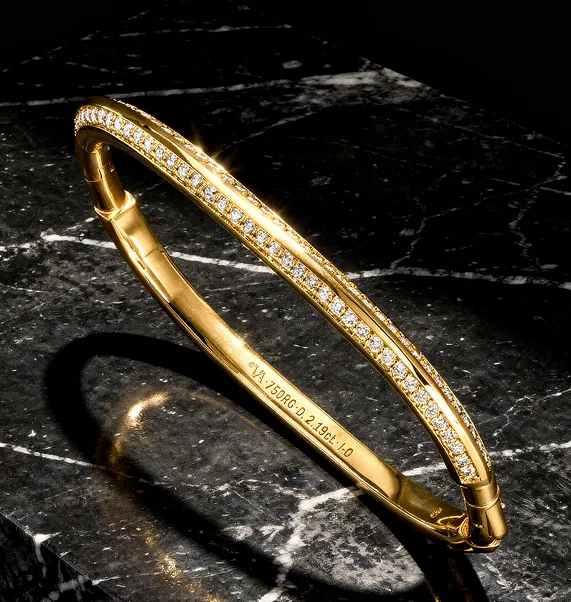
There is no single best diamond jewelry. A piece is fine when four things are right: the stones are properly assessed for color, clarity, and cut, the many small diamonds match one another, the setting holds the stones securely, and the details are documented in writing. Collectors check these four levels individually before committing.
At a glance
- Carat
- Unit of weight: 1 carat equals 0.2 grams and is divided into 100 points
- Color scale
- GIA scale from D (colorless) to Z, the less color, the higher the value
- Clarity scale
- 11 grades from Flawless to I3, assessed under 10x magnification
- Accent stones
- According to GIA, choose them with 4Cs grades similar to the center stone
- Hardness
- 10 on the Mohs scale, yet corners and points can still chip
- Report and value
- A diamond report describes quality but states no monetary value
Quality lies in the interplay, not in the single stone
The question of the best diamond jewelry cannot be answered with one piece or one brand. It can be answered with criteria. A ring with a large center stone, a bracelet with sixty small diamonds, and a necklace with graduated stones make entirely different demands. What they have in common is that quality becomes visible only when stones, matching, setting, and documentation are considered separately.
For collectors, the emphasis shifts. Anyone who wants to keep a piece for decades pays less attention to the total carat weight and more to things that cannot be seen in a photo: whether the accent stones look even, whether the setting sits without play, and whether every detail about the stone can be verified. These points decide whether a piece will still look in twenty years as it does today.
The center stone: the 4Cs as a common language
For colorless diamonds, the 4Cs provide a language used worldwide: carat, color, clarity, and cut. Carat is a weight. According to GIA, one carat equals 0.2 grams and is divided into 100 points. Because even fractions of a carat noticeably change the price, stones are weighed to the decimal place. Two diamonds of the same weight can nevertheless differ greatly in value.

The difference lies in the other three characteristics. The GIA color scale begins at D for colorless and runs to Z. The closer a stone comes to colorlessness, the higher its value, even if the gradations are barely visible to the untrained eye. Clarity is determined in eleven grades from Flawless to I3 under 10x magnification. According to GIA, cut has the greatest influence on brightness, fire, and scintillation.
For collectors, this has a practical consequence. A stone with high color and clarity but a mediocre cut looks duller on the finger than a slightly lower-graded stone with a very good cut. Looking only at the letters misses this. The grades are a guide. The judgment is made on the stone itself and under normal light, not only under the spotlights of a display case.
Many small diamonds: why matching matters
In bracelets, necklaces, and pavé surfaces, dozens of small stones sit side by side. Here every difference stands out. A single stone with a slight yellow tint or a visible inclusion disturbs the look of the whole row. GIA advises choosing accent stones with 4Cs grades similar to those of the center stone. For collector's pieces, this means the small stones deserve the same attention as the large one.
Individual reports usually do not exist for small stones. GIA diamond reports are intended for unmounted natural diamonds from 0.15 carat. The accent stones of a bracelet are therefore generally described by total weight and with a range for color and clarity. Whether this range is narrow or wide says a lot about the care taken in selection. This applies especially to a pavé setting, because the stones lie close together.
| Type of jewelry | What matters | Typical weak point |
|---|---|---|
| Ring with center stone | Cut and clarity of the center stone, secure prongs | Accent stones weaker than the center stone |
| Earrings | Two stones that match in color, size, and appearance | Mismatched pair that only shows in daylight |
| Bracelet | Even color across the whole row, reliable clasp | Individual stones with a color tint or loose seating |
| Necklace | Well-matched graduation of the stones, clean drape at the neck | Break in color impression between center and sides |
| Pendant | Center stone in proportion to bail and chain | Bail or chain too weak for the weight |
Criteria by type of jewelry, in no order of rank.
Setting and metal determine durability
Diamond reaches a hardness of 10 on the Mohs scale. That does not make it unbreakable. A hard blow in the wrong direction can cleave it or chip it at the corners. GIA points out that cuts with pointed corners are often set with prongs to protect these areas. Conversely, a loosely seated diamond can over time wear down the metal prong that is meant to hold it.
The metal also shapes the color impression. The facets of a diamond reflect their surroundings like small mirrors. White gold makes colorless stones appear even more colorless, rose gold gives them a warm glow. 18k (750) gold contains 75 percent fine gold, and the rest determines color and strength. For collector's pieces, it is worth looking at the underside: clean gallery openings, smooth edges, and evenly placed prongs show good craftsmanship.
Natural, treated, documented
According to GIA, an independent laboratory report clarifies what kind of stone it is and of what quality. It also shows whether the diamond is natural and whether it has been treated. For collectors, this is the basis of every further assessment. With colored diamonds, there is the added question of whether the color is of natural origin. More on this under Fancy Color Diamond and in the article on the origin of diamonds in jewelry.

A diamond report is not an appraisal. GIA describes its report as a precise description of the quality characteristics that states no monetary value. Appraisers estimate the value, relying on the details in the report. The value can change over the years, while the characteristics of the stone as a rule do not. Collectors therefore keep the report and the appraisal separately and have the appraisal updated as needed.
Typical mistakes in assessment
- Comparing only the total carat weight and overlooking the color, clarity, and cut of the individual stones.
- Viewing stones only under display lighting. GIA advises checking their appearance under ordinary light as well.
- Choosing a step cut with low clarity. Large, calm facets show inclusions more clearly than a brilliant.
- Ignoring the accent stones, even though they carry the overall impression in a bracelet or necklace.
- Mistaking the laboratory report for an appraisal, or an appraisal for a laboratory report.
Behind almost all of these mistakes lies the same mechanism: a single, easily comparable number displaces the characteristics that take more effort. A good conversation about diamond jewelry therefore begins with the stones in hand, not with a table. If you look at several pieces, view them side by side under the same light and record the details of each stone in writing.
Diamonds in the in-house atelier of Vikar Ahmed
Vikar Ahmed designs and makes jewelry in its in-house atelier in Idar-Oberstein. The pieces shown by the house include colorless diamonds, diamonds in D Flawless, and natural fancy color diamonds in yellow, pink, and orangy brown, set in 18k (750) white and rose gold. Diamond center stones from 0.50 carats and every high-quality, rare colored gemstone come with an independent original certificate, for diamonds almost exclusively from GIA. Clients inquiring from Bad Kreuznach are advised in Idar-Oberstein. The house has no shop of its own in Bad Kreuznach.
Frequently asked questions
What is the best diamond jewelry?
The best diamond jewelry is jewelry in which stone quality, matching, setting, and documentation fit together. A large stone with a weak cut is less convincing than a smaller, very well cut one. In pieces with many stones, what counts above all is that all diamonds match in color and clarity and are securely set.
Does every small diamond in a piece of jewelry need its own report?
No. Individual GIA reports are intended for unmounted diamonds from 0.15 carat. Small accent stones are usually stated with total weight and a range for color and clarity. For the center stone of a ring or pendant, on the other hand, a report of its own is the most reliable basis.
How can I tell whether the diamonds in a bracelet are well matched?
Lay the bracelet on a white surface and look at it from above in daylight. Well-matched stones look like an even band without lighter or more yellowish spots. Individual stones that appear darker or show visible inclusions reveal a wide range in selection.
Can diamond jewelry go in an ultrasonic cleaner?
GIA advises against it at home. Ultrasonic and steam cleaners can loosen stones in their setting. A lint-free cloth, a mild dish soap solution, and a soft brush are safe. Professionals check jewelry for loose stones before using stronger methods.
Does a GIA report state the value of a diamond?
No. A diamond report describes weight, measurements, color, clarity, cut, and known treatments, but states no monetary value. An appraiser estimates the value based on these details. More on this in the glossary under GIA report.
Which gold color suits colorless diamonds?
According to GIA, white gold emphasizes colorlessness for color grades D to J because the facets reflect the light metal. Rose gold forms a warm contrast with stones from D to L. The choice is a question of appearance. It changes nothing about the quality of the stone.
Private consultation
Diamond jewelry is best assessed when the stones lie side by side under the same light and every detail is explained. Vikar Ahmed advises in the showroom in Idar-Oberstein by appointment, and virtually on request. Your inquiry is treated discreetly. Request an appointment for a private consultation.
Further reading
- Assessing diamond bracelets properly
- Diamond necklaces by color, clarity, and construction
- How to recognize fine diamond earrings
- Glossary: the 4Cs
- Jeweler for Bad Kreuznach
Sources
- GIA: 4Cs Carat Weight, accessed 2026-11-17
- GIA: 4Cs Color, Farbskala D bis Z, accessed 2026-11-17
- GIA 4Cs: Diamond Clarity, Reinheitsskala, accessed 2026-11-17
- GIA 4Cs: How to Buy a Quality Diamond, accessed 2026-11-17
- GIA: 10 Tips for Buying a Diamond Engagement Ring (Begleitsteine, Licht, Bericht), accessed 2026-11-17
- GIA: Diamond Grading Reports (Berichtsarten, ab 0,15 Karat), accessed 2026-11-17
- GIA: Diamond Care and Cleaning, accessed 2026-11-17
- GIA 4Cs: Difference Between a Diamond Grading Report and an Appraisal, accessed 2026-11-17
- GIA 4Cs: White, Yellow and Rose Gold Engagement Rings, accessed 2026-11-17
- World Gold Council: About Gold Jewellery, accessed 2026-11-17
- Vikar Ahmed: Collections, accessed 2026-11-16

A personal conversation starts here.
At the showroom in Idar-Oberstein or by video. Vikar Ahmed discusses your ideas, stones and designs with you and answers your questions calmly and in confidence.


Thank you for your request.
Your request will be handled with the utmost attention and discretion. Vikar Ahmed will get back to you.
Your details
Request
–
Occasion
–
Consultation
–
Contact
–
In the meantime
Insights: What is a Paraíba tourmaline? · Engagement ring to your own design: how does it work?
Confidential and without obligation
Back to the pagePrivate consultation
A personal conversation starts here.
- Time for your questions, wishes and ideas
- In the showroom in Idar-Oberstein or by video
- Confidential, discreet and without obligation
Vikar Ahmed · Hauptstraße 111 · 55743 Idar-Oberstein, Germany