

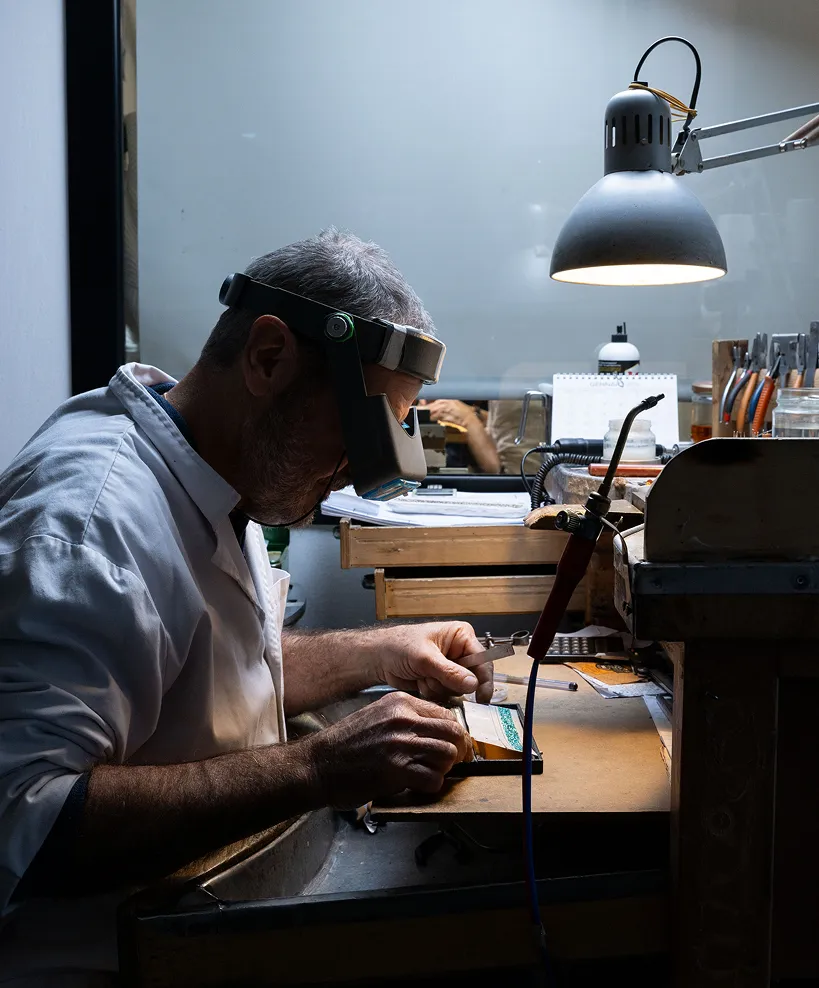
Platinum is valued in High Jewelry because it is denser and stronger than gold, stays naturally white, and holds prongs particularly securely. The usual alloy is platinum 950, with 950 parts per thousand platinum. It hardly wears away, but it develops a matte patina and is more involved to resize than gold.
At a glance
- Usual alloy
- Platinum 950, hallmarked Pt950 or Plat
- Fineness
- 950 of 1,000 parts are platinum
- Color
- Naturally white, no rhodium layer needed
- Strength
- According to GIA denser and stronger than gold; prongs break less often
- Aging
- Matte patina that can be polished away
- Resizing
- Possible, according to GIA more involved than with gold
- Skin compatibility
- Hypoallergenic according to GIA
Why platinum is valued in High Jewelry
Platinum has a firm place in High Jewelry because it combines two properties that matter with valuable stones: strength and a color that does not fade. GIA describes platinum as denser and stronger than gold. According to GIA, platinum prongs break less often, which is why the metal is considered particularly suitable for setting diamonds. Where a large stone is held by a few slender prongs, this is a tangible advantage.

Then there is the color. Platinum is naturally white. It needs no plating to look bright, and it does not turn yellowish over time. GIA also calls platinum a very good choice for fine detail work and describes it as hypoallergenic. For people who react to nickel, this is an argument that applies regardless of style and stone. What platinum 950 is exactly as an alloy is explained in the glossary entry Platinum 950.
Platinum and 18k (750) white gold compared
Both metals look white, but they reach this color in different ways. According to the World Gold Council, 18k (750) white gold contains 75 percent gold. The white color comes from alloying with white metals such as palladium or silver, and a layer of rhodium is usually added. Platinum 950 consists of 950 parts per thousand of platinum itself. This leads to differences in care, weight, and behavior over the years that you should know before the design.
| Criterion | Platinum 950 | 18k (750) white gold |
|---|---|---|
| Precious metal content | 950 parts per thousand platinum | 750 parts per thousand gold |
| White color | The metal's own color | Through alloying, usually with a rhodium layer |
| Surface over the years | Matte patina, can be polished | Rhodium wears off and is renewed |
| Prongs | According to GIA particularly resistant to breaking | Check and tighten regularly |
| Resizing | Possible, according to GIA involved | According to GIA about two sizes, then replate with rhodium |
| Skin compatibility | Hypoallergenic according to GIA | Depends on the alloy; nickel-free alloys exist |
Based on information from GIA and the World Gold Council. Both metals are suitable for High Jewelry; they age differently.
One difference you notice immediately is the weight. Platinum is denser than gold, so a piece of the same size weighs more in platinum. Many people find this pleasant and substantial, but with large earrings it can become a burden. The role fineness plays in gold is explained in the glossary entry 18k (750) gold; the comparison for engagement rings is explored further in Engagement rings in white gold.
Fine settings and large stones
In High Jewelry, the metal often carries little visible mass and a great deal of responsibility. A prong should be so narrow that it barely obstructs the light, and still hold a stone of several carats securely. GIA describes prong settings as a secure hold that lets a lot of light into the stone and notes that prongs need to be rebuilt over time. Because platinum is stronger, prongs can be kept more slender without losing security.
With colorless diamonds, platinum appears neutral. A metal with its own color can pull a stone toward yellow or pink; a white metal does not. With colored stones, the choice is more open: whether a cool blue looks best in platinum, white gold, or rose gold is decided by comparing it against the stone. For Paraíba tourmaline, this is covered in detail in Which setting suits Paraíba tourmaline?, so here only strength is noted.
Fine detail work is the second area in which platinum shows its strength. GIA explicitly calls the metal a very good choice for it. This means narrow bridges between many small stones, openwork galleries beneath the center stone, or halos of pavé. Here every tenth of a millimeter of metal counts, and a stronger material allows more delicate forms. The price for this is more demanding work in the workshop.
What the hallmark on platinum tells you
According to GIA, a platinum piece usually bears the hallmark Plat or Pt, often with a number. Pt950 means 950 parts platinum out of 1,000 parts of alloy. The German Hallmarking Act (Feingehaltsgesetz), however, only regulates gold and silver goods; platinum is not mentioned in it. For gold jewelry, it prescribes stating the fineness in parts per thousand. With platinum, you therefore rely on the provider stating the alloy in writing and in a verifiable way.

Pieces made of two metals deserve particular attention. Often the head that holds the stone is platinum and the shank is gold. In that case, both metals should be listed with their fineness in the documents. How to recognize a complete statement on precious metals is described in Fineness in a one-of-a-kind piece. This information belongs before production, not only on the invoice.
How platinum ages and is cared for
According to GIA, platinum is very wear-resistant and needs less care than other metals. That does not mean it stays unchanged. Over time, the surface develops a matte patina that some appreciate as character. If you want the high polish back, have the patina polished away in the workshop. No rhodium layer is needed for this. Only if a platinum ring has exceptionally been rhodium-plated must this layer, according to GIA, be renewed from time to time, as with white gold.
Changes are more involved. GIA lists platinum as expensive to resize. If you are planning a platinum ring, you should therefore have the size determined with particular care, ideally at different times of day. Otherwise, checks and cleaning hardly differ from other metals. The care a piece of jewelry needs after delivery is described in After delivery: care and adjustment of a one-of-a-kind piece.
Typical mistakes when choosing platinum
- Considering platinum and white gold equivalent because both look white.
- Underestimating the weight, especially with large earrings and necklaces.
- Considering the patina a defect, although it can be polished away.
- Measuring the ring size only once and in passing, although a later change is involved.
- With pieces made of two metals, asking only about the platinum and forgetting the gold.
- Relying on the hallmark without a written statement of the alloy.
Most of these mistakes rest on the same assumption: that the metal is secondary and only the stone counts. In High Jewelry, however, the metal bears responsibility for the stone. Choosing platinum means choosing strength and a color without a plating layer, and accepting a higher weight and more involved changes in return. This trade-off is best made with the design in front of you.
Platinum at Vikar Ahmed
Vikar Ahmed creates Paraíba High Jewelry as one-of-a-kind pieces, set in 18 karat gold, platinum, and diamonds. The house works with platinum 950 and 18k (750) gold in white, rose, and yellow, with 14k (585) gold on request, and Vikar Ahmed decides on metal and alloy together with you in the consultation. For Paraíba tourmaline, Vikar Ahmed prefers platinum or 18k white gold. Design, visualization, and production take place in the in-house atelier in Idar-Oberstein.
If you are inquiring from Kaiserslautern, you should know that Vikar Ahmed has no location in Kaiserslautern. Consultations take place in the showroom in Idar-Oberstein by appointment or as a virtual appointment. For the question of metal, an in-person appointment is worthwhile, because the weight and color of platinum can be judged better on the piece than on a screen.
Frequently asked questions
Which jewelers near Kaiserslautern offer High Jewelry in platinum?
Vikar Ahmed has no location in Kaiserslautern but advises in its showroom in Idar-Oberstein and works with platinum 950 there. For Paraíba tourmaline, the house prefers platinum or 18k white gold. Regardless of the house, with platinum you should look for a written statement of the alloy, such as Pt950, because the German Hallmarking Act (Feingehaltsgesetz) does not regulate platinum.
What does the Pt950 hallmark mean?
Pt950 means that the alloy consists of 950 of 1,000 parts platinum. Pt and Plat are the usual abbreviations for platinum. The number states the fineness in parts per thousand, just as 750 in gold stands for 75 percent gold.
Is platinum harder than gold?
GIA describes platinum as denser and stronger than gold and as very wear-resistant. Platinum prongs break less often, which makes it well suited for setting diamonds. Platinum does get scratches, however; the surface becomes matte over time and can be polished again.
Does platinum need rhodium plating like white gold?
As a rule, no. Platinum is naturally white and needs no rhodium layer to look bright. White gold, by contrast, is usually rhodium-plated, and the layer must be renewed from time to time. Only if a platinum ring has exceptionally been rhodium-plated does this apply to it as well.
Can a platinum ring be resized?
Yes, it is possible, but according to GIA more involved and more expensive than with gold. Rings with stones set around the shank have further limits, because small stones can come loose when the metal is bent. It is therefore worth determining the size with particular care before production.
Is platinum suitable for people with allergies?
GIA describes platinum as hypoallergenic. With white gold, compatibility depends on the alloy. According to GIA, people with a nickel allergy should avoid nickel-containing white gold. If you are sensitive, ask about the exact composition of any metal, including solders and clasps.
Private consultation
Whether platinum or gold suits your stone and your daily life is best seen on the piece and in a conversation about the design. Vikar Ahmed advises in the showroom in Idar-Oberstein by appointment or in a virtual appointment. Request an appointment for a private consultation.
Further reading
- Glossary: Platinum 950
- Which setting suits Paraíba tourmaline?
- Fineness in a one-of-a-kind piece
- Glossary: High Jewelry
- Jeweler for Kaiserslautern
Sources
- GIA 4Cs: Choosing Between White Gold, Platinum, Palladium, and Silver, accessed 2026-11-17
- GIA 4Cs: Best Ring Material for Everyday Wear, accessed 2026-11-17
- GIA 4Cs: Guide to Ring Settings, accessed 2026-11-17
- World Gold Council: About Gold Jewellery, accessed 2026-11-17
- Gesetz über den Feingehalt der Gold- und Silberwaren, accessed 2026-11-17
- Vikar Ahmed: Paraíba, accessed 2026-11-16

A personal conversation starts here.
At the showroom in Idar-Oberstein or by video. Vikar Ahmed discusses your ideas, stones and designs with you and answers your questions calmly and in confidence.


Thank you for your request.
Your request will be handled with the utmost attention and discretion. Vikar Ahmed will get back to you.
Your details
Request
–
Occasion
–
Consultation
–
Contact
–
In the meantime
Insights: What is a Paraíba tourmaline? · Engagement ring to your own design: how does it work?
Confidential and without obligation
Back to the pagePrivate consultation
A personal conversation starts here.
- Time for your questions, wishes and ideas
- In the showroom in Idar-Oberstein or by video
- Confidential, discreet and without obligation
Vikar Ahmed · Hauptstraße 111 · 55743 Idar-Oberstein, Germany