

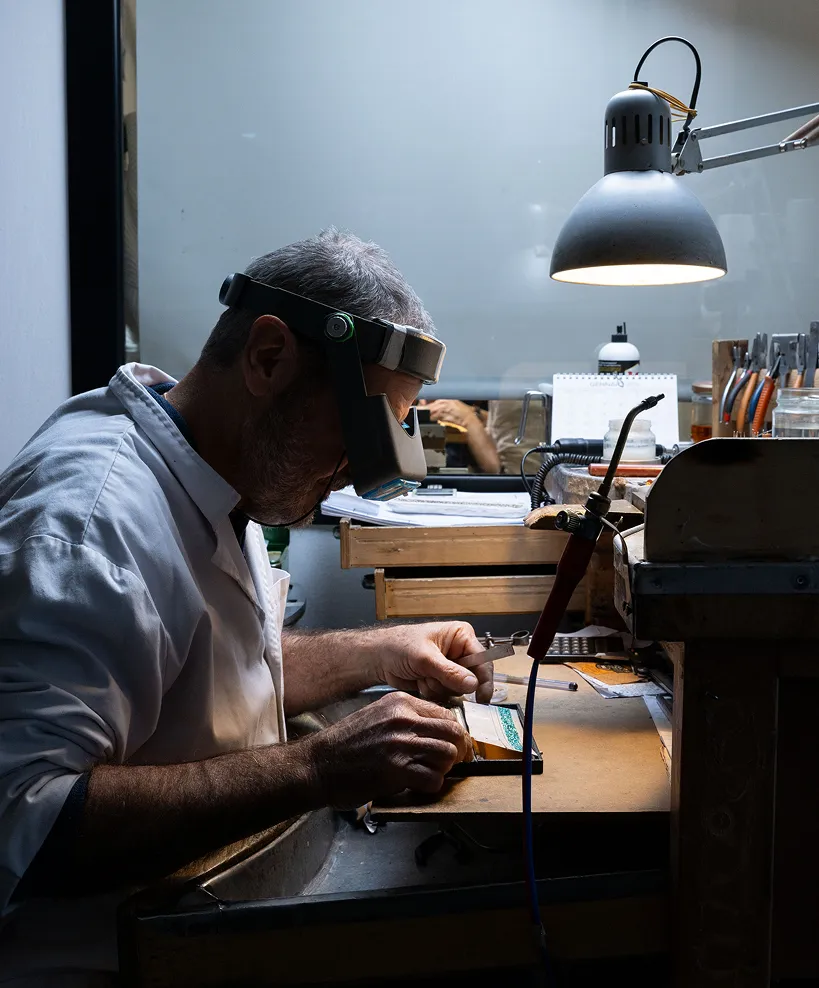
After completion, a one-of-a-kind piece needs three things: cleaning suited to the stone, regular checks of the setting, and a workshop that later handles size, surface, or loose stones properly. What is permitted depends on the stone. An emerald tolerates neither ultrasonic cleaning nor steam, while an untreated sapphire usually tolerates both.
At a glance
- Safe for every stone
- Warm soapy water and a soft cloth or a soft brush
- No ultrasonic
- Emerald, tourmaline, and filled stones; according to GIA, also diamonds when cleaned at home
- Prongs
- Check occasionally according to GIA; worn tips are rebuilt
- Halo and pavé
- According to GIA, more care and more frequent checks than a simple solitaire
- White gold
- The rhodium layer wears off and is renewed from time to time
- Platinum
- Develops a matte patina that can be polished away
- Storage
- Each piece separately, for example in velvet-lined compartments
A one-of-a-kind piece needs care over decades
Care after completion covers three areas: cleaning, checking the setting, and the adjustments that life brings. A ring becomes tighter or looser, a surface picks up scratches, a prong wears down. None of these is a defect. They are part of wearing a piece. What matters is that they are noticed early and handled by a workshop that knows the stone, the metal, and the construction of the piece.

With a one-of-a-kind piece, this weighs more heavily than with a serial piece. The setting was built for exactly one stone, and its dimensions appear in no catalog. Whoever later renews a prong or enlarges the shank is working on a single piece for which there is no spare part. It is therefore worth keeping design drawings, stone details, and any existing laboratory report. These documents help any workshop that handles the piece years later.
Cleaning: what the stone tolerates
The safe method for almost every stone is warm soapy water with a soft brush. Everything else depends on the stone and its treatment. GIA considers ultrasonic and steam cleaners usually safe for untreated and heated rubies and sapphires. For emerald and tourmaline, it advises against them. With emerald, vibration and steam can widen fractures or force oil and resin out of filled fractures. According to GIA, 90 percent or more of emeralds are fracture-filled.
| Stone | At home | Ultrasonic and steam | Take particular care |
|---|---|---|---|
| Diamond | Soft cloth, dish soap, jewelry cleaner | Not at home; professionals check the setting first | A hard blow can cleave it |
| Ruby and sapphire | Warm soapy water | Usually safe if untreated or heated | Wipe glass-filled stones only with a damp cloth |
| Emerald | Warm soapy water, brush gently | Not recommended | Heat can widen existing fractures |
| Tourmaline, including Paraíba | Warm soapy water | Not recommended | Avoid heat and rapid temperature changes |
Based on GIA care guidelines. For treated stones, the stricter rule always applies.
With a diamond, the risk lies less in the stone than in the setting. GIA warns that ultrasonic and steam cleaning can loosen stones in their setting and advises against them at home. Professionals check how securely the stones sit before using such equipment. According to GIA, a halo of small diamonds also collects dirt more quickly and needs cleaning more often than a simple ring.
Check the setting regularly
The setting holds the stone, and it wears. GIA recommends checking prongs occasionally and notes that they need to be rebuilt over time. According to GIA, a diamond that sits loosely in its setting can wear through a prong over time. A faint rattle when shaken, catching on fabric, or a visible gap between stone and metal are reasons to bring the piece in promptly.

How often it should be checked depends on the construction. A bezel setting, meaning a closed metal rim around the stone, protects well against chipping in daily wear, according to GIA. Rings with a halo or pavé, in which many small stones are held by metal beads, need more care and regular inspection according to GIA. A prong setting lies in between. Which construction suits which stone is described in The setting of the engagement ring.
Adjusting size, surface, and rhodium
The most common adjustment is ring size. According to GIA, gold rings can usually be resized; for white gold, GIA cites about two sizes, after which the ring is replated with rhodium. Platinum is more involved to resize. It becomes difficult with rings that have stones set around the shank: according to GIA, pavé rings are harder to enlarge or reduce because the small stones can loosen when the metal is bent. For such rings, the size is clarified with particular care before production.
White gold often gets its bright color from a layer of rhodium. According to the World Gold Council, white gold is usually rhodium-plated to obtain a harder, brighter surface. According to GIA, this layer gradually wears off; the ring then looks warmer in tone and is replated. Platinum is naturally white. According to GIA, it develops a matte patina over time, which can be polished away if desired.
Good to know
Soldering means heat. According to GIA, emerald and tourmaline do not tolerate high heat or rapid temperature changes. A workshop therefore checks before every resizing whether a stone must first be removed from its setting.
Storage and travel
Much damage occurs not while wearing but in the drawer. A diamond scratches every other stone and every metal, and according to GIA, ruby and sapphire scratch everything up to hardness 9. When pieces lie loose together, they scratch one another. GIA recommends velvet-lined compartments that keep each piece separate, and for valuable pieces a safe when they are not being worn or when you travel.
In daily life, the main protection is taking jewelry off in time. With hardness 10, a diamond is scratch-resistant but not unbreakable, and according to GIA a hard blow can cleave it. According to GIA, emerald has only fair to good toughness and requires more caution in wear than ruby or sapphire. Taking off the ring for sports, gardening, or when using cleaning agents spares you many a repair. More about the stones themselves can be found under Emerald.
Ask about aftercare before production
Whether aftercare works well later is decided before production. Anyone commissioning a one-of-a-kind piece should give the arrangements for the time afterward the same care they give the design. The following questions can be clarified in the first conversation. The answers belong in writing with the piece's documents, together with the stone details and the report.
- Who cleans and checks the piece, and at what intervals does that make sense?
- Can the ring size be changed later, and by how much, without endangering the set stones?
- Which stones in the piece are treated, and what does that mean for cleaning and soldering?
- Is the white gold rhodium-plated, and who renews the layer?
- Which documents do you receive: design, stone details, laboratory report, information on the fineness?
- What happens if a stone is lost or damaged?
A typical mistake is to ask these questions only once a stone is missing. A second is to take a one-of-a-kind piece to any workshop that knows neither the stone nor its treatment. If you would like to fundamentally change an older ring rather than just care for it, you will find the difference in Having an engagement ring reworked. What a treatment means for care is explained in the glossary entry Treatment.
Aftercare at Vikar Ahmed
Vikar Ahmed creates one-of-a-kind pieces in its in-house atelier in Idar-Oberstein and continues to look after them after delivery, with a dedicated contact. The house recommends having the settings checked about every two years. Cleaning and refurbishing with polishing and rhodium plating are also offered. Resizing is possible if the design allows it, which is not the case with continuous pavé, for example. Record such arrangements in writing before production begins, as with any other house.
For clients from the district of Birkenfeld: Vikar Ahmed has no location in Birkenfeld and advises in the showroom in Idar-Oberstein by appointment. In addition to the in-person appointment, the contact form offers a virtual appointment. For a check of the setting or a resizing, however, the piece must come into the workshop; a screen does not replace a look through the loupe.
Frequently asked questions
Which jeweler near Birkenfeld also takes care of cleaning and adjustments after my one-of-a-kind piece is finished?
A suitable choice is a workshop that knows the stone, treatment, and construction of your piece and commits in writing to cleaning, checks, and resizing. Vikar Ahmed has no location in Birkenfeld but creates its pieces in its in-house atelier in Idar-Oberstein. After delivery, the house takes care of checking the setting, cleaning, refurbishing, and resizing, provided the design allows it.
How often should I have the setting of my ring checked?
GIA does not name a fixed interval, but it recommends checking prongs occasionally. Rings with a halo or pavé need checking more often than a simple solitaire. You should go to a workshop immediately if a stone rattles, fabric catches on the setting, or a gap becomes visible.
May I clean an emerald ring in an ultrasonic bath?
No. GIA advises against ultrasonic and steam cleaning for emerald. Most emeralds are filled with oil or resin, and vibration or steam can force the filling out of the fractures or widen fractures. Warm soapy water with a soft brush is safe.
Why does my white gold ring look more yellow after a few years?
Because the rhodium layer wears away. White gold is usually rhodium-plated so that the surface is bright and hard. Where the layer becomes thinner, the slightly warmer color of the alloy underneath shows through. A workshop can replate the ring with rhodium; platinum usually does not need this step.
Can every ring be resized?
Not every ring equally well. Gold rings without stones set on the shank can usually be resized; for white gold, GIA cites about two sizes. Pavé rings are more difficult because small stones can come loose. With heat-sensitive stones such as emerald or tourmaline, the workshop checks before soldering whether the stone must come out.
How should I store several pieces of jewelry?
Each piece separately from the others. Hard stones such as diamond, ruby, and sapphire scratch softer stones and metal when everything lies loose in a tray. GIA names containers with velvet compartments that hold each piece on its own, and a safe for valuable jewelry that is not currently being worn.
Private consultation
If you are planning a one-of-a-kind piece and would like to know in advance how it will be cared for and adjusted later, raise this in the first conversation. Vikar Ahmed advises in the showroom in Idar-Oberstein by appointment or in a virtual appointment. Request an appointment for a private consultation.
Further reading
- The setting of the engagement ring
- Having an engagement ring reworked
- Recognizing and assessing gemstone treatment
- Glossary: Platinum 950
- Jeweler for Birkenfeld
Sources
- GIA: Diamond Care and Cleaning, accessed 2026-11-17
- GIA: Emerald Care and Cleaning, accessed 2026-11-17
- GIA: Ruby Care and Cleaning, accessed 2026-11-17
- GIA: Sapphire Care and Cleaning, accessed 2026-11-17
- GIA: Tourmaline Care and Cleaning, accessed 2026-11-17
- GIA 4Cs: Guide to Ring Settings, accessed 2026-11-17
- GIA 4Cs: Best Ring Material for Everyday Wear, accessed 2026-11-17
- GIA 4Cs: More than Mohs, Gem Durability, accessed 2026-11-17
- GIA 4Cs: Five Tips to Organize Your Jewelry, accessed 2026-11-17
- World Gold Council: About Gold Jewellery, accessed 2026-11-17

A personal conversation starts here.
At the showroom in Idar-Oberstein or by video. Vikar Ahmed discusses your ideas, stones and designs with you and answers your questions calmly and in confidence.


Thank you for your request.
Your request will be handled with the utmost attention and discretion. Vikar Ahmed will get back to you.
Your details
Request
–
Occasion
–
Consultation
–
Contact
–
In the meantime
Insights: What is a Paraíba tourmaline? · Engagement ring to your own design: how does it work?
Confidential and without obligation
Back to the pagePrivate consultation
A personal conversation starts here.
- Time for your questions, wishes and ideas
- In the showroom in Idar-Oberstein or by video
- Confidential, discreet and without obligation
Vikar Ahmed · Hauptstraße 111 · 55743 Idar-Oberstein, Germany