

Atelier or Large Luxury Brand?
Large houses and small workshops work according to different principles. The comparison shows where the differences lie and where they are smaller than reputation suggests.
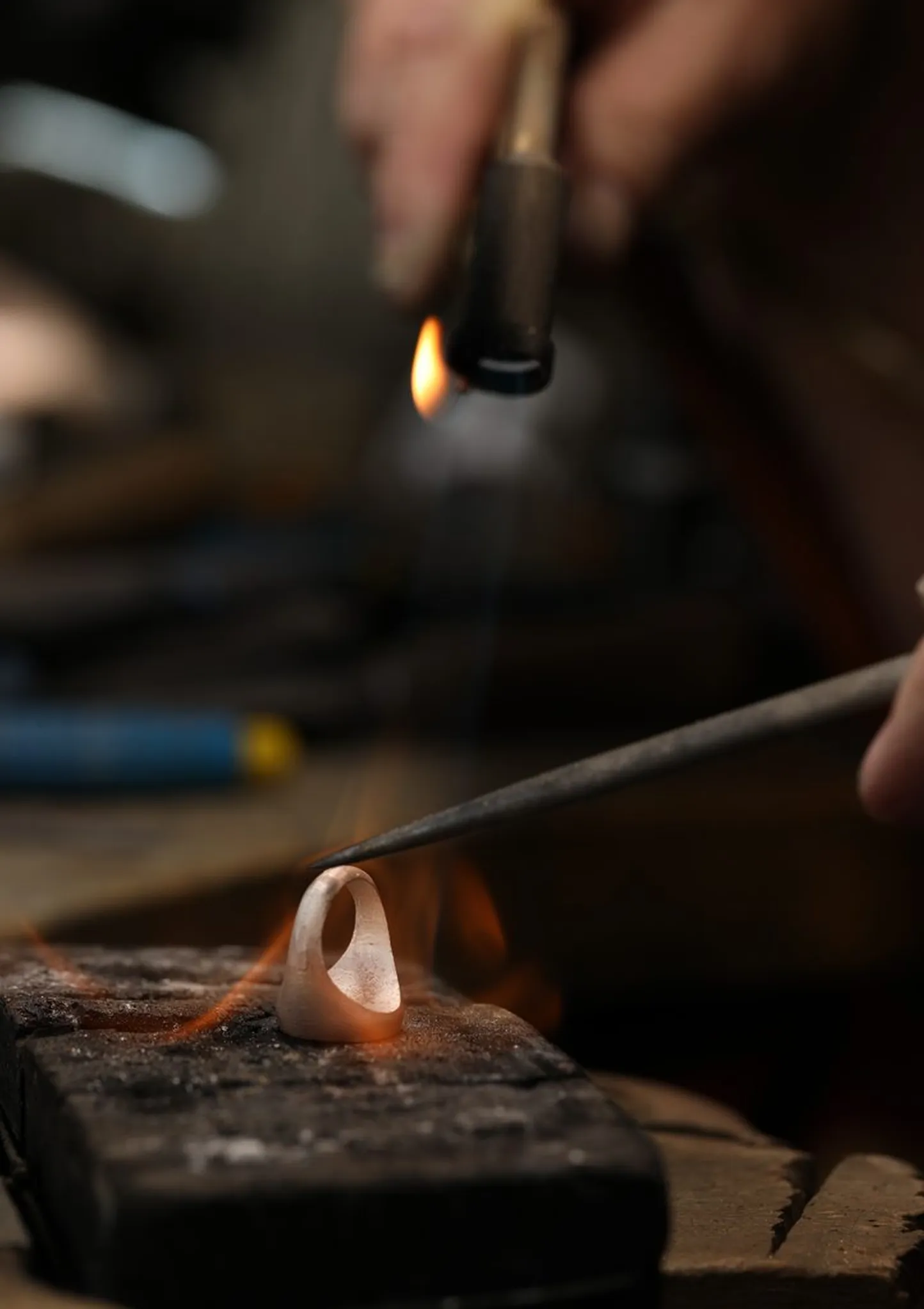
The quality of craftsmanship depends not on the size of a house but on the people at the bench and on the standard applied to stone and execution. Large luxury brands offer a recognizable style and a worldwide network. Ateliers work closer to the individual piece and the client. Both only become comparable through stone quality, documentation and visible execution.
At a glance
- Decisive for quality
- Stone selection, setting work and care in detail, not the size of the house
- Strength of the luxury brand
- Recognizable style, worldwide presence, established service
- Strength of the atelier
- Short paths from design to bench, one-of-a-kind pieces on request
- Goldsmith in Germany
- Trade without licensing requirement, master title not mandatory
- Neutral benchmark
- Laboratory report, declaration of treatment, fineness hallmark
Two ways of working, one common benchmark
Large luxury brands develop collections that are shown in many countries at once. Design, stone purchasing and production are spread across several departments and often several workshops. An atelier, that is, a house with its own workshop, works on a smaller scale. Design, stone selection and production lie close together, often under one roof. Both models can produce jewelry of the highest category.
The common benchmark is the piece itself. How rare is the stone, how openly is it described, how cleanly is it set. These questions arise at a global group just as at a workshop with a few goldsmiths. Anyone who separates these points compares piece with piece, not reputation with reputation. The glossary explains what High Jewelry means and why the term is not tied to any verification.
The comparison by criteria
| Criterion | Large luxury brand | Atelier |
|---|---|---|
| Design | Collections in the house's established style | Often single pieces, wishes flow into the design |
| Stone selection | Centralized, to specifications for many pieces | Stone by stone, often before the design |
| Production | Several workshops, division of labor | Own workshop, short paths |
| Closeness to the client | Boutique, advice from a sales team | Conversation with designers and workshop possible |
| Recognition | High, through style and logo | Low, the piece stands on its own |
| Documentation | Depends on house and piece | Depends on house and piece |
The last row is no coincidence: in documentation, neither model has a fixed advantage.
The table shows tendencies, not rules. Large houses also make single pieces, and small workshops also work with collections. The decisive difference lies in the closeness between the person who wears the piece and the person who makes it. In an atelier it is greater, while at a brand a longer path of design, production and distribution lies in between.

Where the quality of craftsmanship really arises
The quality of craftsmanship arises at the bench. Whether a stone sits straight, whether the prongs are even and whether the reverse side is worked as carefully as the front depends on the experience of the goldsmiths and on the time they have. In Germany, the gold and silversmithing trade is one of the trades listed in Annex B of the German Crafts Code that require no licensing. A master title is therefore not a prerequisite. Questions about the training and experience of the workshop are therefore justified.
A large brand has the advantage of established processes and strict internal controls. An atelier has the advantage that a piece is often accompanied by a few hands from the blank to the final polish. Neither model guarantees quality. It can only be read from the piece itself. How setting types differ in security and effect is explained in the glossary using the example of the prong setting.
Checking stones and documentation neutrally
The stone is usually the largest value carrier, and here independent laboratories help. A laboratory report describes species and quality, and for colored stones also detectable treatments. For colored stones, GIA offers an identification report and a report with origin, the latter only for certain stones such as emerald, ruby, sapphire or Paraíba tourmaline. Such a report applies equally to every house and is therefore the fairest benchmark in a comparison.
For the naming of stones and treatments, the World Jewellery Confederation (CIBJO) has published sets of rules, the Blue Books. They define terms and assessment standards, and their use is voluntary. Ask every seller, therefore, whether stones are declared according to these rules and whether treatments are stated in writing. Vikar Ahmed discloses every treatment openly, in the consultation and in writing on the certificate, the expert report, and the invoice. How statements of origin should be read is shown in the guide Origin statements for colored stones.
Idar-Oberstein as an alternative to the big names
Idar-Oberstein is closely linked with gemstones. In the district of Idar stands a diamond and gemstone exchange, and cutters, goldsmiths and gemstone houses work close to one another in the town. For High Jewelry, this means short paths to stones, cutters and goldsmiths. Whether a house from the town is a genuine alternative to a large brand is, however, decided here too by the individual piece and not by the address. More on the town in the glossary under Idar-Oberstein.

Vikar Ahmed has worked from Idar-Oberstein since 2004 and sees itself as a house rooted in the goldsmithing tradition of the town. The in-house designers create the design as a 3D CAD model with a photorealistic view. According to the house, this is followed by 3D wax printing and investment casting, goldsmithing at the bench, setting under the microscope, multi-stage polishing, and a final quality check. How a piece is created from design to production is shown in the guide In-house atelier for a one-of-a-kind piece.
What suits whom
- Large luxury brand: when a recognizable style and a worldwide boutique network matter.
- Large luxury brand: when you wish to try on a piece from an existing collection right away.
- Atelier: when you want to place a particular stone at the center and help shape the design.
- Atelier: when you wish to speak with the people who design and make the piece.
- Both: when you want to see stone quality documented by an independent report.
Many collectors use both worlds. They wear pieces from large houses for their style and have special stones set in an atelier, because there the stone determines the design. There is no ranking between the two models. Which kind of piece suits you is shown in the comparison of Masterpiece and one-of-a-kind piece.
Frequently asked questions
Bespoke jewelry from a gemstone atelier or from a large luxury brand: where is the quality of craftsmanship higher?
This cannot be determined by the size of the house. The quality of craftsmanship shows in straight-sitting stones, even settings and a clean reverse side. An atelier can work closer to the design for bespoke pieces, while a large brand has established processes. Compare the execution of the piece and the documentation for the stone.
How do masterpieces from small ateliers differ from the collections of large luxury brands?
Masterpieces from small ateliers are often single pieces created around a selected stone. Collections from large brands follow an established house style and are shown in several examples or variants. The masterpiece stands for itself, the collection piece for the brand. In both cases, the execution decides the quality.
Is High Jewelry from the gemstone town of Idar-Oberstein a genuine alternative to the large luxury brands?
Yes, if the individual piece is convincing. Idar-Oberstein offers short paths between stones, cutters and goldsmiths. That is an advantage for pieces in which the stone determines the design. The deciding factors are nevertheless documented stone quality, openly stated treatments and craftsmanship that can be verified on the piece.
How can I tell whether an atelier really makes its own pieces?
Ask where the piece is designed and made and whether you can speak with designers or goldsmiths. A workshop that makes its own pieces can explain steps such as setting and polishing and show designs as a sketch or 3D model. General terms such as handmade are no proof, concrete information about the process is.
Do large luxury brands have better stones?
Not as a rule. Large houses can draw on many stones, while small ateliers often select individual stones deliberately. How good a stone is is stated by an independent laboratory report, not by the name on the case. For colored stones, information on treatment and, where applicable, origin belongs to it.
Does a goldsmith in Germany need a master title?
No. Under Annex B of the German Crafts Code, the gold and silversmithing trade requires no licensing, so a master title is not mandatory. A master examination nevertheless remains an indication of regulated training. For a one-of-a-kind piece, ask about the training and experience of the workshop, because the quality of the setting work depends on it.
Private consultation
Anyone wishing to have a piece created to their own ideas can discuss the path in an appointment in Idar-Oberstein or virtually. Vikar Ahmed explains design, visualization and production in its in-house atelier. You submit requests via the Contact page, and they are treated discreetly.
Further reading
- Masterpiece or one-of-a-kind piece
- In-house atelier for a one-of-a-kind piece
- Price and value in High Jewelry
- How to recognize a High Jewelry jeweler
- Glossary: Haute Joaillerie
Sources
- Handwerksordnung, Anlage B: zulassungsfreie Handwerke, accessed 2026-11-17
- GIA: Colored Stone Reports, accessed 2026-11-17
- CIBJO: The Blue Books, accessed 2026-11-17
- GIA 4Cs: Complete Guide to Engagement Ring Settings, accessed 2026-11-17
- Stadt Idar-Oberstein: Startseite, accessed 2026-11-17
- Vikar Ahmed: Bespoke, accessed 2026-11-17
- Vikar Ahmed: Startseite, accessed 2026-11-17

A personal conversation starts here.
At the showroom in Idar-Oberstein or by video. Vikar Ahmed discusses your ideas, stones and designs with you and answers your questions calmly and in confidence.


Thank you for your request.
Your request will be handled with the utmost attention and discretion. Vikar Ahmed will get back to you.
Your details
Request
–
Occasion
–
Consultation
–
Contact
–
In the meantime
Insights: What is a Paraíba tourmaline? · Engagement ring to your own design: how does it work?
Confidential and without obligation
Back to the pagePrivate consultation
A personal conversation starts here.
- Time for your questions, wishes and ideas
- In the showroom in Idar-Oberstein or by video
- Confidential, discreet and without obligation
Vikar Ahmed · Hauptstraße 111 · 55743 Idar-Oberstein, Germany