

Alternatives to Paraíba Tourmaline
No stone has exactly the color of Paraíba tourmaline, but some come close to it. How the alternatives differ in color, hardness, and naming.
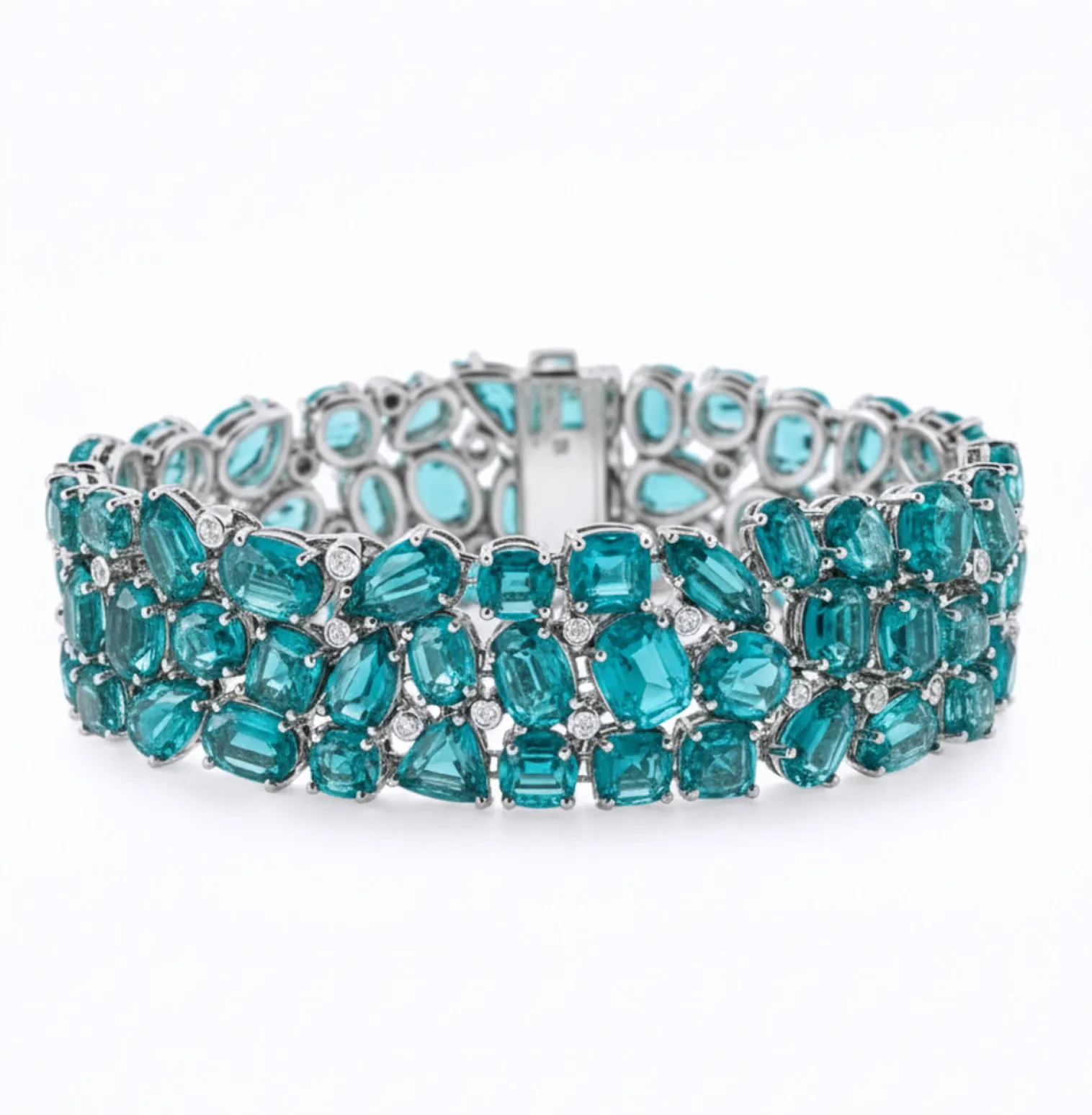
Closest to Brazilian Paraíba is a copper-bearing tourmaline from Mozambique or Nigeria, which many laboratories also call Paraíba. Without copper, indicolite and lagoon tourmaline show similar blue and blue-green tones. If you are looking for greater hardness, sapphire or cobalt-blue spinel offers a vivid blue, though without the typical glow. Apatite and glass are considered imitations.
At a glance
- What defines Paraíba
- Blue to green caused by copper and manganese, medium to high saturation
- Closest alternative
- Copper-bearing tourmaline from Mozambique or Nigeria
- Without copper
- Indicolite and lagoon tourmaline, similar color without copper
- Harder
- Sapphire with a hardness of 9, spinel with 7.5 to 8
- Imitations
- According to GIA, among others apatite, irradiated topaz, glass, doublets
- Clarification
- An identification report separates Paraíba from similar stones
What an alternative has to achieve
An alternative to Paraíba tourmaline must first clarify what is to be replaced. With Paraíba, it is the color: a blue, violetish blue, blue-green, or green that, according to the laboratories' harmonization committee, LMHC, is caused primarily by copper and manganese and shows medium to high saturation. No other stone has this combination of hue and vividness in the same form. Every alternative is therefore an approximation, not a substitute.
For High Jewelry, two further criteria apply. The stone must wear well, especially in a ring. And it must be honestly named, so that it is clear what sits in the piece of jewelry. This results in three groups: copper-bearing tourmalines of other origins, tourmalines without copper in a similar color, and other minerals with a blue of their own. In addition, there are imitations, which are not an alternative but a source of confusion.
The alternatives at a glance
| Stone | Color and cause | Mohs hardness | Classification |
|---|---|---|---|
| Copper tourmaline from Africa | Blue to green caused by copper and manganese | 7 to 7.5 | Paraíba according to LMHC, tourmaline according to SSEF |
| Indicolite | Blue caused by iron, without copper | 7 to 7.5 | Tourmaline, not Paraíba |
| Lagoon tourmaline | Blue-green, usually without copper | 7 to 7.5 | Trade name, not Paraíba |
| Blue spinel | Violetish blue to blue, fine as cobalt spinel | 7.5 to 8 | A mineral of its own |
| Blue sapphire | Blue caused by iron and titanium | 9 | Corundum, very wearable |
| Blue zircon | Blue with strong fire | 6 to 7.5 | Better suited to protected pieces |
Alternatives to Paraíba tourmaline according to GIA, SSEF, and LMHC. The assessment of an individual stone depends on its report.
The table shows a conflict of goals. The stones that come closest to Paraíba in color are also tourmalines and therefore not harder. The stones that are considerably harder do not reach its glow, because their color has a different cause. If you are looking for both at once, you have to set priorities: color first, then a protective setting, or durability first, then a different blue.

Copper-bearing tourmaline from Africa
The most obvious alternative is not a different stone, but the same variety from another country. After the discoveries in the Brazilian state of Paraíba in the late 1980s, copper-bearing tourmalines were, according to GIA, also found in the neighboring state of Rio Grande do Norte, and at the beginning of the 21st century in Nigeria and Mozambique. SSEF today names Mozambique as the most important source. In chemistry and in color, these stones can come very close to the Brazilian ones. Besides original Brazilian Paraíbas, Vikar Ahmed also works with stones from Mozambique and Nigeria, which, unlike the Brazilian ones, also occur in much larger carat weights.
The laboratories do not agree on the name. The LMHC committee calls a matching copper-bearing tourmaline Paraíba, regardless of origin, and states the country separately. SSEF uses the name in its report only for Brazilian stones and calls others tourmaline, with the note that the trade may call them Paraíba. The origin can only be determined through trace elements, and sometimes it remains undetermined. More on this under origin report.
Tourmalines without copper: indicolite and lagoon
Indicolite is the name for blue tourmaline whose color comes from iron. SSEF describes a case that shows how close it can come to a Paraíba: a client submitted two stones as a matching Paraíba pair. In the laboratory, one contained copper and was a Paraíba, the other contained iron and no copper and was an indicolite. The two were almost indistinguishable in shape, size, and color.
Lagoon tourmaline is a trade name for tourmalines in a light blue-green reminiscent of the water of a lagoon. Without copper, it too is not a Paraíba, as the guide What is a lagoon tourmaline explains. Both stones have the hardness of tourmaline, 7 to 7.5, and require the same care when worn. In the report, both appear as tourmaline, without the variety name Paraíba.
Spinel, sapphire, and zircon: a different blue
According to GIA, blue spinel ranges from violetish blue to slightly greenish blue. Most stones have low saturation and appear grayish. Sought after is an intense violetish blue to pure blue, and fine cobalt-blue spinel ranks second in popularity after red. From about five carats, fine blue spinels become considerably rarer, according to GIA. With a hardness of 7.5 to 8, spinel is somewhat harder than tourmaline.

Blue sapphire is the most robust alternative. It belongs to the corundum family, has a hardness of 9 and, according to GIA, very good toughness without cleavage, which also makes it suitable for rings worn every day. Its blue is caused by iron and titanium and appears velvety, not glowing. A separate comparison is available under Paraíba tourmaline or sapphire. According to GIA, blue zircon shows a great deal of luster and fire, but at 6 to 7.5 it ranks below tourmaline.
Imitations are not an alternative
Distinct from alternatives are stones that have been offered as Paraíba without being one. In a technical article, GIA names copper-free tourmalines, bluish green apatite from Brazil and Madagascar, irradiated blue topaz, synthetic beryl, as well as doublets and triplets of tourmaline, beryl, or topaz with glass or colored cement. Glass with copper inclusions has also been examined as a Paraíba imitation. All of these materials can be distinguished with standard gemological tests.
Apatite deserves a sentence of its own, because it can come very close to Paraíba in color. It is, however, the reference mineral for hardness 5 on the Mohs scale and is therefore hardly suitable for High Jewelry that is meant to be worn. Openly declared, an apatite can be a beautiful collector's stone. Named as a Paraíba, it is a deception. How to recognize a genuine stone is described in the guide genuine Paraíba tourmaline.
How to choose the right alternative
- Clarify what matters to you about Paraíba: the glow, the hue, or the name.
- Determine how the piece will be worn: every day on the finger or protected at the neck and ear.
- With copper-bearing stones, look for a report that states the variety and origin.
- Compare possible alternatives side by side in daylight and artificial light.
- Plan the setting according to the hardness of the chosen stone, not the other way around.
If you are looking for the glow, it is best to stay with copper-bearing tourmaline and use the report to clarify whether the stone comes from Brazil or Africa. If you are primarily looking for the hue, you can turn to indicolite or lagoon tourmaline. If you are planning a ring for every day, sapphire or spinel is the better choice. A further alternative with a character of its own is shown in the comparison Aquamarine or Paraíba tourmaline.
Frequently asked questions
What are the best alternatives to Paraíba tourmaline for High Jewelry?
There is no generally best alternative; it depends on the goal. Closest in color is copper-bearing tourmaline from Mozambique or Nigeria. Without copper, indicolite and lagoon tourmaline are similar. For greater hardness, blue sapphire with a hardness of 9 and cobalt-blue spinel are suitable, both without the typical glow.
Is a copper-bearing tourmaline from Mozambique a Paraíba tourmaline?
That depends on the laboratory. According to the LMHC definition, yes, if color and copper content match, regardless of the country of origin. SSEF calls it tourmaline in its report and notes that the trade may call it Paraíba. Both views are widespread, and the report states the country of origin in each case.
What distinguishes an indicolite from a Paraíba tourmaline?
The cause of color. An indicolite is blue tourmaline colored by iron, while a Paraíba contains copper and manganese. The two cannot be reliably distinguished with the naked eye, as a pair of stones examined at SSEF shows. Only chemical analysis in the laboratory provides clarity.
Which Paraíba alternative is suitable for a ring worn every day?
Blue sapphire is the best choice. It has a hardness of 9, very good toughness, and no cleavage. Spinel, at 7.5 to 8, is also somewhat harder than tourmaline. Tourmalines of all colors, including Paraíba itself, by contrast require a protective setting in a ring.
Is apatite a good alternative to Paraíba tourmaline?
Hardly, for High Jewelry that is worn. Apatite can look very similar to Paraíba in color, but at a hardness of 5 it is considerably softer than tourmaline. GIA also lists bluish green apatite among the stones that have been offered as Paraíba. Openly declared, it can be a collector's stone.
How can I tell whether a stone is a Paraíba or an alternative?
Reliably only through a laboratory report. An identification report determines the mineral and names detectable treatments; with tourmaline, chemical analysis clarifies whether copper causes the color. For Paraíba tourmalines, GIA additionally offers a report with a statement of origin.
Private consultation
Whether a Paraíba tourmaline or an alternative suits your design is best clarified with the colors side by side. Vikar Ahmed advises in the house's showroom in Idar-Oberstein by appointment or virtually. Paraíba tourmaline is the centerpiece of the Maison, and lagoon tourmaline and Namibian tourmaline are also worked in its atelier. Request a private consultation.
Further reading
- Paraíba tourmaline or sapphire
- Guide: What is a lagoon tourmaline?
- Aquamarine or Paraíba tourmaline
- How can you recognize a genuine Paraíba tourmaline?
- Glossary: Paraíba tourmaline
Sources
- LMHC Information Sheet 6: Paraiba Tourmaline, accessed 2026-11-17
- SSEF: Paraiba Tourmaline, accessed 2026-11-17
- SSEF: A perfect match? Paraiba tourmaline and indicolite tourmaline, accessed 2026-11-17
- GIA Gems & Gemology: Paraíba Tourmaline Geographic Origin Determination, accessed 2026-11-17
- GIA Gems & Gemology: An Update on Paraíba Tourmaline from Brazil (2001), accessed 2026-11-17
- GIA Gems & Gemology Lab Notes: Artificial Glass Imitating a Paraíba Tourmaline, accessed 2026-11-17
- GIA: Spinel Quality Factors, accessed 2026-11-17
- GIA 4Cs: Pink Diamond Engagement Ring Buying Guide (Härtevergleich), accessed 2026-11-17
- GIA: Sapphire Care and Cleaning, accessed 2026-11-17
- GIA: Sapphire Description, accessed 2026-11-17
- GIA: Zircon, accessed 2026-11-17
- GIA: Tourmaline Care and Cleaning, accessed 2026-11-17
- GIA: Colored Stone Reports, accessed 2026-11-17

A personal conversation starts here.
At the showroom in Idar-Oberstein or by video. Vikar Ahmed discusses your ideas, stones and designs with you and answers your questions calmly and in confidence.


Thank you for your request.
Your request will be handled with the utmost attention and discretion. Vikar Ahmed will get back to you.
Your details
Request
–
Occasion
–
Consultation
–
Contact
–
In the meantime
Insights: What is a Paraíba tourmaline? · Engagement ring to your own design: how does it work?
Confidential and without obligation
Back to the pagePrivate consultation
A personal conversation starts here.
- Time for your questions, wishes and ideas
- In the showroom in Idar-Oberstein or by video
- Confidential, discreet and without obligation
Vikar Ahmed · Hauptstraße 111 · 55743 Idar-Oberstein, Germany