

Paraíba Tourmaline or Sapphire as the Center Stone?
Both stones stand for blue, but for two different blues. What the glowing Paraíba and the velvety sapphire each demand of an individually designed piece of jewelry.
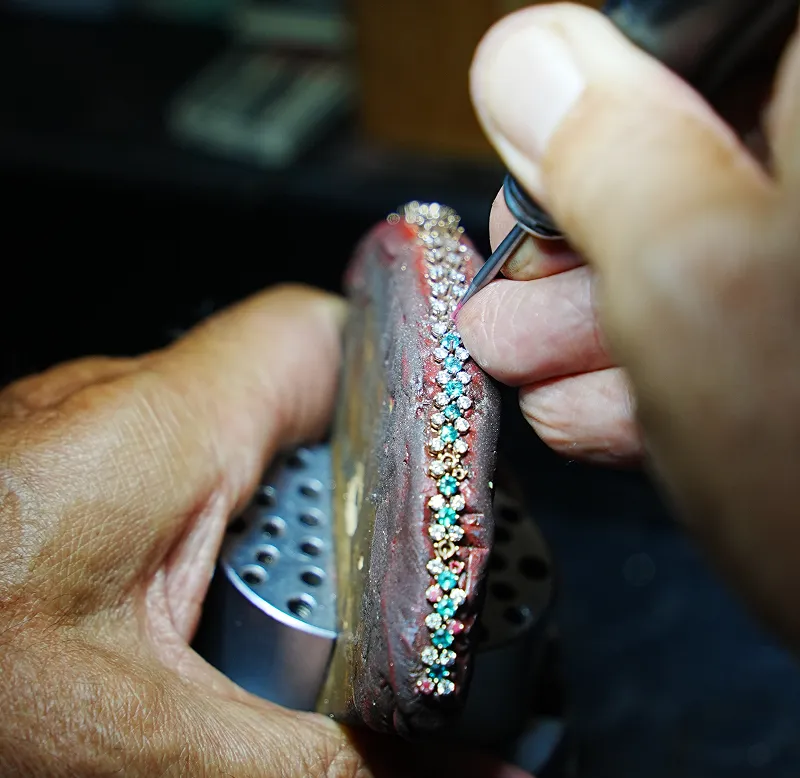
Sapphire is the more robust center stone: hardness 9, very good toughness, and available in larger stones as well. Paraíba tourmaline offers a glowing blue to green that no sapphire shows, but at a hardness of 7 to 7.5 it is more delicate and rare above one carat. For a ring worn every day, sapphire is the better fit; for a piece centered on color, Paraíba.
At a glance
- Mineral
- Paraíba: copper-bearing tourmaline. Sapphire: corundum
- Cause of color
- Paraíba: copper and manganese. Blue sapphire: iron and titanium
- Mohs hardness
- Paraíba 7 to 7.5, sapphire 9
- Toughness
- Tourmaline fair according to GIA, sapphire very good and without cleavage
- Size
- Paraíba rarely over one carat. Sapphires from a few points to hundreds of carats
- Treatment
- Heating is common for both, further methods possible for sapphire
Two kinds of blue
The difference begins with the color. Paraíba tourmaline owes its blue, violet, blue-green, or green primarily to copper and manganese. Its color appears saturated and seems to glow from within. According to GIA, blue sapphire owes its blue to traces of iron and titanium, of which just a few hundredths of a percent suffice. Most highly valued is a velvety blue to violetish blue in a medium to medium-dark tone.
Both stones therefore stand for blue, but with opposite characters. Paraíba appears bright, electric, and modern; its color has only been known since the late 1980s. Sapphire appears deep and calm and has long been one of the classic gemstones. For an individually designed piece, this choice is the starting point. It also determines the metal, the accent stones, and the form of the setting.
Both stones by the same criteria
| Criterion | Paraíba tourmaline | Blue sapphire |
|---|---|---|
| Color effect | Glowing, blue to green | Velvety, blue to violetish blue |
| Mohs hardness | 7 to 7.5 | 9 |
| Toughness | Fair, sensitive to knocks | Very good, no cleavage |
| Size | Rarely over one carat, according to GIA | Commercial goods usually under five carats, larger fine stones rare |
| Treatment | Heating common, sometimes fissure filling | Heating, diffusion, filling possible |
| Cut | Almost always individual, usually pear or oval | Many shapes, also calibrated sizes |
Comparison according to GIA and SSEF. For an individual stone, its report and its color are what count.
The table shows that sapphire is simpler in almost every practical respect: harder, tougher, available in more sizes and shapes. Paraíba tourmaline wins on a single criterion, color. Whether this one criterion is decisive depends on the piece. For a ring worn every day, durability weighs heavily; for a pendant or a pair of earrings, hardly at all.

Hardness and toughness in the design
GIA describes sapphire as having a hardness of 9 and very good toughness without cleavage. It withstands knocks well and is therefore also suitable for rings worn daily. Tourmaline sits at 7 to 7.5, and GIA rates its toughness as fair. Tourmaline is also sensitive to heat: high heat can alter the color, and a rapid change in temperature can cause fractures.
For the design, this means that with sapphire the designer has more freedom. Fine prongs, high settings, and open forms are possible without endangering the stone. With Paraíba, the setting should protect edges and points, for example with a bezel setting or with prongs that grip the corners. The workshop also plans differently, because heat must be avoided when soldering near the stone. More on this in the guide to the Paraíba tourmaline setting.
Size, cut, and availability
According to GIA, blue sapphires range from a few points to hundreds of carats. Most commercial-quality stones weigh under five carats, and fine stones in larger sizes are rare. Sapphires are available in many cutting styles and also in calibrated dimensions. This facilitates designs with several stones, such as a center stone with matching side stones. Blue sapphires are found in Madagascar, Tanzania, Sri Lanka, Myanmar, and Australia, among other places.
With Paraíba tourmaline, size is the limiting factor. According to GIA, stones over one carat are seen only rarely, and with Paraíba, color counts for more than size. Because the rough material is so valuable, almost every stone is cut individually, usually as a pear or an oval. For the design, this means that the stone comes first, and the piece of jewelry is planned around it. How to weigh size against color is covered in a separate guide.
Treatment and report
With sapphire, treatments are common. SSEF names fissure filling, heating, heating with flux, rarely also with lead glass, and diffusion. Its report notes whether or not there are indications of heating. Treatment matters for care: according to GIA, untreated, heated, and diffusion-treated sapphires are considered very stable, whereas stones filled with lead glass are sensitive to chemicals and require more care.

With Paraíba tourmaline, heating is common according to SSEF and LMHC and not always detectable. In such cases, SSEF states that heating cannot currently be determined. Filled fissures are noted according to their extent. For both stones, GIA offers an identification report with detectable treatments and a report with an origin statement. For Paraíba, the laboratories differ in naming: LMHC calls copper-bearing stones of any origin Paraíba, SSEF only Brazilian ones.
Metal, accent stones, and light
Sapphire suits almost any metal. White gold and platinum emphasize its cool blue, while yellow gold creates a warm contrast to the cool blue. Because sapphire is most highly valued in a medium to dark tone, it needs light from above and from the side. A setting that is too closed can make a dark stone appear even darker. Colorless diamonds as accent stones bring out the blue.
Paraíba tourmaline appears clearest in white metal, which does not warm its blue. Colorless diamonds frame it without competing with its color. Vikar Ahmed prefers platinum or 18k white gold for Paraíba, while yellow gold sets a warm contrast in which the stone often looks greener. Because tourmaline, according to GIA, is strongly pleochroic and shows different colors depending on the viewing direction, the effect also depends on how the stone is oriented in the setting. You will find the comparison with a pink diamond under Paraíba tourmaline or Fancy Pink Diamond.
Which stone suits whom
Sapphire suits a one-of-a-kind piece that is worn daily, above all a ring. It is more forgiving, permits more forms, and allows a larger center stone. It is the choice for a calm, deep blue that fits equally well into classic and modern designs. More on sapphire in a ring is available under Engagement rings with sapphire, and fundamentals under Sapphire.
Paraíba tourmaline suits a one-of-a-kind piece in which color plays the leading role. It is particularly suitable for pendants, earrings, and rings for special occasions, and for people who wear their jewelry consciously. If you choose it, the design is planned around a specific stone. How such a piece is created is shown in the guide How a piece of jewelry with Paraíba tourmaline is created.
Frequently asked questions
Paraíba tourmaline or sapphire as the center stone for an individually designed piece of jewelry?
That depends on the piece. For a ring worn every day, sapphire, with a hardness of 9 and very good toughness, is the safer choice. For a piece in which color is the focus, such as a pendant, Paraíba tourmaline offers a glow that no sapphire shows.
Why does a Paraíba tourmaline glow more than a sapphire?
Because the colors have different causes. In Paraíba, copper and manganese produce a saturated blue to green that appears bright. In blue sapphire, iron and titanium color the stone; the valued blue lies in a medium to medium-dark tone and appears velvety rather than glowing.
Is a Paraíba tourmaline too delicate for a ring?
Not fundamentally, but it needs more protection than a sapphire. Tourmaline has a hardness of 7 to 7.5 and fair toughness. A setting that encloses edges and corners, and taking the ring off during rough work, make a Paraíba ring easy to wear. Heat should be avoided during repairs.
Are sapphires treated?
Frequently. SSEF names heating, heating with flux, diffusion, and the filling of fissures, rarely with lead glass. A laboratory report states whether there are indications of heating. Heated sapphires are considered stable, whereas stones filled with lead glass require particular care during cleaning and repair.
Which stone is easier to find in larger sizes?
Sapphire. According to GIA, blue sapphires occur from a few points to hundreds of carats, even though fine large stones are rare. Paraíba tourmalines over one carat, by contrast, are seen only rarely. If you are planning a large center stone, sapphire offers a broader selection.
Can a sapphire be combined with Paraíba tourmalines?
Yes, if the colors are placed deliberately. The deep blue of sapphire and the bright glow of Paraíba form a clear contrast. It is advisable to give one stone the leading role and to use the other sparingly. Colorless diamonds can mediate between the two.
Private consultation
Whether sapphire or Paraíba tourmaline forms the center of your one-of-a-kind piece is best clarified in conversation and with the stones in front of you. Vikar Ahmed develops individual pieces in three steps: design, three-dimensional visualization, and realization in its in-house atelier in Idar-Oberstein. Request a private consultation.
Further reading
- Gemstone: Sapphire
- Guide: Engagement rings with sapphire
- Alternatives to Paraíba tourmaline
- Bespoke: the path to a one-of-a-kind piece
- Glossary: 3D design
Sources
- GIA: Sapphire, accessed 2026-11-17
- GIA: Sapphire Quality Factors, accessed 2026-11-17
- GIA: Sapphire Description, accessed 2026-11-17
- GIA: Sapphire Care and Cleaning, accessed 2026-11-17
- SSEF: Sapphire, accessed 2026-11-17
- GIA: Tourmaline Quality Factors, accessed 2026-11-17
- GIA: Tourmaline Care and Cleaning, accessed 2026-11-17
- SSEF: Paraiba Tourmaline, accessed 2026-11-17
- LMHC Information Sheet 6: Paraiba Tourmaline, accessed 2026-11-17
- GIA: Colored Stone Reports, accessed 2026-11-17

A personal conversation starts here.
At the showroom in Idar-Oberstein or by video. Vikar Ahmed discusses your ideas, stones and designs with you and answers your questions calmly and in confidence.


Thank you for your request.
Your request will be handled with the utmost attention and discretion. Vikar Ahmed will get back to you.
Your details
Request
–
Occasion
–
Consultation
–
Contact
–
In the meantime
Insights: What is a Paraíba tourmaline? · Engagement ring to your own design: how does it work?
Confidential and without obligation
Back to the pagePrivate consultation
A personal conversation starts here.
- Time for your questions, wishes and ideas
- In the showroom in Idar-Oberstein or by video
- Confidential, discreet and without obligation
Vikar Ahmed · Hauptstraße 111 · 55743 Idar-Oberstein, Germany