

What Is a Lagoon Tourmaline?
The name sounds like a gemstone species of its own, but it describes a color. What a Lagoon tourmaline is, what defines it, and what a laboratory report says about it.
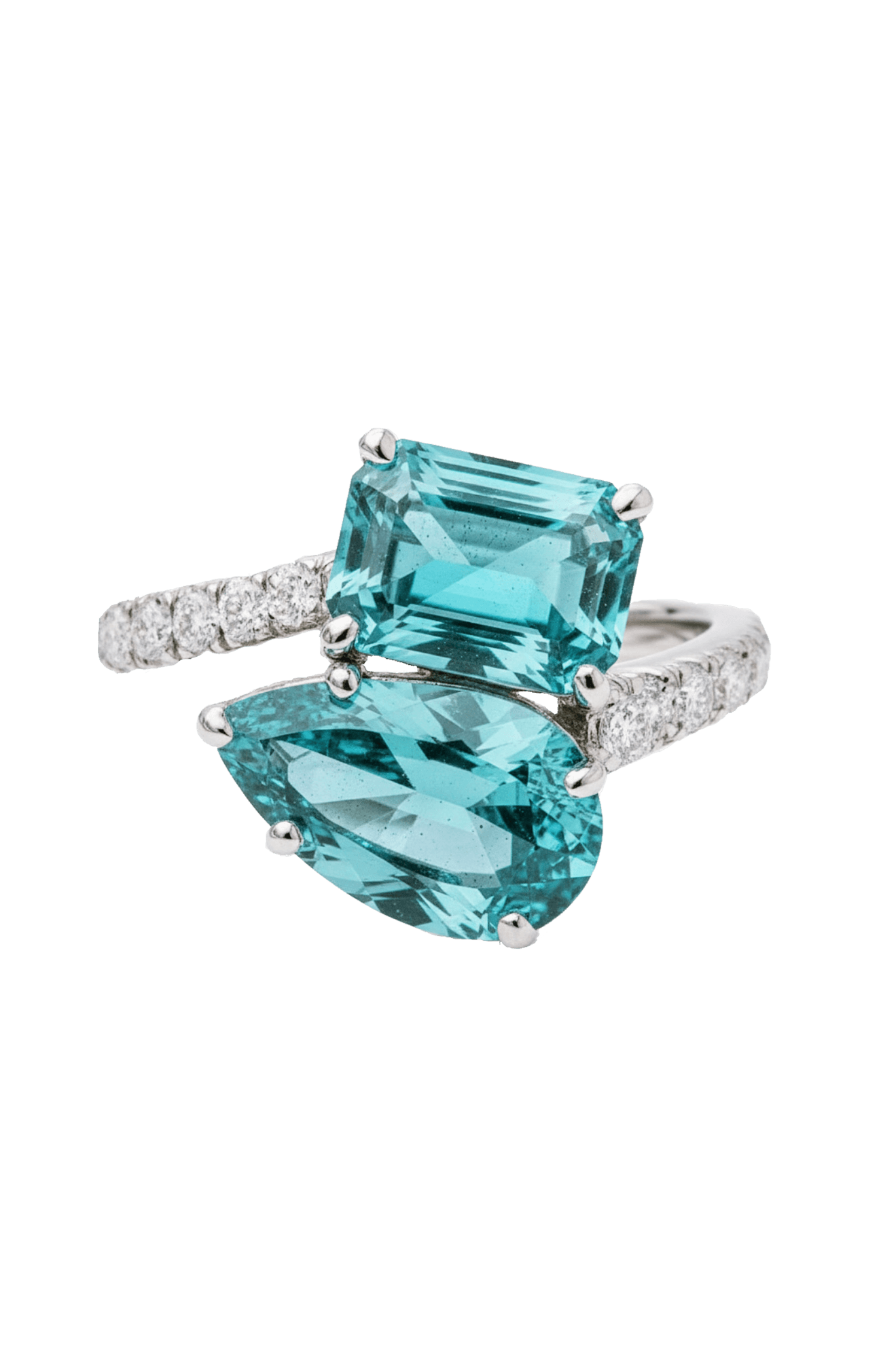
A Lagoon tourmaline is a tourmaline in a clear bluish green, named after the color of a tropical lagoon. The name comes from the trade and is not a laboratory designation. According to GIA, the color is usually caused by iron, not copper. A Lagoon tourmaline is therefore not a Paraíba tourmaline, even if the hues are similar. Such stones are known above all from Namibia.
At a glance
- Type of term
- Trade name for a color, not a laboratory designation
- Mineral
- Tourmaline, in gem quality usually elbaite
- Color
- A blend of blue and green, like a tropical lagoon
- Cause of color
- In blue and green tourmalines, according to GIA, iron, possibly titanium
- Known origin
- Namibia, Erongo region, for example Usakos and Neu Schwaben
- Mohs hardness
- 7 to 7.5, toughness fair according to GIA
- Distinction
- Paraíba tourmaline only with copper and manganese as the cause of color
A name for a color
Lagoon is a word of the trade. It describes a tourmaline whose color lies between blue and green and recalls the water of a tropical lagoon. There is no laboratory grade behind it, and there are no fixed limits for the hue. Two suppliers may therefore mean somewhat different stones by Lagoon. The name says nothing about clarity, treatment, or origin. It only classifies a color.

According to the Gemological Institute of America, GIA for short, tourmaline is not a single mineral species but a group of related minerals with the same crystal structure. Most gem tourmalines belong to the species elbaite. The trade has coined its own names for individual colors: rubellite for pink to red, indicolite for blue. Lagoon belongs in this series. An overview of all colors is given on the page on tourmaline.
Where Lagoon tourmalines come from
The name is closely linked to Namibia. A report in the journal Le Gemmologue on the tourmalines of the Erongo region names two mines. According to this report, pockets of tourmalines in Lagoon and vivid blue were found near Usakos between 2005 and 2007, and in March 2016 several kilograms in mint green and Lagoon bluish green. The Neu Schwaben mine yields tourmalines ranging from Lagoon bluish green to indigo blue.
The name is nevertheless not proof of origin. Bluish green tourmalines also occur elsewhere, and nothing prevents the trade from calling them Lagoon as well. GIA issues reports with an origin statement for only a few gemstone species. Paraíba tourmaline is one of them; other tourmalines are not. Anyone who wants Namibia as the origin depends on the information provided by the supply chain.
Iron instead of copper: the difference from Paraíba
A Lagoon tourmaline and a Paraíba tourmaline can be similar in hue. The line is drawn by chemistry. According to GIA, blue and green colors in tourmalines are produced by traces of iron and possibly titanium. In Paraíba tourmaline, it is copper, together with manganese. The copper creates the luminosity the trade describes as neon. A stone colored by iron looks calmer, even when it is intense.
The major laboratories set this boundary in the Laboratory Manual Harmonisation Committee, LMHC for short. A tourmaline is called Paraíba tourmaline only if its color is caused mainly by copper and manganese. Tourmalines with mere traces of copper and low saturation do not qualify. An iron-rich tourmaline containing copper whose spectrum is dominated by iron absorption does not receive the name either. The direct comparison is shown in Lagoon tourmaline or Paraíba.
| Criterion | Lagoon tourmaline | Paraíba tourmaline |
|---|---|---|
| Type of name | Trade name for a color | Variety name as defined by the laboratories |
| Cause of color | Usually iron, possibly titanium | Mainly copper and manganese |
| Effect | Clear, calm bluish green | Blue to green with striking luminosity |
| Report with origin | Not offered by GIA | Possible at GIA |
| Mohs hardness | 7 to 7.5 | 7 to 7.5 |
Lagoon tourmaline and Paraíba tourmaline compared. Information according to GIA and LMHC.
Distinction from indicolite
Closer to Lagoon than Paraíba tourmaline is indicolite. GIA describes indicolite as dark violetish blue, blue, or greenish blue. Lagoon, by contrast, refers to the range in which blue and green blend, with a more pronounced green component. The boundary is fluid. A stone with an intense greenish blue may carry either name depending on the supplier. What counts for you is therefore the stone itself, not the designation.

Neither name appears in a report as a quality grade. The Swiss laboratory SSEF describes colors with terms such as blue, light blue, greenish blue, or green and, by its own account, does not use trade terms. A report records that the stone is tourmaline and names detectable treatments. Lagoon is a word for the conversation about the stone, not for the document that accompanies it.
How to recognize quality
In a Lagoon tourmaline, color comes first: a balanced bluish green, neither too pale nor too dark. Tourmalines show different colors depending on the viewing direction. GIA describes how cutters orient the table to achieve the desired depth of color, and how many tourmalines are cut as long rectangles to lose little material. A well-cut stone shows an even color from above.
- Color: a balanced bluish green, evenly distributed across the table.
- Clarity: according to GIA, stones without inclusions visible to the naked eye are more valuable.
- According to GIA, whitish, conspicuous inclusions are undesirable in any color.
- Cut: no bright window in the center, no dark zones at the ends.
- Size: according to GIA, the price per carat rises markedly from about five carats at similar quality.
For Paraíba tourmaline, GIA describes stones over one carat as rare. There is no comparable statement for Lagoon tourmaline, so the size a piece calls for is decided by the individual stone. The effect of a ring with this stone is described in the guide to the ring with Lagoon tourmaline.
Treatment and care
According to GIA, heating and irradiation are the two most important treatments for tourmaline. This makes a difference for care: a color produced by irradiation can fade under heat or strong light. Tourmaline is resistant to chemicals. Great heat can change its color, and a rapid change in temperature can cause fractures. Ask, therefore, what is known about the treatment. Vikar Ahmed advises cleaning Lagoon tourmalines by hand only, with lukewarm water and a soft cloth, without ultrasonic or steam cleaners. The glossary explains the basic terms under treatment.
- Clean with warm soapy water and a soft brush, then rinse thoroughly.
- Do not use ultrasonic or steam cleaners; GIA advises against them for tourmaline.
- Avoid great heat and rapid changes in temperature.
- Store separately from diamond jewelry, which scratches any softer stone.
Lagoon tourmaline in jewelry
With a hardness of 7 to 7.5 and fair toughness, Lagoon tourmaline behaves in jewelry like any tourmaline. On the neck and the ear it is well placed. In a ring or bracelet it needs a setting that protects edges and corners. In a bracelet with several stones, what matters is that they match in color and size. How Lagoon and Paraíba differ there is shown in the comparison Paraíba or Lagoon in a bracelet.
At Vikar Ahmed, Lagoon tourmalines are worked just as Brazilian Paraíba tourmalines, Namibian tourmaline, and rubellite are. Which stone suits a piece of jewelry is a question of effect. Lagoon tourmaline brings a calm bluish green, Paraíba tourmaline a luminosity that goes back to copper. With Lagoon tourmaline, Vikar Ahmed expects almost eye-clean clarity, and the decisive criteria are the brilliance of the color and a precise cut. More on the stone itself is found under Lagoon tourmaline.
Frequently asked questions
Is a Lagoon tourmaline a Paraíba tourmaline?
No. Under the definition of the major laboratories, only a tourmaline whose color is caused mainly by copper and manganese is called Paraíba tourmaline. In Lagoon tourmaline, the bluish green is usually produced by iron. The hues may be similar; the luminosity and the designation in the laboratory report differ.
Where do Lagoon tourmalines come from?
They are known above all from the Erongo region in Namibia, for example from the mines near Usakos and Neu Schwaben. The name itself, however, is not tied to any locality. Bluish green tourmalines of other origin may also be called Lagoon. The name does not prove origin.
Does Lagoon appear in the laboratory report?
As a rule, no. Laboratories describe the color with neutral terms such as greenish blue or bluish green and identify the material as tourmaline. Laboratories such as SSEF, by their own account, do not use trade names for colors. Lagoon is the supplier's classification, which you should be able to see in the stone itself.
Are Lagoon tourmalines treated?
That is possible. According to GIA, heating and irradiation are the most important treatments for tourmaline. An irradiated color can fade under heat or strong light. An identification report names the treatments that can be detected. Also ask what the supplier knows about the stone.
Is a Lagoon tourmaline suitable for a bracelet?
Yes, with a protective setting. On the wrist, a stone is knocked more often than on the neck, and with a hardness of 7 to 7.5 tourmaline is considerably softer than diamond. With several stones, their color should match well, because on the wrist they lie directly next to each other. A bezel or channel setting protects the edges best.
How does Lagoon differ from indicolite?
According to GIA, indicolite refers to dark violetish blue, blue, or greenish blue. Lagoon refers to the range in which blue and green blend. Both names come from the trade, and the boundary is fluid. In the end, the stone itself decides, not the name under which it is offered.
Private consultation
Whether a Lagoon tourmaline or a Paraíba tourmaline suits your idea is best seen when both lie side by side. Vikar Ahmed advises in the house's showroom in Idar-Oberstein by appointment, and virtually on request. Request an appointment for a private consultation.
Further reading
- Glossary: Lagoon tourmaline
- Lagoon tourmaline or Paraíba
- Alternatives to Paraíba tourmaline
- Gemstone: Tourmaline
- Glossary: Neon quality
Sources
- GIA: Tourmaline Description, accessed 2026-11-17
- GIA: Tourmaline Quality Factors, accessed 2026-11-17
- GIA: Tourmaline Care and Cleaning Guide, accessed 2026-11-17
- GIA: Colored Stone Services, accessed 2026-11-17
- LMHC Information Sheet 6: Paraiba Tourmaline (Version 8, 2023), accessed 2026-11-17
- SSEF: Paraiba Tourmaline, accessed 2026-11-17
- Le Gemmologue: Tourmalines of Erongo, Namibia, accessed 2026-11-17

A personal conversation starts here.
At the showroom in Idar-Oberstein or by video. Vikar Ahmed discusses your ideas, stones and designs with you and answers your questions calmly and in confidence.


Thank you for your request.
Your request will be handled with the utmost attention and discretion. Vikar Ahmed will get back to you.
Your details
Request
–
Occasion
–
Consultation
–
Contact
–
In the meantime
Insights: What is a Paraíba tourmaline? · Engagement ring to your own design: how does it work?
Confidential and without obligation
Back to the pagePrivate consultation
A personal conversation starts here.
- Time for your questions, wishes and ideas
- In the showroom in Idar-Oberstein or by video
- Confidential, discreet and without obligation
Vikar Ahmed · Hauptstraße 111 · 55743 Idar-Oberstein, Germany