

Choosing the Solitaire Engagement Ring
In a solitaire, there is nothing behind which a detail could hide. Which decisions carry the ring, and in which order they make sense.
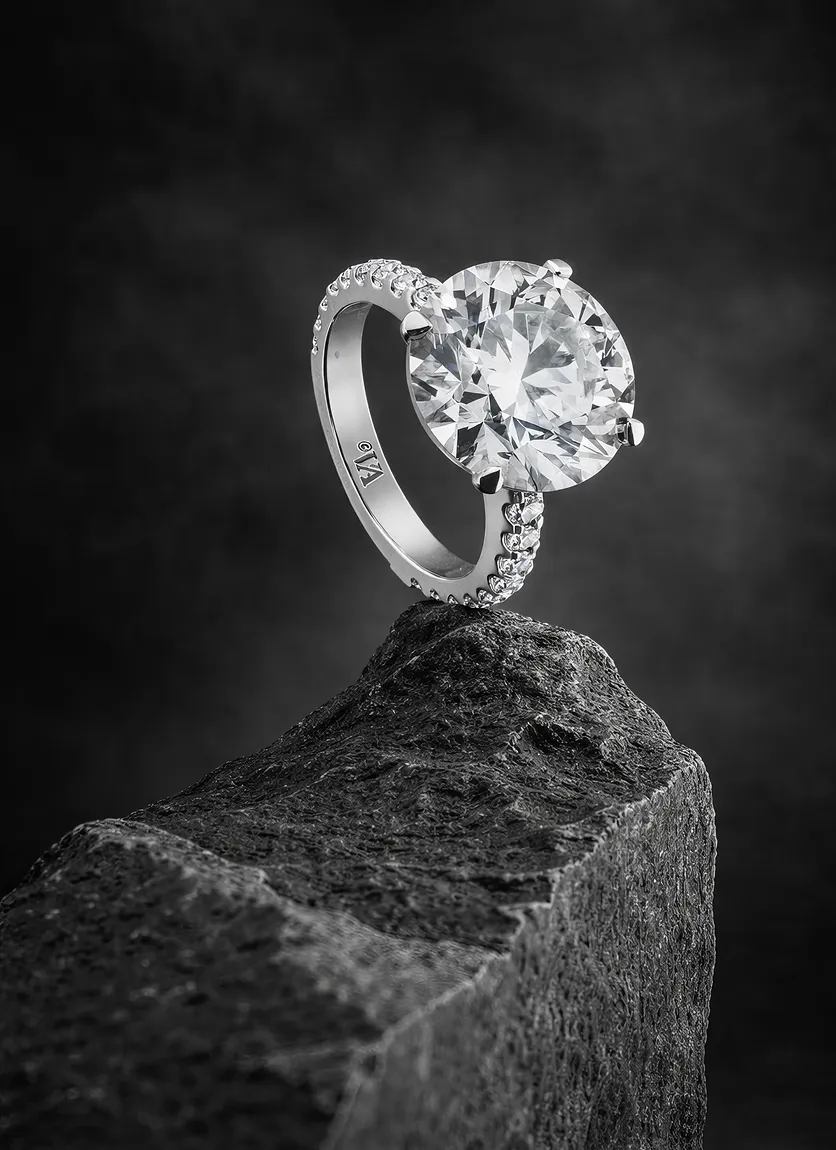
A good solitaire engagement ring combines a stone of documented quality, a shape that suits the hand, and a setting that holds it securely. Six prongs secure a round stone more firmly, four show more of it. A bezel setting protects it on active hands. Because the one stone carries everything, its selection counts for more than any detail of the band.
At a glance
- Solitaire
- A single main stone with little or no further ornament
- Most common shape
- Round brilliant with 57 or 58 facets
- Oval
- Length to width usually 1.3 to 1.4 to 1, looks larger per carat
- Carat
- Unit of weight, 1 carat equals 200 milligrams or 100 points
- Prongs
- Four show more of the stone, six hold it more securely
- Bezel setting
- Encloses the edge, protects best, lets in somewhat less light
One stone carries the whole ring
The solitaire lives from a single decision. GIA describes it as a ring with one center stone and little or no further ornament, in which simplicity directs the eye entirely to the shape, size, and quality of the stone. What has succeeded in the stone is seen at once. So is what is lacking. This is why the selection of the stone comes first, and the band and setting are designed around it.

A ring with diamonds set in the band distributes the effect differently. Small stones in the band, often set closely together as pavé, add extra sparkle and place the center stone in a frame of light. The price for this is upkeep: according to GIA, pavé settings need to be checked occasionally, and the size is difficult to change. The solitaire with a plain band remains less complicated on both counts.
Shape and cut of the center stone
The most common shape for a solitaire is the round brilliant. According to GIA, it has exactly 57 or 58 facets and is cut for the greatest possible sparkle. GIA also names cushion, princess, radiant, and pear as widespread shapes for solitaire rings. Each shape changes the effect: round stones look calm and symmetrical, elongated shapes make the finger appear slimmer. The guide Which cut for the engagement ring? gives an overview.
The oval cut is especially popular for solitaires, because it looks larger per carat. A length to width ratio between 1.3 and 1.4 to 1 is usual. Many ovals show a dark shadow in the shape of a bow tie at the center, which is only faint in well-cut stones. Pointed shapes such as pear, marquise, or princess need protective prongs at the points so that they do not chip.
Carat weight and visible size
The carat measures weight, not size. One metric carat equals 200 milligrams, divided into 100 points. How large a stone appears from above also depends on its shape and cut. GIA points out that a stone of 0.99 carat can hardly be distinguished visually from one of 1.00 carat. Two stones of the same weight are also not of equal value, because color, clarity, and cut play a part.
With a high carat weight, the task shifts. At the same quality, a larger diamond is rarer and correspondingly more valuable. At the same time, a large stone shows color and inclusions more clearly. An independent report is indispensable here. The setting has to carry the weight securely without raising the stone unnecessarily high. The guide Engagement ring with 1 carat explores what a stone of around one carat means.
The setting: prongs, bezel, cathedral
The setting determines security and the play of light at the same time. In a prong setting, narrow metal claws hold the stone and let plenty of light in. According to GIA, four prongs make a round stone look slightly more square, while six emphasize its roundness and offer more hold. According to GIA, the six-prong setting was introduced more than 125 years ago and still shapes the image of the solitaire today.

| Setting | Effect | In everyday wear |
|---|---|---|
| Four prongs | Much of the stone visible, round looks slightly square | Have the prongs checked at intervals |
| Six prongs | Emphasizes the round shape | More hold for the stone, also check regularly |
| Bezel setting | Clear, modern line around the stone | Protects the edge, ideal for active hands |
| Cathedral | Stone on arches, looks higher and more elegant | Can catch on clothing |
| Tension setting | Stone appears to float freely | Size hardly changeable, stone can come loose |
Basis: GIA, Guide to Engagement Ring Settings and What is a Solitaire Setting. More on the construction types in the glossary entry Prong setting.
What keeps a solitaire timeless
A solitaire ages slowly, because it contains almost nothing tied to a fashion. What carries it over decades are proportions: the ratio of stone size to band width, the height of the setting above the finger, and a prong shape that holds the stone without covering it. A slender band makes the stone look larger, a sturdier one looks calmer and lasts longer.
Anyone torn between a solitaire and a ring with many small diamonds should think of later rings. The solitaire can be complemented by a plain wedding band, a guard ring, or later an eternity ring. The ring with many stones is already complete. The guide Solitaire or eternity ring draws the direct comparison with the continuous band of stones.
The metal of the setting also shapes the stone. A white metal such as platinum or rhodium-plated white gold makes a colorless diamond appear most neutral. Yellow gold, by contrast, according to GIA intensifies the yellowish tone of a diamond that is visibly tinted from color grade M. Anyone who loves yellow gold and chooses a very white stone can have the prongs worked in white and the band in gold. More on the alloy in the glossary entry 18k (750) gold.
Typical mistakes with a solitaire
- Looking only at carat weight: a poorly cut large stone sparkles less than a smaller good one.
- Choosing a very high setting although the hands do a lot of work: the stone knocks against things more often.
- Leaving the points of a pear, marquise, or princess unprotected.
- Not thinking of the wedding band: a low setting may require a cutout in the wedding band.
- Doing without an independent report, although the one stone carries the value of the ring.
- Never having the prongs checked: they wear and can loosen over time.
A solitaire made to order
- Select the stone: shape, weight, and quality, documented by a report.
- Determine the setting: prongs or bezel, height and form suited to the stone and everyday life.
- Design the band: width, profile, and metal, coordinated with a later wedding band.
- Review the design: in a visualization before crafting, with all proportions.
- Craft and set: the stone is set and the surface polished by hand.
At Vikar Ahmed, engagement rings are individually designed and made in Germany. A classic such as the solitaire can be developed further, just as a completely new idea can be realized. In-house designers create the design, a three-dimensional rendering with CAD shows the ring before it is crafted, and goldsmiths from Idar-Oberstein set the stone and polish by hand. A classic solitaire takes about two weeks as a guide once the right diamond is available. The work is planned toward a fixed date for the proposal, so it is best mentioned in your first request.
Frequently asked questions
What distinguishes a solitaire ring from an engagement ring with diamonds set in the band?
The solitaire carries a single stone on a plain band. In a ring with set stones, small diamonds also sit in the band. It therefore sparkles all around, but requires occasional checks of the small settings and is harder to resize. The solitaire remains simpler and more flexible.
Solitaire or a ring with many small diamonds: which looks more timeless as a one-of-a-kind piece?
Usually the solitaire. It reduces the ring to stone and proportion and is thus hardly tied to an era. A ring with many small stones can age just as beautifully if it is cleanly crafted, but it reads more strongly as a design of its time. As a one-of-a-kind piece, the solitaire shows itself above all in the stone and setting.
Which atelier makes a solitaire ring with a high carat weight to order?
Look for a house that handles design, setting, and polishing itself, presents every large stone with an independent report, and visualizes the ring before crafting. Vikar Ahmed in Idar-Oberstein designs engagement rings individually and crafts them as one-of-a-kind pieces in its in-house atelier.
Where in Kaiserslautern can I have a solitaire ring in a timeless design made as a one-of-a-kind piece?
Look for a workshop that designs the stone and setting with you and shows you the design before crafting begins. Vikar Ahmed advises in Idar-Oberstein and has no location in Kaiserslautern. What couples from the city can bear in mind is set out on the page Jeweler for Kaiserslautern.
Four or six prongs for a solitaire?
Four prongs show more of the stone and make a round brilliant look slightly more square. Six prongs emphasize the roundness and are considered the more secure option, because the stone is held at more points. For large stones and active hands, six are the more cautious choice.
Does an oval solitaire look larger than a round one?
Yes, at the same weight it usually does. Seen from above, the oval shows more surface and visually lengthens the finger. A length to width ratio of around 1.3 to 1.4 to 1 is usual. Look for a well-cut stone so that the shadow at the center remains faint.
Private consultation
Which shape, which weight, and which setting suit your hand is best seen on the stone itself. Vikar Ahmed advises in the showroom in Idar-Oberstein by appointment, and virtually on request. Request an appointment for a private consultation.
Further reading
- Solitaire or eternity ring
- Which cut for the engagement ring?
- The setting of the engagement ring
- Glossary: Prong setting
- Glossary: Solitaire
Sources
- GIA 4Cs: What is a Solitaire Setting?, accessed 2026-11-17
- GIA 4Cs: Complete Guide to Engagement Ring Settings, accessed 2026-11-17
- GIA 4Cs: Guide to Diamond Engagement Ring Shapes, accessed 2026-11-17
- GIA 4Cs: Diamond Carat Weight, accessed 2026-11-17
- GIA 4Cs: Guide to White, Yellow, and Rose Gold Engagement Rings, accessed 2026-11-17
- Vikar Ahmed: Verlobungsringe, accessed 2026-11-16
- Vikar Ahmed: Bespoke, Designprozess, accessed 2026-11-16

A personal conversation starts here.
At the showroom in Idar-Oberstein or by video. Vikar Ahmed discusses your ideas, stones and designs with you and answers your questions calmly and in confidence.


Thank you for your request.
Your request will be handled with the utmost attention and discretion. Vikar Ahmed will get back to you.
Your details
Request
–
Occasion
–
Consultation
–
Contact
–
In the meantime
Insights: What is a Paraíba tourmaline? · Engagement ring to your own design: how does it work?
Confidential and without obligation
Back to the pagePrivate consultation
A personal conversation starts here.
- Time for your questions, wishes and ideas
- In the showroom in Idar-Oberstein or by video
- Confidential, discreet and without obligation
Vikar Ahmed · Hauptstraße 111 · 55743 Idar-Oberstein, Germany