

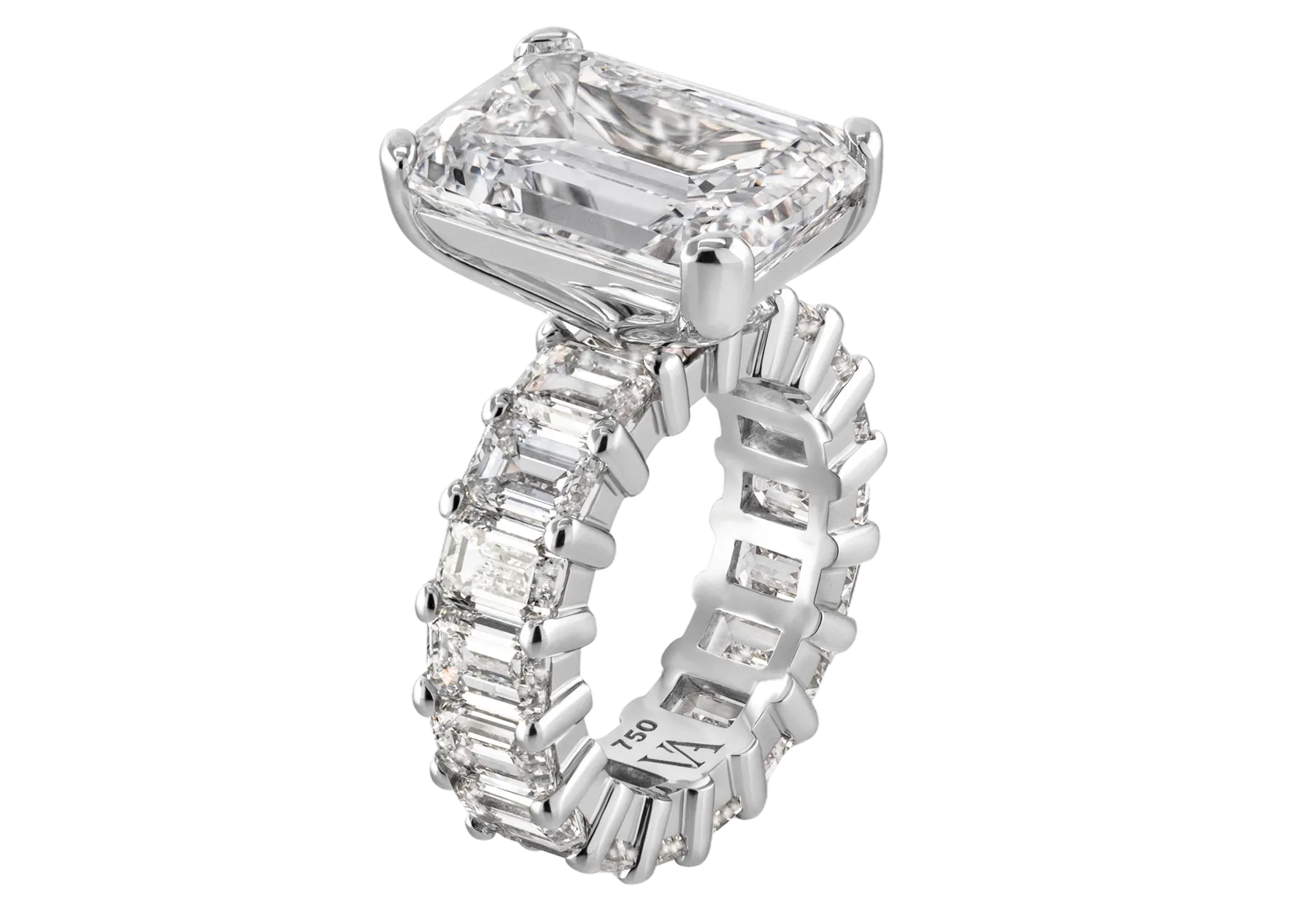
With large stones, cuts with a long tradition look the most timeless: the round brilliant, the oval, and the emerald cut. The larger the stone, the more clearly it shows color and inclusions, especially in a step cut. A setting with six prongs or a basket holds it securely. Rose gold presents colorless stones with warmth.
At a glance
- Timeless cuts
- Round brilliant, oval, emerald cut
- Shows the most
- Step cuts: large, calm facets make color and inclusions visible
- Forgives the most
- Brilliant cuts: many facets mask small inclusions
- Prongs
- Four or six for round stones, large stones tend to get more according to GIA
- Rose gold
- Gold with copper and silver, a contrast to stones from D to L
- Usual size
- According to GIA, most diamonds in jewelry weigh one carat or less
A large stone changes the requirements
A large center stone is not simply an enlarged small one. According to GIA, most diamonds in jewelry weigh one carat or less. Going well beyond this means moving into a range in which every property of the stone becomes more visible and the setting has to hold more weight. With large stones, cut, clarity, setting, and metal interlock more closely than in a delicate solitaire.
Timeless means two things here. In twenty years, the ring should not look like the year it was made, and it should then sit just as securely as it does today. The first is a question of cut and proportion, the second a question of setting and craftsmanship. Both can be planned before production if the stone is known and the design is shown in three dimensions in advance.
Which cuts age gracefully on large stones
Shapes that have been used in jewelry for generations look natural even on a large stone. According to GIA, the round brilliant is the most popular shape. At the same weight, the oval looks more elongated and lengthens the finger. The emerald cut, a step cut with cut corners, looks calm and architectural. Fashionable shapes and very unusual proportions, by contrast, stand out more on large stones than on small ones.

| Cut | Effect on a large stone | Demands on the stone |
|---|---|---|
| Round brilliant | Bright, lively sparkle, classic | Very good cut, clarity can be somewhat lower |
| Oval | Elongated, soft, looks large face-up | Even outline, calm light pattern without a dark zone |
| Emerald cut | Calm, mirror-like, architectural | High clarity and color, because the table is open |
| Radiant cut | Angular like the emerald cut, sparkles like a brilliant | Clean corners, protection of the corners in the setting |
Four widespread cuts for large center stones compared.
More on the difference between shape and cutting style can be found in the article Which cut for the engagement ring?. For large stones, there is an additional point: proportions that barely stand out at half a carat are immediately visible at several carats. An oval that is too long or an emerald cut that is too shallow then no longer looks classic but unbalanced. With the oval, there is also the so-called bow-tie effect, a dark shadow across the center. According to GIA, it is present to some degree in every oval, and a good cut keeps it small.
What a large stone reveals about itself
According to GIA, larger facets show color and inclusions more clearly. In step cuts such as the emerald cut, inclusions are considerably more visible than in brilliant cuts because of the few large facets. GIA therefore advises choosing a higher color grade for step cuts. If you need leeway on clarity, a brilliant cut serves you better, as its many facets mask small inclusions.
For the assessment, this means: a large stone should always be examined with a laboratory report and on the stone itself. Clarity is determined according to the GIA scale under 10x magnification, but whether an inclusion is disturbing to the naked eye only becomes clear by looking at the stone. Normal light is just as important. GIA recommends viewing a diamond under everyday lighting as well, not only under spotlights. More on this in the article Clarity or carat.
The setting has to carry more
According to GIA, round diamonds are usually set with four or six prongs, depending on their size. Large stones tend to get additional prongs, and for large or deep stones a basket setting that supports the stone from below is also suitable. Four prongs make a round stone look slightly square, six emphasize its roundness. The prong setting lets in a lot of light but should be checked regularly.
As size increases, height usually does too. A cathedral setting raises the stone above the shank and stabilizes it with arches, but catches more easily on clothing. A bezel setting encloses the edge completely and protects well against knocks, but lets somewhat less light into the stone. According to GIA, a halo of small diamonds makes the center stone look larger, but it needs more care to keep all stones secure.
Rose gold and a large stone
According to GIA, rose gold is created by alloying gold with copper and silver, and the copper content gives the rosy hue. Because the facets of a diamond act like small mirrors, a large stone takes on the color of the setting more strongly than a small one. According to GIA, diamonds from D to L form a beautiful contrast with rose gold, while stones in the M to Z range look softer in it. Anyone who does not tolerate copper should avoid rose gold.

A proven solution for large colorless stones is a combination: a shank in rose gold, prongs in white gold. This keeps the warm tone on the finger, while the light metal directly at the stone supports its colorlessness. GIA explicitly mentions such combinations as an option. More on choosing the color in the article Rose gold or white gold for the engagement ring?.
Typical mistakes with a large center stone
- Choosing a large emerald cut with low clarity because the number in the report sounds good.
- Choosing the setting from a photo without checking how high the stone will later sit above the finger.
- Planning four prongs for a large, heavy stone, even though six or a basket give more hold.
- Setting a stone with a slight tint in white gold, where it shows more than in rose gold.
- Choosing unusual proportions that date more quickly on a large surface.
Almost all of these mistakes can be avoided before production. This includes viewing the stone under normal light and in different setting variations, checking the height on your own finger, and comparing the gold color against the stone. A three-dimensional visualization shows in advance how prongs, height, and shank work together.
Large stones in the in-house atelier of Vikar Ahmed
Vikar Ahmed designs engagement rings individually and makes them in its in-house atelier in Idar-Oberstein, in 18k (750) gold in white, rose, and yellow or in platinum 950. The pieces shown include diamonds in the emerald cut and the radiant cut. For valuable center stones, the house prefers a prong setting, and solitaires are also made with 10 to 40 carats. If you would like to see large stones in different cuts at the appointment, it is best to say so when you inquire. Clients coming from Bad Kreuznach will find no shop of the house there. Consultations take place in Idar-Oberstein, with details under Jeweler for Bad Kreuznach.
Frequently asked questions
Which engagement rings with a large stone look especially timeless because of their cut?
Rings with a round brilliant, oval, or emerald cut in classic proportions. These shapes have been common for generations and look natural even at several carats. The brilliant forgives small inclusions, the emerald cut demands a very clean stone. A plain setting keeps the cut looking current longer than fashionable details do.
How many prongs does a large stone need?
For round stones, four or six prongs are usual, and according to GIA, large stones tend to get more. Six prongs distribute the hold and emphasize the roundness. For large or deep stones, a basket setting that additionally supports the stone from below is also common.
Does a colorless diamond look yellowish in rose gold?
Not necessarily. The facets reflect the rosy metal, which creates a warm glow. According to GIA, stones from D to L form a good contrast with rose gold. If you want the stone to look as colorless as possible, have it set in white gold prongs and choose the shank in rose gold.
Is a large emerald cut more sensitive to inclusions?
Yes, in terms of visibility. Step cuts have a few large facets through which one looks deep into the stone. According to GIA, inclusions are considerably more visible in them than in a brilliant cut. For a large emerald cut, higher clarity and color are therefore worthwhile.
Does a large, high-set stone catch in everyday life?
The risk increases with height. According to GIA, raised settings such as the cathedral setting catch more easily on clothing, and prongs can snag on fabrics. A lower setting, a bezel, or side supports reduce this. The height should be checked on your own finger.
From what size is a stone in an engagement ring considered large?
There is no fixed threshold. According to GIA, most diamonds in jewelry weigh one carat or less, so considerably heavier stones are the exception. How large a stone looks also depends on cut, shape, and finger width. At the same weight, an oval looks larger than a brilliant.
Private consultation
How a large stone looks in rose gold or white gold and which setting carries it is best seen on the stone and in the visualization. Vikar Ahmed advises in the showroom in Idar-Oberstein by appointment or virtually. Request an appointment for a private consultation.
Further reading
- Which cut for the engagement ring?
- High Jewelry diamond rings with high carat weight
- Rose gold or white gold for the engagement ring?
- Glossary: Emerald cut
- Jeweler for Bad Kreuznach
Sources
- GIA 4Cs: How to Buy a Quality Diamond (Treppen- und Brillantschliff), accessed 2026-11-17
- GIA 4Cs: Oval Cut Diamond Buying Guide, accessed 2026-11-17
- GIA 4Cs: Complete Guide to Engagement Ring Settings, accessed 2026-11-17
- GIA 4Cs: White, Yellow and Rose Gold Engagement Rings, accessed 2026-11-17
- GIA: 10 Tips for Buying a Diamond Engagement Ring, accessed 2026-11-17
- GIA: 4Cs Carat Weight, accessed 2026-11-17
- GIA 4Cs: Diamond Clarity, accessed 2026-11-17
- Vikar Ahmed: Collections, accessed 2026-11-16
- Vikar Ahmed: Verlobungsringe und Engagement, accessed 2026-11-16

A personal conversation starts here.
At the showroom in Idar-Oberstein or by video. Vikar Ahmed discusses your ideas, stones and designs with you and answers your questions calmly and in confidence.


Thank you for your request.
Your request will be handled with the utmost attention and discretion. Vikar Ahmed will get back to you.
Your details
Request
–
Occasion
–
Consultation
–
Contact
–
In the meantime
Insights: What is a Paraíba tourmaline? · Engagement ring to your own design: how does it work?
Confidential and without obligation
Back to the pagePrivate consultation
A personal conversation starts here.
- Time for your questions, wishes and ideas
- In the showroom in Idar-Oberstein or by video
- Confidential, discreet and without obligation
Vikar Ahmed · Hauptstraße 111 · 55743 Idar-Oberstein, Germany