

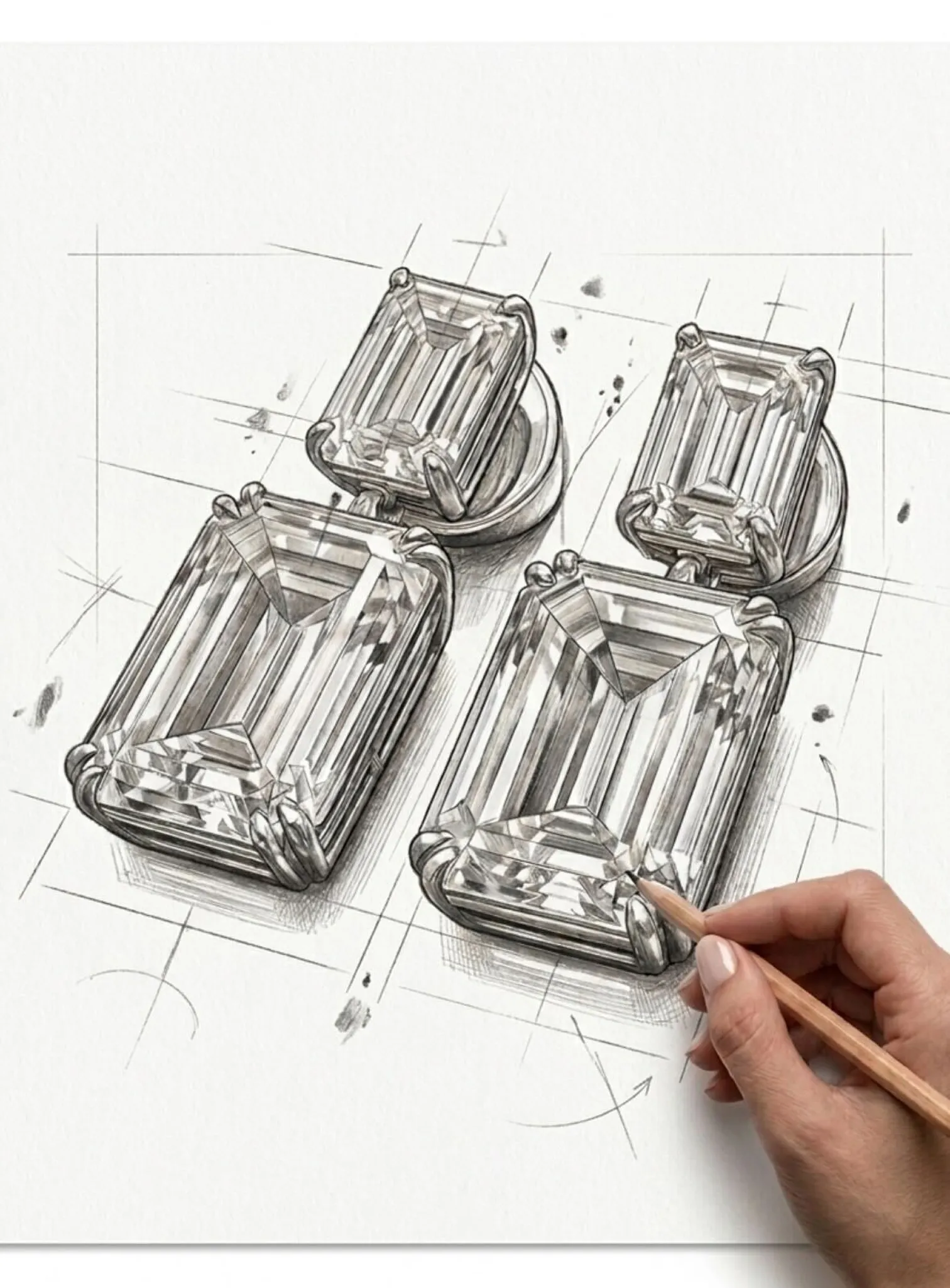
A wedding keepsake succeeds when both partners decide early what it should stand for and who decides what. Stone, form, symbol, engraving, and metal can all be shaped together. How much of this you determine depends on the workshop's process: briefing, sketch, three-dimensional visualization, and approval before production are the points at which your input takes effect.
At a glance
- Common forms
- Pendant, ring, bangle, earrings
- Personal elements
- Stone, symbol, engraving, date, existing gold or stones
- Input takes effect at
- Briefing, sketch, 3D visualization, approval
- 18k (750) gold
- 75 percent gold, 25 percent other metals
- Fineness in the hallmark
- For jewelry in thousandths, Section 5 German Hallmarking Act (Feingehaltsgesetz)
- Withdrawal
- Generally excluded for pieces made to your specifications, Section 312g BGB
One piece, two voices
Wedding keepsake jewelry differs from other one-of-a-kind pieces in one respect: there are two clients. Both associate their own images with the day, and often only one of them wears the piece. Before stones and forms are discussed, it is therefore worth reaching an understanding as a couple. What should the piece stand for: the day itself, the shared life, or a place? And who has the final word on matters of taste?

Couples who clarify this in advance arrive at a design more quickly. A simple division has proven itself: the person who wears the piece decides on form, size, and comfort. Both together decide on what makes up the memory, such as a symbol, a stone, or an engraving. How input is generally distributed with one-of-a-kind pieces is described in How much you shape a one-of-a-kind piece.
What form the keepsake takes
The form determines how often the piece is worn and how much room it offers for personal elements. A ring is visible every day, but sits beside the wedding and engagement rings and must suit them. A pendant offers more surface and protects delicate stones. A bangle can be generously engraved on the inside. Earrings are suitable when a pair of stones is to carry the memory.
| Form | Worn | Room for the memory | What to watch for |
|---|---|---|---|
| Ring | Daily, highly visible | Engraving inside, stone, profile | Suits the wedding and engagement rings |
| Pendant | Often, protected | Front and back, motif | Chain length and position on the body |
| Bangle | Often, prone to knocks | Long inner surface for engravings | Fit on the wrist |
| Earrings | For occasions | Pair of stones, form | Weight and closure |
Rough orientation. Which form suits depends on the everyday life of the wearer.
Anyone undecided between a pendant and a ring will find a detailed weighing in the guide Pendant or ring as a keepsake?. For the ring, there is an additional point: its size varies with temperature. According to GIA, fingers swell in warmth and contract in the cold, and wide shanks fit more tightly. A keepsake ring that is meant to suit the wedding ring is therefore best tried on together with it.
Making the memory visible: symbol, stone, engraving
The memory can be openly visible or hidden. Open elements are a symbol, a form that refers to the place of the wedding, or a stone in a color that played a role on the day. Hidden elements are engravings on the inside, a small stone on the back of a pendant, or a detail that only the two of them know. Hidden elements keep a piece restrained and still make it personal.
For engravings: short lasts longer than long. A date, initials, or a single word remain legible even when the inside of a ring wears down over the years. With stones, durability counts. According to GIA, stones with low toughness are better placed in earrings and necklaces than in rings and bracelets. A stone with meaning should therefore sit where it will survive the years.
- The date or coordinates of the wedding venue as an engraving.
- A stone that takes up the color of a detail from the wedding day.
- Two stones that stand for the two partners.
- A motif from the invitation, the flowers, or the venue as a form.
- A detail from the wedding ring that recurs in the new piece.
Incorporating old gold and existing stones
Many couples would like to bring in something they already have: the gold of an heirloom, a stone from a family ring. This is possible, but requires an honest examination beforehand. Old gold often has a different fineness than the planned piece. According to the World Gold Council, 18k (750) gold contains 75 percent gold and 25 percent other metals. Whatever is melted down must be brought to the desired alloy for the new piece.

On the finished piece, the fineness is stated in thousandths under Section 5(1) of the German Hallmarking Act (Feingehaltsgesetz), so 750 for 18k gold. Existing stones should be examined before resetting, for species, treatment, and damage. An older stone may have fractures that grow during setting. What counts when setting your own stone is explained in An individual setting for your own gemstone. Clear information on the metal is described in Fineness in a one-of-a-kind piece.
Where your input takes effect in the process
Input is not a question of courtesy, but of process. It takes effect at the points where a design is still open. After that, every change becomes more involved. For couples, it is worth being present together at each stage or agreeing beforehand who decides. The following steps show where each decision is made.
- Briefing as a coupleOccasion, meaning, the wearer, everyday life, existing stones or gold.
- Sketch or watercolorDirection, symbol, and color. Changes are easiest here.
- 3D visualizationCheck proportion, size, engraving surface, and the seating of the stones from all sides.
- ApprovalBoth agree to the design, and only then does production begin.
Approval also has a legal side. For goods produced according to the individual selection or specification of the consumer, there is no right of withdrawal under Section 312g(2) no. 1 of the German Civil Code (BGB), even if the contract is concluded at a distance. A keepsake made to your design generally falls under this. All the more care should go into the approval. What it looks like is shown in The bespoke design.
Typical mistakes with keepsake jewelry
- Putting too many symbols into one piece until none of them is legible.
- Forgetting the everyday life of the wearer, such as profession or sports.
- Planning long engravings on small surfaces.
- Setting a delicate stone with meaning in a ring that is worn every day.
- Mentioning the anniversary date too late.
The last mistake is easy to avoid. Anyone who wants to present the piece on a particular anniversary should mention the date in the very first inquiry. Design, agreement as a couple, and production take time, and a couple often needs longer for decisions than a single person. A buffer for a second design round therefore belongs in the schedule from the start.
Keepsake jewelry at Vikar Ahmed
At Vikar Ahmed, a one-of-a-kind piece is created in three steps: design, visualization, realization. The in-house designers develop independent concepts into which personal wishes are incorporated, first as a sketch and watercolor. A three-dimensional representation in CAD makes the piece tangible before production. Production takes place as a one-of-a-kind piece in the in-house atelier, and custom wedding bands are also available on request. As a guide, the house gives about 4 to 6 weeks for more elaborate custom pieces and works toward requested dates. So mention a wedding date right away when you inquire.
Consultations take place in the showroom in Idar-Oberstein by appointment or virtually. The house has no location in Trier; couples from there will find the details at Jeweler for Trier. Whether existing gold or a family stone can be incorporated is clarified in conversation, based on the actual piece. The pieces the house shows are made of 18k (750) white gold and 18k (750) rose gold. Other metals such as platinum or yellow gold are best raised in the design conversation.
Frequently asked questions
My husband and I want to have a piece of jewelry designed as a keepsake of our wedding. How do goldsmiths in Trier differ in how much we can shape the design?
What matters is at how many stages you are both involved: the briefing, the sketch, the 3D model, and the approval. Ask whether you will see several variants and until when changes are possible. Vikar Ahmed has no location in Trier and advises in Idar-Oberstein.
Can gold from an heirloom be used for the new keepsake?
In principle yes, after the fineness has been checked. Old gold often has a different alloy than the planned piece and must be refined for it. Whether this is worthwhile depends on quantity and condition. On the new piece, the fineness is stated in thousandths, so 750 for 18k gold.
Which engraving suits a wedding keepsake?
Short engravings last longest: a date, initials, coordinates, or a single word. Long sentences become hard to read on small surfaces and wear away more quickly on the inside of a ring. The inside of a bangle or the back of a pendant offers more space.
What should we do if we cannot agree on the design?
Decide beforehand who decides on what. It often helps if the person who wears the piece determines form and size, and both together decide on symbol and stone. Two variants in the design make differences visible and make the decision easier.
Does a keepsake ring have to suit the wedding ring?
If both are worn on the same hand, yes. Profile, width, metal color, and the height of the stone should be matched so that the rings do not rub against each other. It is best to bring the wedding and engagement rings to the appointment, so that the design can be checked beside them from the start.
Can a piece made to our design be returned?
As a rule, no. For goods produced according to the individual selection or specification of the consumer, Section 312g(2) no. 1 of the German Civil Code (BGB) provides no right of withdrawal. It is all the more important that both partners expressly approve the design before production.
Private consultation
A keepsake begins with a conversation as a couple. Vikar Ahmed advises couples in the showroom in Idar-Oberstein by appointment or in a virtual appointment. Your inquiry is treated with discretion. Request an appointment for a private consultation.
Further reading
- Having jewelry made: from wish to one-of-a-kind piece
- Glossary: 18k (750) gold
- Glossary: 3D design
- Bespoke at Vikar Ahmed
Sources
- World Gold Council: About Gold Jewellery, accessed 2026-11-17
- § 5 Feingehaltsgesetz, accessed 2026-11-17
- § 312g BGB: Widerrufsrecht, accessed 2026-11-17
- GIA 4Cs: More than Mohs, Gem Durability, accessed 2026-11-17
- GIA 4Cs: How to Determine Ring Size, accessed 2026-11-17
- Vikar Ahmed: Bespoke, Designprozess, accessed 2026-11-16
- Vikar Ahmed: Collections, accessed 2026-11-16

A personal conversation starts here.
At the showroom in Idar-Oberstein or by video. Vikar Ahmed discusses your ideas, stones and designs with you and answers your questions calmly and in confidence.


Thank you for your request.
Your request will be handled with the utmost attention and discretion. Vikar Ahmed will get back to you.
Your details
Request
–
Occasion
–
Consultation
–
Contact
–
In the meantime
Insights: What is a Paraíba tourmaline? · Engagement ring to your own design: how does it work?
Confidential and without obligation
Back to the pagePrivate consultation
A personal conversation starts here.
- Time for your questions, wishes and ideas
- In the showroom in Idar-Oberstein or by video
- Confidential, discreet and without obligation
Vikar Ahmed · Hauptstraße 111 · 55743 Idar-Oberstein, Germany