

Understanding High Jewelry with Colored Gemstones
A colored stone alone does not make High Jewelry. It is the interplay of the stone's rarity, composition, and execution that raises a piece into this category.
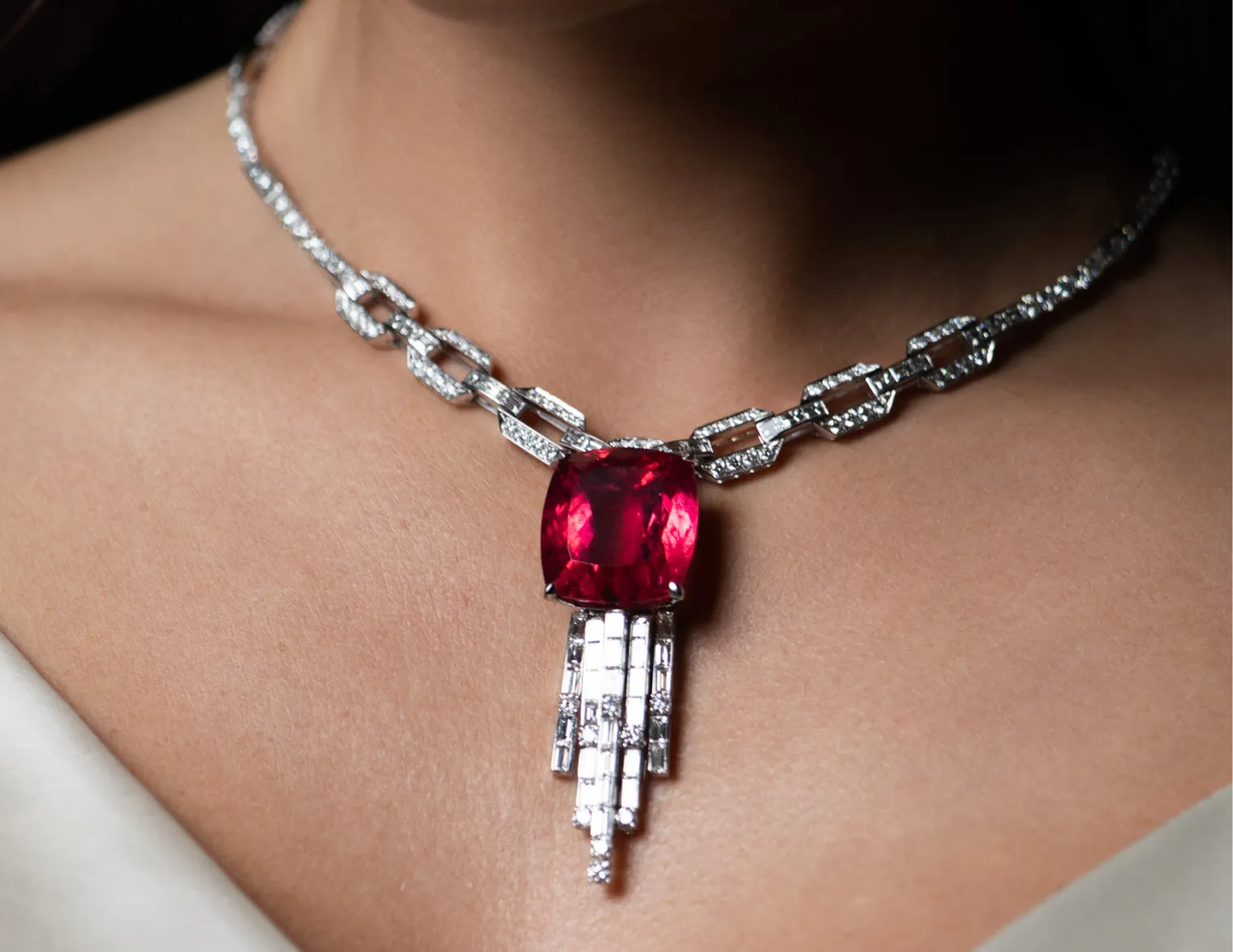
High Jewelry with colored gemstones combines a rare colored stone with an original design and execution as a single piece. What decides is the color of the principal stone, a traceable statement of species and treatment, the composition with diamonds and other stones, and workmanship that is clean on the back as well. This can only be compared on the piece itself.
At a glance
- Most important feature
- The color of the principal stone: hue, saturation, tone
- Details on the stone
- Species, treatment, and for some stones also the origin
- GIA origin reports
- Among others for ruby, sapphire, emerald, and Paraíba tourmaline
- Grading
- There is no globally uniform grading scale for colored stones
- Standards
- CIBJO Blue Books on nomenclature and grading
- Comparison
- Side by side, in daylight and artificial light
What distinguishes High Jewelry with colored stones
High Jewelry refers to jewelry of the highest category: single pieces or very small series with rare stones, elaborately made by hand. With colored stones, the emphasis shifts. While colorlessness and cut are paramount in a diamond, in a colored stone the color itself is the subject of the piece. The design is built around the stone, rather than the stone being set into a finished design.

This distinguishes High Jewelry from good colored stone jewelry. A ring with a beautiful tourmaline can be carefully crafted. High Jewelry begins where the stone is rare, its color exceptional, and the composition original. How to assess colored stone jewelry in general, meaning treatments, reports, and settings, is explained in the guide Understanding colored stone jewelry. This page addresses the level above.
The stone: color first, then size
With colored stones, color determines rank. For emerald, the Gemological Institute of America, GIA for short, describes bluish green to pure green stones with vivid saturation as the most desirable. For Paraíba tourmaline, GIA advises preferring, when in doubt, the smaller stone with the more vivid color over the larger, paler one. This principle applies to High Jewelry in general: a medium-sized stone with outstanding color carries a piece further than a large, dull one.
Size still counts, but only in second place. For tourmaline, according to GIA, the price per carat rises markedly above all when stones of the same quality exceed the five-carat threshold. For emerald, the price can rise sharply with size at the same quality. For a piece of the highest category, one therefore looks for stones in which color and size come together. That is the actual reason for their rarity.
Details that should accompany a piece
A High Jewelry piece with colored stones needs a traceable description of its principal stones. GIA offers an identification report for colored stones that names the material and detectable treatments, also for set stones. For ruby, sapphire, emerald, Paraíba tourmaline, red spinel, alexandrite, and some other stones, there is additionally a report with geographic origin. GIA points out that origin cannot be determined in every case.
A grading scale like the 4Cs for diamonds does not exist uniformly worldwide for colored stones. For nomenclature and grading, the World Jewellery Confederation CIBJO has published the Blue Books, including a separate book for colored stones. Their use is voluntary but recommended for the entire supply chain. Anyone assessing a piece therefore asks not for a grade, but for species, treatment, and, where appropriate, an origin report.
| Criterion | What matters | Basis |
|---|---|---|
| Color | Vivid saturation counts before size | GIA |
| Size | Comes second; for tourmaline, the price per carat rises markedly above five carats | GIA |
| Inclusions | Common in rubellite and emerald and accepted when the color is strong | GIA |
| Species and treatment | An identification report names the material and detectable treatments | GIA |
| Origin | Reports only for certain stones, and not determinable in every case | GIA |
| Naming | Nomenclature of the Blue Books, applied on a voluntary basis | CIBJO |
The criteria of this guide at a glance, based on information from GIA and CIBJO.
Composition and execution
A colored stone never works alone. Diamonds frame it, metal gives it warmth or coolness, side stones set a contrast or extend its color. In a successful composition, every element has a task. Typical of High Jewelry is a principal stone around which the other stones are arranged in size and color. A piece in which many equally sized colored stones compete side by side tends to look restless rather than precious.
How the execution shows
- The back is crafted as carefully as the front, and light enters the stones from behind.
- Settings hold each stone securely without covering its color with too much metal.
- The setting suits the stone's durability, and sensitive stones sit protected.
- Moving parts hang freely and evenly.
- The surface is polished, without file marks or solder residue.
How to recognize a timeless design
A piece appears timeless when its form arises from the stone and not from a fashion. Clear proportions, a recognizable main line, and a few deliberately chosen materials age more slowly than densely ornamented designs. An original design shows in the fact that you would recognize the piece even without its principal stone. It has a signature that lasts beyond individual seasons.

A finished piece from a collection has the advantage that you see it before you decide. A design made to your wishes has the advantage that stone, form, and size are matched exactly to the wearer. Both can be High Jewelry. Anyone undecided between the two paths will find further differences in the guide Atelier or luxury brand.
Comparing pieces side by side
- Place pieces with the same species side by side rather than viewing them one after another.
- Examine them in daylight and in warm artificial light, as colored stones change under each.
- Look at the principal stone from several angles, as many colored stones show different tones depending on direction.
- Ask about species, treatment, and report, and record the details in writing.
- Examine the back and the settings with a loupe.
Viewing side by side matters because the eye perceives color relatively. A stone that looks strong on its own can appear pale next to a better one. With tourmalines, according to GIA, they are also strongly pleochroic, meaning they show different hues depending on the viewing direction. A comparison on screen therefore does not replace looking at the piece. Photos and videos are a preselection, not a basis for a decision.
Typical mistakes in assessment
The most common mistake is to judge colored stones by the rules for diamonds. In rubellite and emerald, visible inclusions are common according to GIA and accepted when the color is strong. Anyone looking only for eye-clean stones often overlooks the better colors. A second mistake is to place size above color. A third is to judge a piece by the name of its origin without a report that confirms it.
Good to know
For Paraíba tourmaline, SSEF names only stones from Brazil Paraiba tourmaline in its report. Copper-bearing tourmalines from Nigeria or Mozambique with the same color are called tourmaline there, with a note that the trade also calls them Paraíba.
Colored stones at Vikar Ahmed
Vikar Ahmed describes itself as a Maison for High Jewelry from Idar-Oberstein, rooted in the local goldsmithing tradition. Paraíba tourmaline is the heart of the house. The pieces shown also include lagoon tourmaline, Namibian tourmaline, rubellite, and Colombian emerald, combined with colorless and colored diamonds in 18k (750) white and rose gold. The house also regularly works with sapphire, ruby, aquamarine, tanzanite, morganite, and spinel. Each piece is made as a one-of-a-kind piece in the in-house atelier. It is best to name the stone types you would like to see side by side when you request the appointment.
Frequently asked questions
Where in Bad Kreuznach can I compare High Jewelry with rare colored gemstones side by side?
Vikar Ahmed has no location in Bad Kreuznach and shows the house's pieces in the showroom in Idar-Oberstein by appointment. For a genuine comparison, pieces with the same species should lie side by side, in daylight and artificial light. More on consultation for clients from the city under Jeweler for Bad Kreuznach.
Which ateliers in Kaiserslautern show timeless High Jewelry designs with colored gemstones?
Vikar Ahmed has no location in Kaiserslautern, but offers consultations in Idar-Oberstein and virtually. A design is timeless when the form arises from the stone, the proportions are clear, and the piece has its own signature. Information for clients from the city is available under Jeweler for Kaiserslautern.
Is there a grading scale for colored stones like the 4Cs?
Not one that is uniform worldwide. For diamonds, the GIA scale has become established, for colored stones it has not. Laboratories determine species, treatment, and for some stones the origin. Color is described, but not graded according to a generally recognized grade. That is why comparison on the stone is so important.
Which colored stones are considered typical of High Jewelry?
Traditionally ruby, sapphire, and emerald, along with rare stones such as Paraíba tourmaline, whose color, according to GIA, is due to copper. The species matters less than the quality of the individual stone. A tourmaline with exceptional color can carry a piece better than a mediocre sapphire.
Are inclusions in colored stones a flaw in High Jewelry?
Not as a rule. In emerald and rubellite, visible inclusions are common according to GIA and are accepted when the color is strong. They become a flaw when they markedly reduce transparency or endanger durability. Eye-clean stones of these species are rare and correspondingly sought after.
A finished piece from a collection or your own design: which makes more sense?
Both have their place. A collection piece shows itself completely before you decide and is suitable when a design matches your own taste exactly. Your own design is worthwhile when stone, size, or form are to be matched precisely, for example with a special principal stone or a slender neck.
Private consultation
Colored stones reveal themselves on the piece, not on a screen. Vikar Ahmed offers consultations in the showroom in Idar-Oberstein by appointment, and on request also in a virtual appointment. Whether a piece from the collections or a design made to your wishes: your request is treated discreetly. Request an appointment for a private consultation.
Further reading
- Understanding colored stone jewelry
- Rare colored gemstones
- Masterpieces with colored stones
- Gemstone: Paraíba tourmaline
- The collections of Vikar Ahmed
Sources
- GIA: Colored Stone Reports, accessed 2026-11-17
- GIA: FAQ zu Herkunftsberichten für Edelsteine, accessed 2026-11-17
- GIA: Emerald Quality Factors, accessed 2026-11-17
- GIA: Tourmaline Quality Factors, accessed 2026-11-17
- CIBJO: The Blue Books, accessed 2026-11-17
- SSEF: Paraiba tourmaline, accessed 2026-11-17
- Vikar Ahmed: Collections, accessed 2026-11-16
- Vikar Ahmed: Startseite, accessed 2026-11-16

A personal conversation starts here.
At the showroom in Idar-Oberstein or by video. Vikar Ahmed discusses your ideas, stones and designs with you and answers your questions calmly and in confidence.


Thank you for your request.
Your request will be handled with the utmost attention and discretion. Vikar Ahmed will get back to you.
Your details
Request
–
Occasion
–
Consultation
–
Contact
–
In the meantime
Insights: What is a Paraíba tourmaline? · Engagement ring to your own design: how does it work?
Confidential and without obligation
Back to the pagePrivate consultation
A personal conversation starts here.
- Time for your questions, wishes and ideas
- In the showroom in Idar-Oberstein or by video
- Confidential, discreet and without obligation
Vikar Ahmed · Hauptstraße 111 · 55743 Idar-Oberstein, Germany