

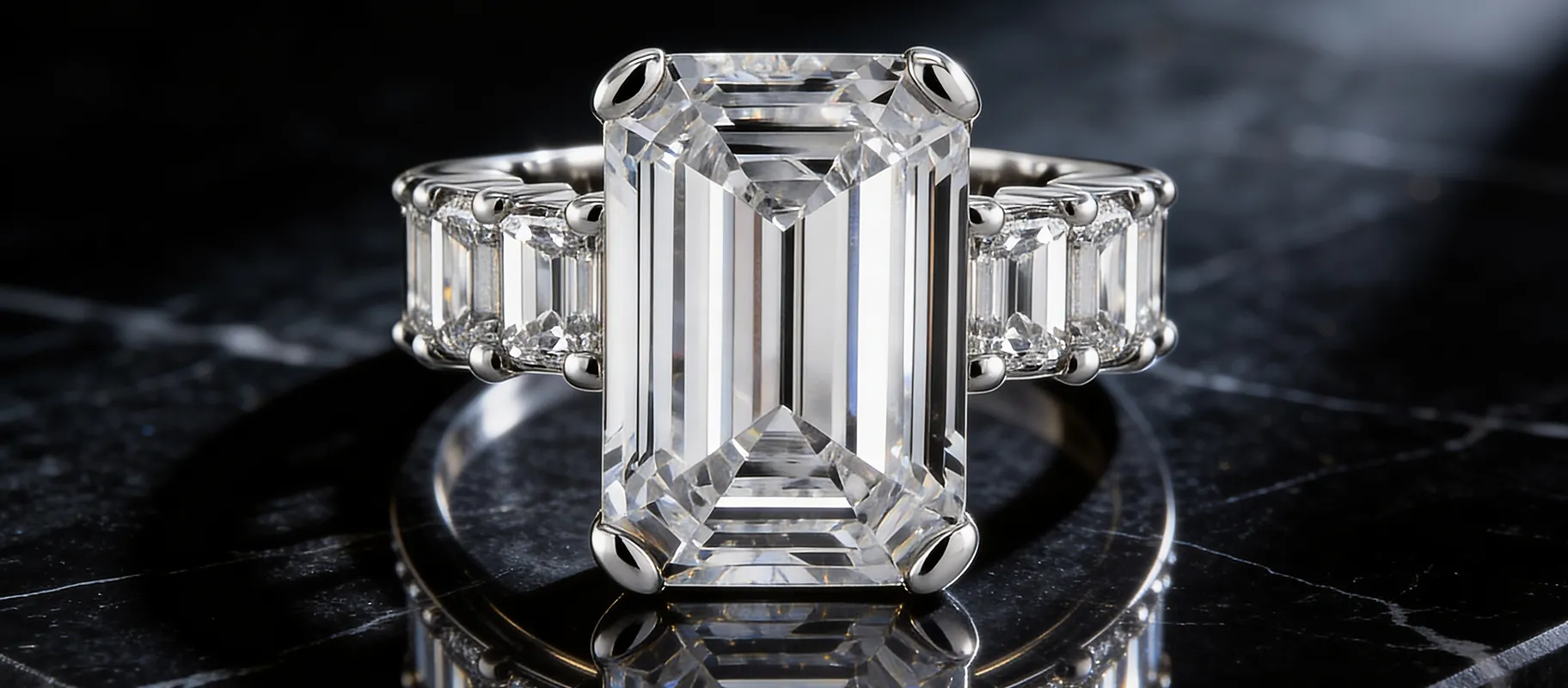
Your own watercolor is well suited as a model for a ring, because it captures color, form, and mood. However, it usually shows only one view and no dimensions. The workshop therefore translates it into stones, setting, and proportions, shows the ring as a model from all sides, and produces it only after your approval.
At a glance
- What the watercolor shows
- Color, outline, mood, usually from one view
- What it leaves open
- Dimensions, height, side view, construction of the setting
- Translating color
- The painted tone is compared side by side with real stones
- Translating form
- Three-dimensional model, checked for scale and manufacturability
- Ring size
- Wide shanks fit more snugly and often need a larger size
- Rights
- Your watercolor remains your work, settle its use in writing
A watercolor is a good beginning
Anyone who paints their dream ring has already done the most important groundwork: they have decided what they like. A watercolor captures things that are hard to describe, such as how warm a red should appear, how delicate a shank is, or how the stone floats above the finger. For the workshop, this is more valuable than a list of adjectives, because it shows an intention, not a guess.
But a watercolor is not a blueprint. It almost always shows only one view, usually from above or at an angle from the front. Height, wall thickness, the underside of the setting, and the width of the shank in detail are missing. Watercolor runs, edges become soft, light is painted rather than measured. The goldsmith's task is to build a ring from this image that remains true to it and still holds.
What the image sets and what remains open
An honest inventory before the first conversation is helpful. Go through your watercolor and note which elements are indispensable and which only carry the mood. The following table shows which questions the workshop typically has to clarify before the image becomes a design.

| Element in the image | What it conveys | What the workshop clarifies |
|---|---|---|
| Color of the stone | Tone and mood | Which gemstone species achieves this tone in nature |
| Outline of the stone | Shape, such as oval, round, or angular | Cut, dimensions, and length-to-width ratio |
| Line of the shank | Delicate, strong, curved | Minimum thickness for daily wear |
| Painted highlights | Sparkle or luster | Whether accent stones or the cut can achieve this |
| Gold tone | Warm or cool | Gold color and alloy |
| Ornament | Character of the ring | Whether it can be made and is durable at this size |
The more clearly you record what is binding, the closer the finished ring stays to the image.
The side view is missing particularly often. Yet it decides how high the stone sits, whether it catches on sweaters, and whether a wedding band will later fit beside it. If you have an idea of this, paint or sketch the ring a second time from the side, even roughly. How sketch, watercolor, and digital model are combined in the design is explained in the guide Sketch, watercolor, or CAD.
Translating the painted color into a stone
Color is free on paper, but not in nature. A painted pink can correspond to a rubellite, a pink sapphire, or a spinel, and a painted turquoise blue to a Paraíba or Lagoon tourmaline. Each of these gemstone species has its own hardness, its own inclusions, and its own way of guiding light. The choice of species therefore follows not only the tone but also the daily wear the ring is meant to withstand.
The tone itself is best compared directly. Place your watercolor next to real stones and look at both in daylight and under indoor light. Stones look different depending on the light, paper hardly at all. Expect the matching stone to be somewhat lighter, darker, or more saturated than your image. What matters is that it carries the same mood. How colored stones look in an engagement ring is described in the guide Engagement ring with a colored gemstone.
From the image to a three-dimensional model
- Discuss the watercolorBinding elements and mood are separated, and open questions are noted.
- Determine the stoneSpecies, cut, and dimensions are determined, and the color is compared against the stone.
- Technical drawingTop view, side view, and shank are drawn with dimensions.
- Three-dimensional modelThe ring is constructed digitally and shown from all sides, as a prototype if needed.
- Approval and productionOnly after your agreement is the ring made in metal and the stone set.
The step into the model is the real test. In its jewelry design training, GIA describes how designs are built in CAD according to scale, proportion, and the relationship of the elements to one another. Prototypes from the 3D printer are compared with the digital model. For your ring, this means: on the model you can see whether the delicate line of your watercolor still looks delicate in gold or needs to be reinforced. The glossary explains the term under 3D design.
Setting and ring size: where the image must give way
Many painted rings show a stone that floats almost freely. In metal, it needs support. Prongs reveal much of the stone, but according to GIA their tips can catch on fabrics and should be inspected occasionally. A bezel setting, that is, a closed metal rim, protects the edges of the stone very well and looks calmer. A halo of small stones makes the center stone appear larger. Which solution comes closest to the watercolor becomes clear only in the model. More on this in the glossary under Prong setting.

The width of the shank also changes the fit. GIA points out that rings with a wide shank fit more snugly and usually need to be chosen somewhat larger. Fingers are narrower in the cold and thicker in warmth, and the ring must fit over the knuckle. Anyone who has painted a substantial ring should therefore have the ring size measured with a sizer of similar width, not with a narrow ring.
Your watercolor and the rights to it
A picture you painted yourself is your work. Whether it is protected by copyright depends, under § 2 of the German Copyright Act, on whether it is a personal intellectual creation. In practice, another question is more important: may the workshop later show your motif or the ring made from it, or make it a second time? Record this in writing before work begins, as well as whether you will receive the original back.
If the contract is concluded without a personal meeting, for example by email after a virtual appointment, a special rule applies. Under § 312g para. 2 no. 1 of the German Civil Code (BGB), there is no right of withdrawal for goods that are not prefabricated and are produced according to the consumer's individual specification. A ring based on your watercolor falls into this category. Therefore, check model, stone, and dimensions carefully before you approve production.
Typical mistakes with painted models
- Expecting a stone to match the painted tone exactly.
- Painting only the top view and leaving height and side view to the workshop without asking.
- Requesting a very fine line that will not hold up in daily wear.
- Measuring the ring size with a narrow ring although a wide one has been painted.
- Checking the model only on screen without knowing its dimensions in millimeters.
None of these mistakes makes a watercolor unsuitable as a model. They arise when image and blueprint are confused. Anyone who understands their watercolor as a statement of intent and remains open to suggestions on construction receives a ring that looks like the image and can still be worn every day. How a design generally moves from briefing to approval is described in the guide The bespoke design.
Watercolors in the design process at Vikar Ahmed
At Vikar Ahmed, watercolors are themselves part of the design. In-house designers develop concepts in sketches and watercolors that incorporate personal wishes. A 3D CAD design with a photorealistic view then makes the piece tangible before production. It is made as a one-of-a-kind piece in the in-house atelier in Idar-Oberstein. In Kaiserslautern, the house has no location; appointments take place in the showroom in Idar-Oberstein or virtually.
Frequently asked questions
I have painted a watercolor of my dream ring myself and want to have it made. Which goldsmith in Kaiserslautern works with such models?
What matters is a workshop that designs its own pieces, translates your image into a three-dimensional model, and shows it to you before production. Vikar Ahmed has no location in Kaiserslautern. The atelier in Idar-Oberstein itself works with watercolors and CAD in the design process and offers consultations by appointment, in person or virtually.
Is a watercolor of the top view enough as a model for a ring?
As a starting point, yes; as a blueprint, no. The top view shows color and outline, but not how high the stone sits or how the shank runs from the side. The workshop adds these views in the technical drawing and in the model, which you approve before production.
Can a gemstone have exactly the color from my watercolor?
Rarely exactly, but often very close. Painted color is free, while stones have a natural color range depending on their species and look different under different light. Therefore compare your image directly next to real stones, in daylight and under indoor light, and pay attention to the mood rather than the exact tone.
Which setting comes closest to a floating stone in the watercolor?
Usually a prong setting, because it shows little metal and reveals much of the stone. Its tips should be inspected occasionally. Anyone who wants more protection for the edges chooses a bezel setting, which looks calmer. Which solution best matches the image is shown by the three-dimensional model.
Will I get my watercolor back after production?
That is a matter of agreement, not chance. Clarify before work begins whether the workshop keeps the original, makes a copy, or returns it, and whether the image or ring may be shown later. Record the answer in writing, together with design, material, and time frame.
Private consultation
Bring your watercolor with you or send a photo in advance. The appointment covers what in the image is binding, which stones carry the color, and how the ring should look from the side. Vikar Ahmed offers consultations in the showroom in Idar-Oberstein by appointment or virtually. Request an appointment for a private consultation.
Further reading
- Engagement ring from your own design: from idea to model
- Having jewelry made from your own sketch
- Pendant from your own watercolor
- Glossary: 3D design
- Bespoke at Vikar Ahmed
Sources
- GIA: Jewelry Design and Technology Program, accessed 2026-11-17
- GIA 4Cs: Complete Guide to Engagement Ring Settings, accessed 2026-11-17
- GIA 4Cs: How to Determine Ring Size, accessed 2026-11-17
- UrhG § 2 Geschützte Werke, accessed 2026-11-17
- BGB § 312g Widerrufsrecht, accessed 2026-11-17
- Vikar Ahmed: Startseite (Skizzen und Aquarelle), accessed 2026-11-16
- Vikar Ahmed: Bespoke, Designprozess, accessed 2026-11-16

A personal conversation starts here.
At the showroom in Idar-Oberstein or by video. Vikar Ahmed discusses your ideas, stones and designs with you and answers your questions calmly and in confidence.


Thank you for your request.
Your request will be handled with the utmost attention and discretion. Vikar Ahmed will get back to you.
Your details
Request
–
Occasion
–
Consultation
–
Contact
–
In the meantime
Insights: What is a Paraíba tourmaline? · Engagement ring to your own design: how does it work?
Confidential and without obligation
Back to the pagePrivate consultation
A personal conversation starts here.
- Time for your questions, wishes and ideas
- In the showroom in Idar-Oberstein or by video
- Confidential, discreet and without obligation
Vikar Ahmed · Hauptstraße 111 · 55743 Idar-Oberstein, Germany