

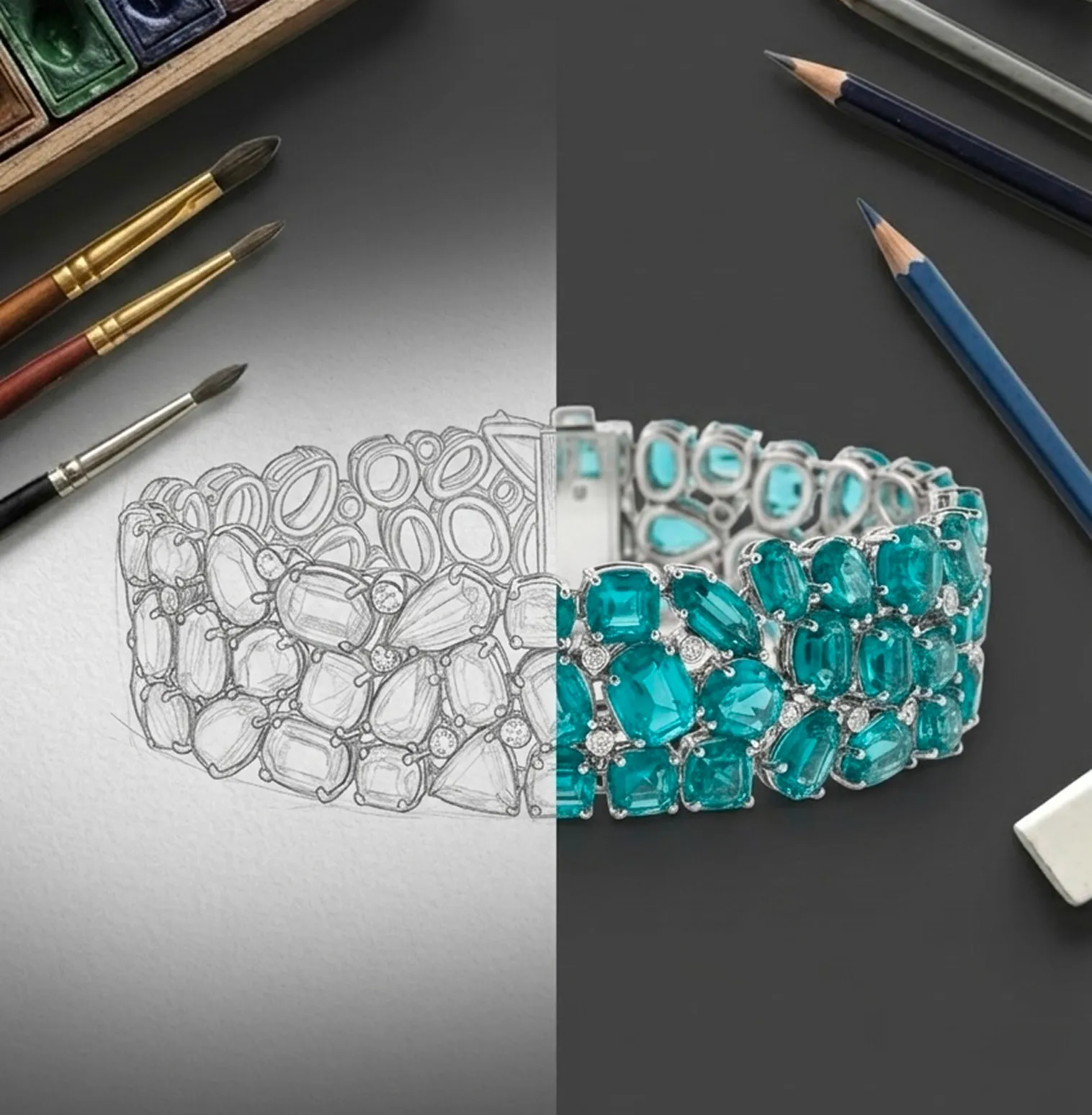
Jewelry made from your own sketch comes about in four steps: the workshop reads your drawing, clarifies dimensions and construction, shows a three-dimensional model, and produces the piece after your approval. Your sketch should show the main view, the approximate size, and marked essential elements. What the drawing leaves open, the workshop proposes. Settle usage rights to the design in writing beforehand.
At a glance
- Sufficient
- One main view with approximate size and marked essential elements
- Helpful
- Side view, drawing at actual size, notes on stone and metal
- The workshop's task
- Determining dimensions, wall thicknesses, setting, and clasp
- Review
- Model checked for scale, proportion, and manufacturability
- Rights
- Copyright only for a personal intellectual creation (Section 2 UrhG)
- Withdrawal
- Excluded for pieces made to your specifications (Section 312g(2) German Civil Code (BGB))
The sketch shows what you mean
A sketch does not have to be beautiful to work. It has to show what matters to you. A few lines on a piece of paper often convey more than a long description, because they capture proportion, direction, and character. For the workshop, the sketch is a commission in visual form: it shows the goal, not the way. The way, meaning dimensions, material thicknesses, and construction, is added by the goldsmith.
This guide applies to all types of jewelry, from pendants and earrings to bangles. There is a separate page for engagement rings: An engagement ring from your own design. If you work with watercolor instead of pencil, you will find advice under From your own watercolor to a ring. Here the question is how a drawing becomes legible for any kind of piece and what happens between paper and metal.
What a good template contains
A sketch becomes legible when the workshop can see what is binding. Therefore mark the elements you do not want to do without, and write next to them what merely describes a mood. If possible, draw the piece once at actual size. Many ideas look convincing in a large format and become too fussy at actual size. You notice this fastest yourself, on paper.

- Main view: the way others will see the piece
- Side view or back, if something is meant to happen there
- Approximate size, ideally a drawing at a scale of 1 to 1
- Marked essential elements and marked open areas
- Notes on stone, color, and metal, even if these are still undecided
What is missing is not a problem, as long as it is said. A sentence such as “I don't know about the clasp” is more valuable to the workshop than a drawn clasp that is only a guess. That way the goldsmith knows where to make suggestions and where to keep to your line. How much of the design you hand over and how much you keep is described in the guide How much you shape a one-of-a-kind piece.
Every type of jewelry raises different questions
A sketch for a pendant has to answer different questions than one for a ring. A ring bears loads every day, a pendant has to hang correctly, an earring has to hold securely. The table shows what your drawing should ideally clarify for each type of jewelry and where the workshop typically steps in.
| Type of jewelry | What the sketch should clarify | Where the workshop steps in |
|---|---|---|
| Ring | Top view, height of the stone, width of the shank | Wall thickness, ring size, setting |
| Pendant | Outline, front and back, suspension | Center of gravity, bail, chain thickness |
| Earrings | Length, movement, whether stud or drop | Weight, clasp, pair mirrored exactly |
| Bangle or bracelet | Profile, opening, stone setting | Fit, clasp, edge protection |
| Necklace | Line, centerpiece, length | Articulation, flexibility, clasp |
The right-hand column lists points that remain open in most sketches and must be resolved with technical expertise.
Some limits arise from practice. According to GIA, wide ring shanks fit more tightly and usually need a larger size. Rings with pavé are difficult to resize. For earrings, GIA names screw-back and safety clasps as the most secure variants. Such points rarely appear in a sketch, but they decide whether the piece holds up in everyday life. There are separate guides for pendants, for example A pendant from a sketch.
From line to model
- Reading the sketchEssential elements, mood, and open points are gone through together.
- Setting dimensionsSize, stone, metal, wall thicknesses, and clasp are determined.
- Showing the modelThe piece is constructed in three dimensions and shown from all sides.
- ApprovingYou check proportion and details and give your approval in writing.
- MakingThe piece is cast or built, set, and polished.
The most important step is the model. In its jewelry design training, GIA teaches building CAD models according to scale, proportion, and the relationship of the elements to one another, and comparing 3D-printed prototypes with the digital model. The aim is durable pieces that are comfortable to wear, within the bounds of cost, time, size, style, and production method. The model shows you whether your line looks the same in metal as on paper. The glossary explains the term under 3D design.
Who owns the sketch and the design
Your sketch is your work. Whether it is protected by copyright is decided by Section 2 of the German Copyright Act (UrhG): works of applied art are also protected, but only if they are a personal intellectual creation. A simple form often does not meet this standard. Under Section 2 of the German Designs Act, a registered design protects a design that is new and has individual character, meaning it produces a different overall impression than designs already known.

Because statutory protection is uncertain in the individual case, the question belongs in the agreement. Clarify whether the workshop may show your piece, whether it may make it a second time, and who receives the worked-out design. If the contract is concluded without a personal meeting, the following also applies: under Section 312g(2) No. 1 of the German Civil Code (BGB), the right of withdrawal does not apply to goods made to the consumer's individual specifications. Approving the model is therefore your most important checkpoint.
Common mistakes with your own templates
- Drawing only in a large format and never checking the effect at actual size.
- Guessing the clasp, bail, or suspension instead of leaving it open.
- Not separating essential elements from mood, so that every line seems binding.
- Approving the model without having seen the back and the side view.
- Discussing usage rights and the return of the sketch only verbally.
Behind most mistakes lies the same expectation: that the sketch is already the finished piece. It is the beginning of a conversation. If you say openly what matters to you and what does not, you give the workshop room to find technical solutions without changing the idea. How a design is presented and agreed upon is explained in the guide Sketch, watercolor, or CAD.
Your own designs at Vikar Ahmed
At Vikar Ahmed, in-house designers develop independent concepts that incorporate personal wishes, in sketches and watercolors. With CAD, the piece is shown in three dimensions and can be experienced before production. Goldsmiths from Idar-Oberstein realize it as a one-of-a-kind piece in the house's in-house atelier. The showroom is in Idar-Oberstein, and the house has no location in Kirn or Trier. As a guide, more elaborate custom pieces take about four to six weeks and High Jewelry and bespoke projects about one to three months, so a fixed date belongs in your request from the start.
Frequently asked questions
Who makes jewelry from my own sketch in Kirn?
Vikar Ahmed has no location in Kirn. The atelier in Idar-Oberstein takes your own sketches as a starting point, works them out with in-house designers, shows the piece in CAD, and makes it as a one-of-a-kind piece in its in-house atelier. If possible, bring the drawing at actual size and with the essential elements marked.
Which ateliers in Idar-Oberstein make jewelry from my design?
Look for ateliers that combine design and production in-house and show you a model before production. Vikar Ahmed in Idar-Oberstein incorporates personal wishes into its own concepts, visualizes the piece with CAD, and makes it as a one-of-a-kind piece in its in-house atelier, by appointment.
Do I need to be good at drawing to have jewelry made from my own sketch?
No. A sketch does not have to be beautiful, it has to show what matters to you. Mark essential elements, note open points, and if possible draw the piece once at actual size. The workshop adds dimensions, construction, and clasp in the model.
Is my jewelry sketch protected by copyright?
Only if it is a personal intellectual creation, as Section 2 UrhG requires for works of applied art. With simple forms, this is often not the case. Therefore settle in writing before starting whether the workshop may show the piece or make it again.
What should I check on the model before approval?
Above all, size and proportion in relation to the body, the side view, and the back. For rings, the height of the stone and the width of the shank, for earrings, length and clasp, for pendants, how the piece hangs on the chain. Whatever does not fit can still be changed easily at this stage.
Can I send my sketch in advance as a photo?
Yes, a photo of the sketch is enough for the first exchange, especially before a virtual appointment. Photograph it straight from above, in good light, and with a ruler next to it so that the size remains recognizable. Bring the original to the personal appointment when details are discussed.
Private consultation
Bring your sketch with you or send a photo in advance, ideally with notes on stone and metal. Vikar Ahmed advises in the house's showroom in Idar-Oberstein by appointment or virtually and discusses there how your drawing becomes a piece of jewelry. Request an appointment for a private consultation.
Further reading
- The bespoke design: briefing, variations, approval
- A pendant from your own design
- The private design consultation
- Glossary: Bespoke
- Bespoke at Vikar Ahmed
Sources
- GIA: Jewelry Design and Technology Program, accessed 2026-11-17
- GIA 4Cs: How to Determine Ring Size, accessed 2026-11-17
- GIA 4Cs: How to Choose Diamond Stud Earrings, accessed 2026-11-17
- UrhG § 2 Geschützte Werke, accessed 2026-11-17
- Designgesetz § 2 Designschutz, accessed 2026-11-17
- BGB § 312g Widerrufsrecht, accessed 2026-11-17
- Vikar Ahmed: Bespoke, Designprozess, accessed 2026-11-16
- Vikar Ahmed: Startseite (Skizzen und Aquarelle), accessed 2026-11-16

A personal conversation starts here.
At the showroom in Idar-Oberstein or by video. Vikar Ahmed discusses your ideas, stones and designs with you and answers your questions calmly and in confidence.


Thank you for your request.
Your request will be handled with the utmost attention and discretion. Vikar Ahmed will get back to you.
Your details
Request
–
Occasion
–
Consultation
–
Contact
–
In the meantime
Insights: What is a Paraíba tourmaline? · Engagement ring to your own design: how does it work?
Confidential and without obligation
Back to the pagePrivate consultation
A personal conversation starts here.
- Time for your questions, wishes and ideas
- In the showroom in Idar-Oberstein or by video
- Confidential, discreet and without obligation
Vikar Ahmed · Hauptstraße 111 · 55743 Idar-Oberstein, Germany