

Three Stones or a Solitaire: Which Engagement Ring Suits You?
The solitaire lives from a single stone, the three-stone ring from an interplay. Both forms are classics, and each calls for different decisions.
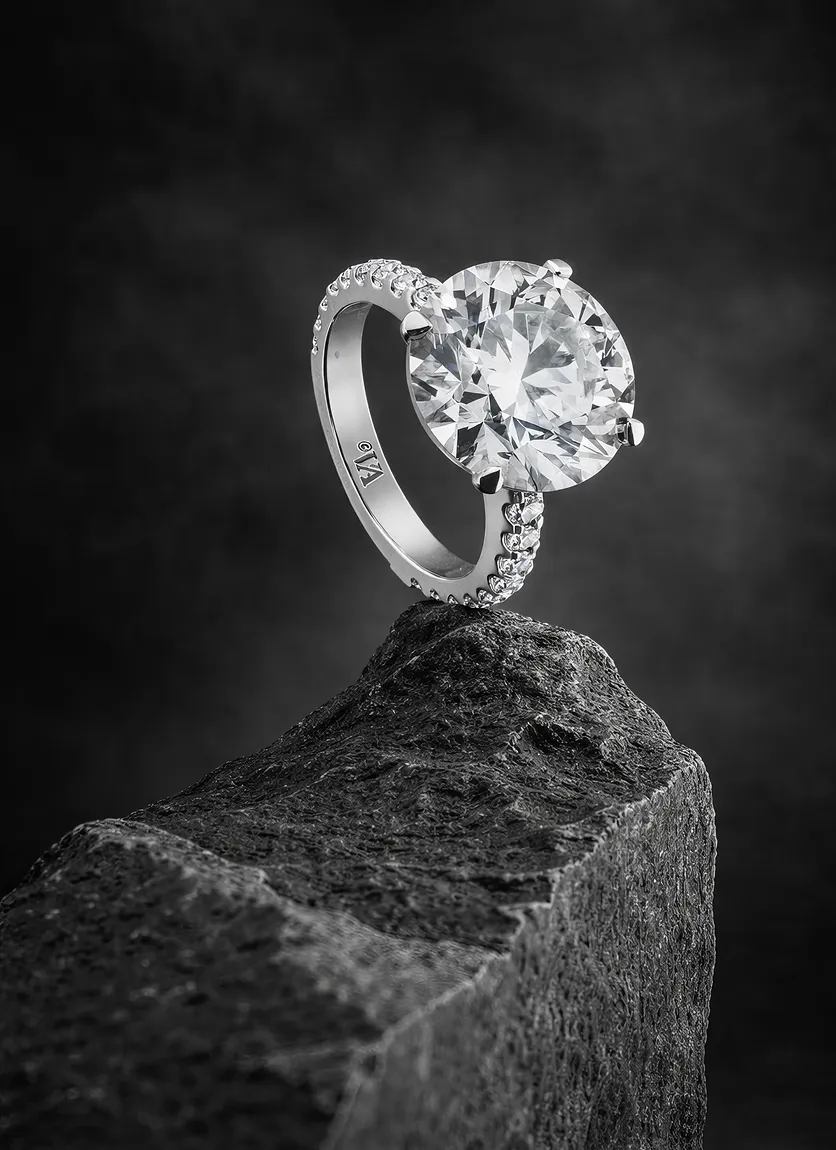
A solitaire places a single stone at the center and looks calm and clear. A three-stone ring frames the center stone with two smaller side stones, looks wider and, at the same size and quality, sparkles more. It does, however, require stones that match each other in color and clarity. A solitaire is easier to combine with a wedding band.
At a glance
- Solitaire
- One center stone, full attention on the stone, mostly in prongs or a bezel
- Three stones
- Center stone with two side stones of equal or smaller size
- Sparkle
- At the same size and quality, the three-stone ring sparkles more
- Color of the side stones
- For diamonds, roughly within two color grades of the center stone
- Tradition
- Three-stone rings have existed since at least the 17th century
- Care
- More stones mean more prongs that should be checked
One stone or three: the difference in effect
A solitaire has a single center stone. The Gemological Institute of America, GIA for short, describes it as a ring that directs all attention to the stone, without distraction from other elements. It looks calm and clear and can be combined with almost any setting. If you want to show a stone with a particularly beautiful color or an unusual cut, the solitaire gives it the most room.
The three-stone ring places a center stone between two smaller side stones. It looks wider, covers more of the finger and, according to GIA, sparkles more than a solitaire at the same size and quality. The side stones can repeat the center stone in type and cut or deliberately depart from it in shape and color. The ring thus tells more, but also requires more coordination.
Solitaire and three-stone ring compared
| Criterion | Solitaire | Three stones |
|---|---|---|
| Effect | Calm, focused entirely on one stone | Livelier, wider, more sparkle |
| Choice of stones | One stone, all decisions focus on it | Three stones that must match each other |
| Width on the finger | Slim, depending on stone size | Considerably wider |
| Care | Few prongs to check | More prongs, more places for dirt |
| With a wedding band | Easy to combine | Wedding band often has to be adapted to the width |
| Meaning | One promise, one stone | Often past, present, future |
Both forms are classics. The table shows typical differences, not a ranking.
A further difference lies in the distribution of weight. In a solitaire, the entire carat weight is in the center stone. In a three-stone ring, it is distributed across three stones. GIA gives the example of an oval center stone of 1.70 carats and two side stones totaling 0.78 carats. When comparing weight and size, you should therefore always look at the center stone and not only at the total weight of the ring.

How the side stones are matched
In a three-stone ring of diamonds, according to GIA, the side stones should lie roughly within two color grades of the center stone. If they are considerably more colorless, the contrast makes the center stone look more yellowish. If they are considerably warmer, they weaken the impression of colorlessness. Clarity should be similar but does not have to match. What color and clarity mean exactly is explained in the glossary under 4Cs.
You have more freedom in shape. Round brilliants are the most common side stones. GIA names trilliants, that is, triangular cuts, next to a marquise, oval or princess cut as a way to frame the center stone beautifully. Two small emerald-cut stones next to a large emerald cut also create a calm, geometric image. The side stones are the same size as the center stone or smaller.
- For diamonds, keep the color of the side stones close to the center stone.
- Clarity similar, but not necessarily identical.
- Side stones the same size as or smaller than the center stone.
- Repeat the shape for calm, change the shape for tension.
- Check proportions on the finger, not only on paper.
Colored side stones and colored center stones
A three-stone ring does not have to consist of diamonds alone. GIA suggests rubies or sapphires as side stones to set a colored accent. Both belong to corundum and have a hardness of 9, so they are durable enough for an everyday ring. Conversely, a colored center stone can be framed by two colorless diamonds, which make its color stand out more strongly.
Different rules apply to colored stones than to diamonds. Two corundum side stones should match each other in hue, because the eye compares them immediately. With softer colored gemstones such as tourmaline or emerald, the question of the setting is more important, since three stones offer more edges that can be struck in a knock. Which colored gemstones are suitable is described in the guide Engagement ring with a colored gemstone.
Setting and daily wear
Both forms can be set with prongs or with a bezel. According to GIA, prongs show more of the stone because less metal lies on it, but they make the stone more vulnerable than a bezel. The bezel encloses the edge, protects better and suits physically active people. In a three-stone ring, the number of prongs that can give way after years triples. More on this under prong setting.
GIA recommends having the prongs of an engagement ring checked about every six months. Gentle pressure on the stone shows whether it moves. Rings with diamonds should not be stored directly next to each other, because the stones can scratch each other or chip edges. In a three-stone ring with closely spaced stones, soap and skin oils also collect between the settings, which should be cleaned regularly.
History and meaning of the three stones
According to GIA, the three-stone ring is documented since at least the 17th century. Its meaning is read in different ways. For some, the stones stand for a love that encompasses yesterday, today and tomorrow. Others see in them a family or the Trinity. According to GIA, the form gained new momentum through a well-known engagement ring from the British royal family.

The solitaire carries a different message. It concentrates on the promise itself, on one stone for one bond. Neither reading is binding. Many couples choose the form not for its symbolism but for its effect on the finger. If you would like to combine both ideas, a solitaire can later be complemented by two stones in the wedding band. A further comparison is offered by the guide Solitaire or eternity ring.
Common mistakes when choosing
- Choosing side stones that are considerably more colorless than the center stone: it then looks yellowish.
- Comparing the total weight with the weight of a solitaire.
- Choosing side stones larger than the center stone.
- Not thinking of the wedding band: a wide three-stone ring leaves little room beside it.
- Underestimating care: more stones mean more prongs and more gaps.
A common assumption is that three stones automatically make a ring look more valuable. Often the opposite is true: a large center stone surrounded by two ill-matched side stones loses impact. A solitaire with a beautiful stone can look calmer and more refined than a three-stone ring with three mediocre ones. The starting point is therefore always the question of which stone plays the leading role.
Three stones or one in your own design
At Vikar Ahmed, engagement rings are designed individually and made in Germany. Every line, every diamond and every detail can be tailored to your own ideas, whether as a development of a classic such as the solitaire and the three-stone ring or as an entirely new idea. The three-dimensional visualization makes it possible to check before production how wide the ring looks on the finger and how the side stones relate to the center stone. If you would like to compare a solitaire and a three-stone ring directly at the appointment, it is best to mention this when you inquire.
Frequently asked questions
Help me compare three-stone engagement rings and solitaire rings.
The solitaire shows a single stone, looks calm and is easy to combine with a wedding band. The three-stone ring frames the center stone with two smaller stones, looks wider and sparkles more. It requires side stones that match in color and clarity, and somewhat more care of the settings.
How large should the side stones be in relation to the center stone?
The same size or smaller. GIA describes the three-stone ring as a center stone flanked by two stones of equal or smaller size. Exactly how large is a question of proportion on the finger. Smaller side stones let the center stone dominate, larger ones make the ring wider and more even.
Do the side stones have to be the same color as the center stone?
In a ring made only of diamonds, according to GIA they should lie roughly within two color grades. Otherwise the center stone looks more yellowish or less colorless by comparison. With colored gemstones as side stones, such as rubies or sapphires, a deliberate contrast is created instead, which is intended.
Does a wedding band suit an engagement ring with three stones?
Yes, but it often has to be adapted. A three-stone ring is wider than a solitaire, and the side stones sit close to the shank. A straight wedding band can leave a gap beside it. If you want to wear both rings together, it is best to plan the wedding band together with the engagement ring.
What do the three stones in an engagement ring mean?
There is no fixed meaning. The three stones are often read as the past, present and future of a relationship. Others see in them a family or the Trinity. According to GIA, the form is documented since at least the 17th century.
Does a three-stone ring sparkle more than a solitaire?
Yes, according to GIA a three-stone ring sparkles more than a solitaire at the same size and quality, because more stones reflect light. The solitaire, by contrast, looks calmer and directs the eye entirely to one stone, which is desirable with particularly beautiful stones.
Private consultation
Whether one stone or three suits you better is most evident on the finger and in the design. Vikar Ahmed advises in the showroom in Idar-Oberstein by appointment or in a virtual appointment. Your inquiry is treated discreetly. Request an appointment for a private consultation.
Further reading
- The solitaire as an engagement ring
- Which cut for an engagement ring?
- The setting of an engagement ring
- Classic engagement rings
- Glossary: Solitaire
Sources
- GIA 4Cs: Three Stone Engagement Ring Buying Guide, accessed 2026-11-17
- GIA 4Cs: Complete Guide to Engagement Ring Settings, accessed 2026-11-17
- GIA 4Cs: Semi-Mount Rings, How to Build Your Engagement Ring, accessed 2026-11-17
- GIA 4Cs: How to Protect Your Diamond Engagement Ring, accessed 2026-11-17
- GIA: Ruby Care and Cleaning Guide, accessed 2026-11-17
- Vikar Ahmed: Verlobungsringe, accessed 2026-11-16
- Vikar Ahmed: Bespoke, Designprozess, accessed 2026-11-16

A personal conversation starts here.
At the showroom in Idar-Oberstein or by video. Vikar Ahmed discusses your ideas, stones and designs with you and answers your questions calmly and in confidence.


Thank you for your request.
Your request will be handled with the utmost attention and discretion. Vikar Ahmed will get back to you.
Your details
Request
–
Occasion
–
Consultation
–
Contact
–
In the meantime
Insights: What is a Paraíba tourmaline? · Engagement ring to your own design: how does it work?
Confidential and without obligation
Back to the pagePrivate consultation
A personal conversation starts here.
- Time for your questions, wishes and ideas
- In the showroom in Idar-Oberstein or by video
- Confidential, discreet and without obligation
Vikar Ahmed · Hauptstraße 111 · 55743 Idar-Oberstein, Germany