

Lagoon Tourmaline: What a Statement of Origin Means
A blue-green tourmaline with a stated locality appears documented. Whether it is depends on who makes the statement and what it is based on.
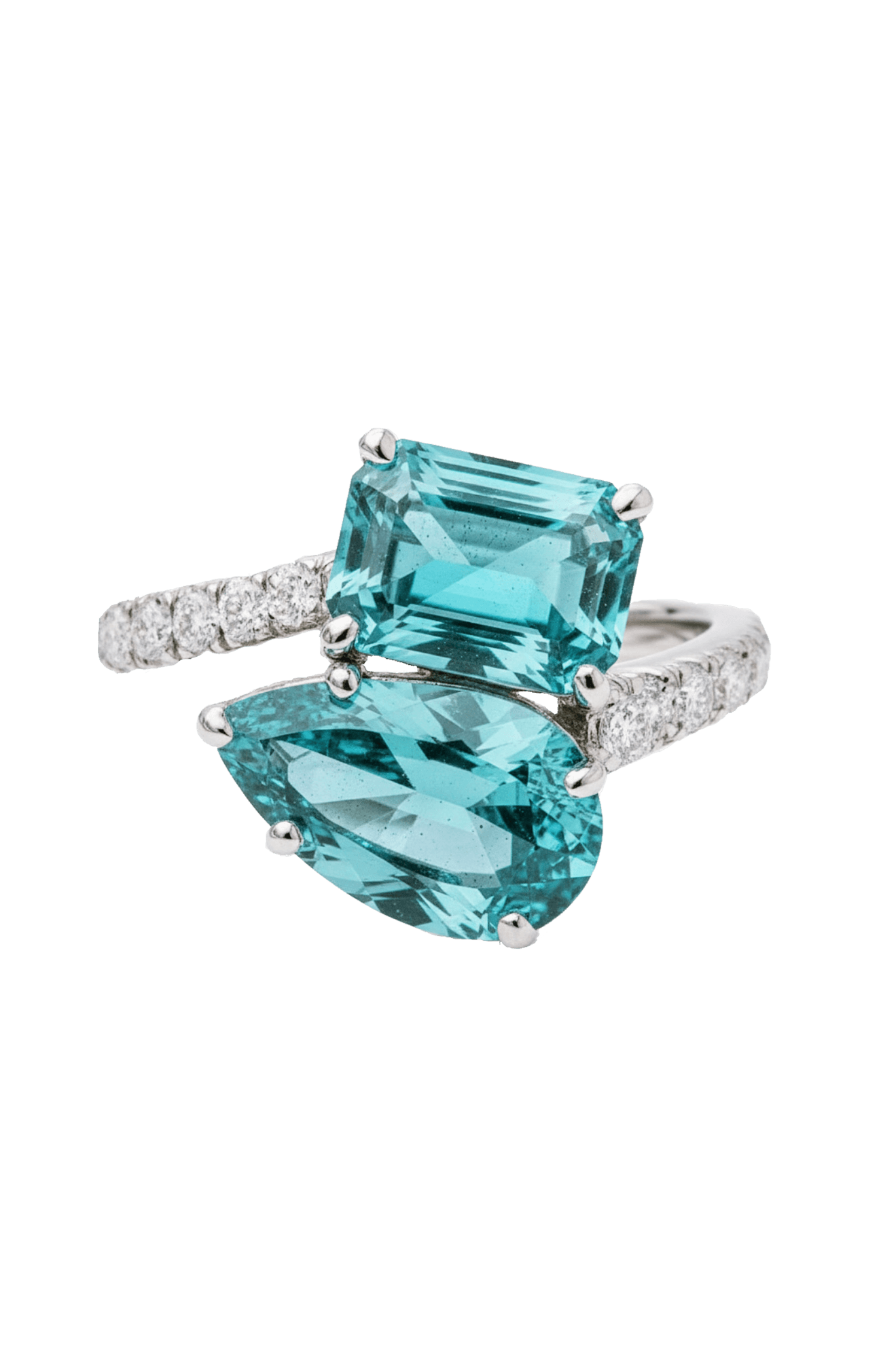
A statement of origin for a Lagoon tourmaline is usually a claim by the seller, not a laboratory finding. Lagoon is a trade name for blue-green tourmalines, and laboratories do not write it in reports. GIA offers origin reports for Paraíba tourmaline, but not for tourmaline in general. A stated locality only becomes reliable when traceable documentation or a laboratory supports it.
At a glance
- Lagoon
- Trade name for blue-green tourmaline, not a laboratory designation
- In the laboratory report
- Tourmaline, plus a descriptive color statement
- GIA origin report
- Available for Paraíba tourmaline, not offered for tourmaline in general
- Cause of blue and green
- In tourmaline usually iron, in Paraíba tourmaline copper and manganese
- Origin in the report
- According to SSEF an expert opinion, not a measured value
- Key question
- Who makes the statement of locality, and with what evidence
Lagoon describes a color, not a locality
Lagoon is a name from the trade. It stands for tourmalines in a light to medium blue-green reminiscent of the water of a tropical lagoon. There is no binding definition, and no laboratory determines from which hue a stone may carry the name. What a seller calls Lagoon can therefore differ considerably from stone to stone. The term is explained in the glossary under Lagoon tourmaline; this page addresses the question of locality.

Many dealers associate the name with a particular area. A technical article on Le Gemmologue describes deposits in the Erongo region of Namibia, whose mines yield tourmalines ranging from Lagoon blue-green to indigo blue. It does not follow that every Lagoon tourmaline comes from Namibia. The trade name is tied to the color. A blue-green tourmaline from another deposit can carry the same name without anything changing about the stone.
Who makes a statement of origin
A statement of locality for a colored stone can come from three directions. Most often the seller names it, based on information from their supplier. Less often there is a chain of documents accompanying the stone from mining through cutting to the jewel. The third possibility is the finding of a gemological laboratory that examines the stone itself and derives an origin from it. Only the last form is independent of the seller.
| Type of statement | What it is based on | What it proves |
|---|---|---|
| Claim by the seller | Information from the supply chain | As much as the chain behind it supports |
| Documented supply chain | Papers from mining to cutting | The path of this stone, if complete |
| Laboratory finding | Examination of the stone itself | An expert assessment, as far as determinable |
The statements do not exclude one another. A statement of locality is strongest when several forms are consistent.
What a laboratory can say about blue-green tourmaline
A laboratory first determines what material it is and tests for treatments. GIA describes its Colored Stone Identification Report as follows: it identifies and describes the material and lists detectable treatments. This report does not state an origin. GIA offers the report with geographic origin only for a fixed list of stones, including ruby, sapphire, emerald, and Paraíba tourmaline. Tourmaline in general is not among them.
The Swiss laboratory SSEF uses descriptive color statements in its reports such as blue, light blue, greenish blue, or green, and no trade names. A word like Lagoon therefore does not appear in the report but in the seller's text. If you are shown a Lagoon tourmaline with a report, you will read tourmaline and a color description there. Which laboratories exist and what they stand for is shown in the glossary under SSEF and Gübelin.
Good to know
Even where laboratories state it, origin is an assessment. SSEF explicitly calls origin determination an expert opinion, based on inclusions, trace elements, and spectroscopic data compared with reference stones.
The real test: iron or copper
For a blue-green tourmaline, the question of the cause of color is usually more revealing than the question of locality. According to GIA, green and blue in tourmaline are usually caused by traces of iron, possibly also titanium. In Paraíba tourmaline, by contrast, the color is based mainly on copper and manganese. Under the definition reproduced by GIA and SSEF, the name Paraíba applies regardless of the country of origin, as long as color and cause of color match.

A case from SSEF shows how close the two groups can come. A client submitted two tourmalines as a matching pair of Paraíba tourmalines. Shape, size, and color were identical. The analysis showed that only one of the two stones contained copper. The other contained iron, no copper, and was therefore an indicolite, a blue tourmaline without the cause of color of Paraíba. The difference could not be seen with the eye.
For the question of origin, this means: before a locality counts, it should be established which tourmaline is present. A copper-bearing stone belongs to the group for which laboratories offer origin reports. An iron-colored Lagoon tourmaline remains a tourmaline whose locality can at most be documented through the supply chain. The direct comparison of the two stones is covered in the guide Lagoon tourmaline or Paraíba.
How to recognize a reliable statement of locality
A statement of origin is worth as much as the document behind it. Ask therefore not only about the country but about the source of the statement. An answer such as "from Namibia" without further documents is information, not proof. An invoice with a stated locality proves what the seller declared, not where the stone comes from. The more specifically mine, period, and intermediate stages are named, the better the statement can be assessed.
- Ask who makes the statement of locality: seller, supplier, or laboratory.
- Ask to see the document on which the statement is based.
- Check whether the weight and dimensions in the document match the stone.
- Clarify whether a laboratory has determined the material and tested for treatments.
- Distinguish between color name and origin: Lagoon says nothing about locality.
A laboratory report can usually be verified with the issuing laboratory using the report number. This ensures that report and stone belong together. What a report generally records about the origin and treatment of colored stones is explained in the guide Origin and treatment of colored stones. The same principle applies to Lagoon tourmaline with one restriction: an origin from the laboratory is rarely to be expected for it.
Common misunderstandings
- Lagoon is taken as a designation of origin. It is a color name from the trade.
- A report with the word tourmaline is read as proof of origin. It confirms the material.
- A blue-green stone is taken for a Paraíba tourmaline. Only the cause of color decides this.
- An origin on the invoice is considered verified. It reflects the seller's declaration.
- A well-known country of origin is equated with higher quality. Color and clarity count on the stone itself.
A further point concerns treatment. According to GIA, heating can lighten green tourmalines that are too dark and influence the color of other tourmalines. A statement of origin says nothing about this. Whether a stone is treated is clarified by testing for treatments, not by the locality. Both statements belong in the same conversation but are separate questions. More in the glossary under treatment.
When origin matters for Lagoon tourmaline
For the effect in a jewel, the origin of a Lagoon tourmaline is secondary. What the stone shows on the finger or at the neck is determined by hue, saturation, clarity, and cut. For collectors, locality can still play a role, for example when a collection is organized by deposit. Then a well-documented supply chain counts for more than a trade name, and the documents should be passed on with the stone.
Lagoon tourmalines and Namibian tourmalines are among the stones set in pieces by Vikar Ahmed. For these stones, a statement of origin is only worth as much as the laboratory report it rests on. Vikar Ahmed tests colored stones without their own laboratory report gemologically in house and provides a guarantee for them. If you choose a tourmaline for its color, you should learn both in the conversation: how the color comes about and what a stated origin is based on. An overview of the stone itself is given on the page Lagoon tourmaline.
Frequently asked questions
Does the name Lagoon appear in a laboratory report?
As a rule, no. Laboratories such as SSEF use descriptive color statements such as blue, greenish blue, or green, and no trade names. The report names the material as tourmaline and describes the color. The name Lagoon comes from the trade and appears in the seller's text, not in the finding.
Can a laboratory determine the origin of a Lagoon tourmaline?
Only to a limited extent. GIA offers origin reports for a fixed list of stones, including Paraíba tourmaline, but not for tourmaline in general. A blue-green tourmaline without copper therefore falls outside this service. Its origin can then be traced mainly through a documented supply chain.
Does every Lagoon tourmaline come from Namibia?
No. The name describes a color. A technical article names mines in the Erongo region of Namibia as a source of tourmalines in Lagoon blue-green, but stones from other deposits can also be called that. Whether a particular stone comes from Namibia is shown only by evidence for exactly that stone.
How does a Lagoon tourmaline differ from a Paraíba tourmaline?
In the cause of its color. Green and blue in tourmaline are usually caused by iron. A Paraíba tourmaline owes its color mainly to copper and manganese. This cannot be distinguished reliably with the naked eye. Clarity comes from a laboratory's chemical analysis.
What does a statement of origin on the invoice prove?
It proves what the seller declared about the stone. Whether the statement is correct depends on the documents behind it, such as papers from the supply chain. An invoice replaces neither these documents nor a laboratory finding. Ask therefore for the document on which the stated locality is based.
Is a Lagoon tourmaline from a well-known country of origin better?
Not in itself. Quality is decided by the hue, saturation, clarity, and cut of the individual stone. A well-known country of origin can hold a particular appeal for collectors but does not replace looking at the stone. Two stones from the same mine can turn out very differently.
Private consultation
Whether the origin of a tourmaline matters for your piece and how it can be documented is best clarified in conversation. Vikar Ahmed advises in the showroom in Idar-Oberstein by appointment or in a virtual appointment. Your inquiry is treated discreetly. Request an appointment for a private consultation.
Further reading
- What is a Lagoon tourmaline?
- Lagoon tourmaline and Paraíba compared
- Glossary: Origin report
- What a gemstone report contains
- Gemstone: Tourmaline
Sources
- GIA: Colored Stone Identification und Identification & Origin Report, accessed 2026-11-17
- GIA: Tourmaline Description, Farbursachen und Varietäten, accessed 2026-11-17
- GIA: Gem Treatment, accessed 2026-11-17
- GIA Gems & Gemology: Paraíba Tourmaline Geographic Origin Determination (Winter 2019), accessed 2026-11-17
- SSEF: Paraiba Tourmaline Report, Farbangaben und Herkunft, accessed 2026-11-17
- SSEF: A perfect match, Paraiba tourmaline and Indicolite tourmaline, accessed 2026-11-17
- Le Gemmologue: Tourmalines of Erongo, Namibia (Sébastien Bahri, 2018), accessed 2026-11-17
- Vikar Ahmed: Collections, accessed 2026-11-16

A personal conversation starts here.
At the showroom in Idar-Oberstein or by video. Vikar Ahmed discusses your ideas, stones and designs with you and answers your questions calmly and in confidence.


Thank you for your request.
Your request will be handled with the utmost attention and discretion. Vikar Ahmed will get back to you.
Your details
Request
–
Occasion
–
Consultation
–
Contact
–
In the meantime
Insights: What is a Paraíba tourmaline? · Engagement ring to your own design: how does it work?
Confidential and without obligation
Back to the pagePrivate consultation
A personal conversation starts here.
- Time for your questions, wishes and ideas
- In the showroom in Idar-Oberstein or by video
- Confidential, discreet and without obligation
Vikar Ahmed · Hauptstraße 111 · 55743 Idar-Oberstein, Germany