

Namibian Tourmalines and Brazilian Paraíba Tourmalines
Namibia and Brazil stand for two very different tourmalines. For collectors, and for jewelry with many stones such as chandelier earrings, the differences are worth knowing.
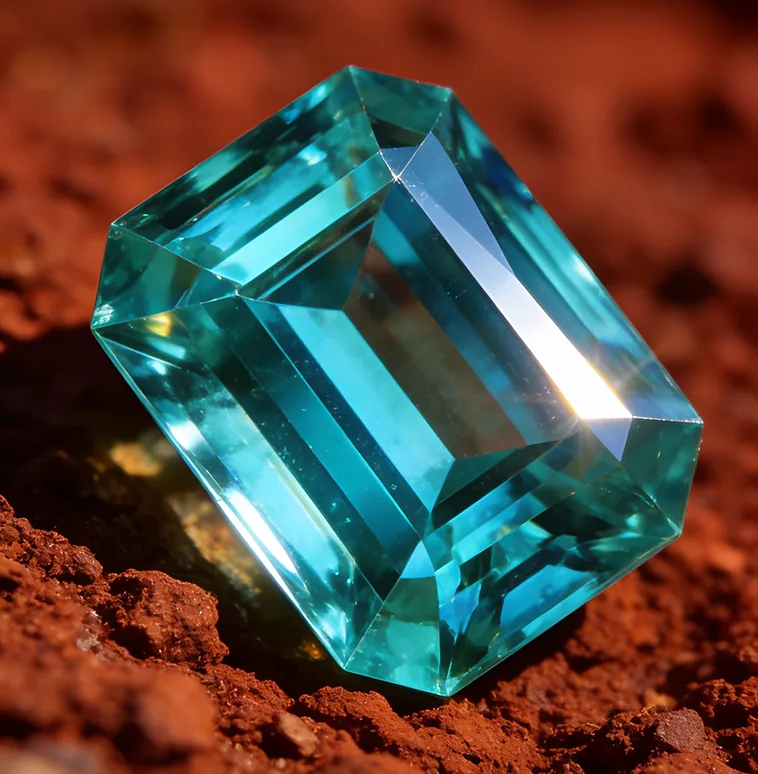
Brazilian Paraíba tourmalines appeal to collectors through their copper-induced neon color and great rarity, mostly in small sizes. Namibian tourmalines offer a broad color range from blue-green to indigo, and larger stones as well. For chandelier earrings with several stones, Namibian material is often easier to match, while Paraíba is the rarer stone with an origin report.
At a glance
- Namibian deposits
- Mainly the Erongo region around Omaruru, Usakos, and Karibib
- Colors from Namibia
- Blue-green, indigo, mint green, yellow, reddish brown, also rubellite
- Paraíba from Brazil
- Discovered in the late 1980s, colored by copper and manganese
- Copper compared
- Brazilian stones average around 11,400 ppmw, African stones below 2,000
- Paraíba size
- According to GIA, rarely over one carat
- Origin report
- Available from GIA for Paraíba tourmaline, not for other tourmalines
Two origins, two kinds of appeal
Comparing Namibian tourmalines with Brazilian Paraíba tourmalines does not mean comparing two quality grades of the same stone. Paraíba tourmaline is a category of its own, defined by copper as the cause of its color. Namibian tourmalines are an origin with many colors. According to GIA, iron usually produces green and blue tones in tourmaline, and manganese red and pink tones. For collectors, this creates two different incentives: on one side the extreme rarity of a color, on the other the variety and the chance of finding larger stones.

With chandelier earrings, meaning earrings with several elements hanging one below the other, a practical question arises. Such a pair often needs many stones that match in color and shape. Whether this works with a particular tourmaline depends on how many suitable stones exist at all. The guide on chandelier earrings describes the construction of such earrings in detail.
What distinguishes Namibian tourmalines
The best-known Namibian tourmalines come from the Erongo region. According to a report in the journal Le Gemmologue, mining is concentrated around Omaruru, Usakos, and Karibib, with two larger mines and many small operations. The stones form in cavities within pegmatites, which are coarse-grained rock veins. These pockets are irregularly distributed, so output fluctuates strongly, and years without finds can be followed by rich discoveries.
The color range is broad. Le Gemmologue names blue-green in lagoon tones, indigo, mint green, bright blue, strong yellow, and reddish brown. The Gübelin collection of the Gemological Institute of America, GIA for short, includes Namibian tourmalines as indicolite in blue, as rubellite in red, and as verdelite in green. According to Le Gemmologue, individual stones of almost 100 carats have come from the same region. The page on tourmaline gives an overview of the tourmaline group.
Brazilian Paraíba tourmaline
Paraíba tourmaline was discovered in the late 1980s in the Brazilian state of Paraíba, and later also in Rio Grande do Norte. Its color, ranging from neon blue through violet-blue to green, is due mainly to copper and manganese. In a study, GIA measured that Brazilian stones contain on average around 11,400 ppmw of copper, meaning parts per million by weight. For African stones from Nigeria and Mozambique, the value was below 2,000.
For collectors, color matters most in Paraíba tourmaline, and according to GIA blue and violet are especially sought after. Dealers rarely see stones over one carat, and almost all are cut individually. The guide on Brazilian Paraíba tourmaline explains how the origins differ in detail.
Neon blue from Namibia is not Paraíba tourmaline
Some Namibian tourmalines show a bright blue that resembles Paraíba tourmaline at first glance. Le Gemmologue reports on neon blue stones from Usakos examined by the Swiss laboratory SSEF. Iron and manganese were found, but no copper. By the laboratories' definition, a tourmaline is a Paraíba tourmaline only if its color is due mainly to copper and manganese, regardless of the country it comes from.

For collectors, this leads to a clear rule: color alone says nothing about the classification. A blue-green tourmaline from Namibia can be very beautiful, but without copper it is not a Paraíba tourmaline and should not be called one. Conversely, SSEF lists a copper-bearing stone from Africa in its report as tourmaline, with the note that the trade may call it Paraíba tourmaline. More on this under lagoon tourmaline.
The two origins compared
| Criterion | Namibian tourmalines | Brazilian Paraíba tourmaline |
|---|---|---|
| Cause of color | Iron or manganese, depending on color | Mainly copper and manganese |
| Color range | Blue-green, indigo, green, yellow, red | Neon blue, violet-blue, blue-green, green |
| Sizes | Large stones also known | Rarely over one carat |
| Availability | Fluctuating, depending on finds | Very limited |
| Treatment | To be clarified by report in each case | Frequently heated, according to SSEF |
| Origin report from GIA | Not offered | Available |
Classification according to GIA, SSEF, and Le Gemmologue. Each stone must be assessed individually.
The comparison shows that there is no generally better choice. Anyone looking for a stone whose rarity can be documented will prefer Paraíba tourmaline. Anyone looking for color in a larger format, or needing many stones for one piece of jewelry, has more latitude with Namibian tourmalines. Hardness and care are the same for both, since both are tourmalines at 7 to 7.5 on the Mohs scale.
What chandelier earrings demand of the stones
A chandelier earring distributes several stones over a length of a few centimeters. Each stone must match its counterpart on the other ear in color, shape, and size. With Paraíba tourmalines this is a considerable task, because even two well-matched stones are rare. A pair with many Paraíba tourmalines is therefore a collector's piece in the true sense. More often, a single Paraíba tourmaline carries the pair, complemented by diamonds.
Namibian tourmalines allow different designs. Their color range makes gradients possible, for example from mint green to indigo, and larger stones can form the lower end. Because earrings, according to GIA, are exposed to hard knocks less often than rings and bracelets, tourmalines can be set more openly there, which shows their color to greater effect. Weight remains a limit, however: large stones make the earring heavy.
Typical mistakes in the comparison
- Taking a blue-green tourmaline for a Paraíba tourmaline based on its color.
- Accepting statements of origin without a report or traceable documentation.
- With chandelier earrings, choosing the main stone first and leaving the accompanying stones to chance.
- Choosing large stones without considering the weight on the ear.
- Not asking about treatments, even though heating is often undetectable in tourmaline.
The last point deserves attention. According to GIA, heating changes the color of tourmaline permanently and cannot be detected. A report can therefore only record what is detectable. This makes a written statement from whoever supplies the stone all the more important. The guide on tourmalines and their treatment describes how tourmalines are treated and what is disclosed.
Namibian and Brazilian tourmalines at Vikar Ahmed
Both origins appear in the pieces shown by Vikar Ahmed: Brazilian Paraíba tourmaline, which the house describes as its centerpiece, and Namibian tourmaline, along with lagoon tourmaline and rubellite. For Paraíba, the house specializes in original Brazilian stones, mostly up to about 1 carat, and also works with Paraíbas from Mozambique and Nigeria, including much larger carat weights. Each piece is created as a one-of-a-kind piece: design, three-dimensional visualization with CAD, and production in the in-house atelier in Idar-Oberstein.
Whether a tourmaline comes from Namibia or from Brazil is reliably recorded only in a laboratory report. For a pair of chandelier earrings, the construction matters alongside the stone. The three-dimensional visualization makes it possible to check the length, gradient, and weight of the pair before production. More on the design process on the Bespoke page, more on the stone under Paraíba tourmaline.
Frequently asked questions
Namibian tourmalines or Brazilian Paraíba tourmalines for chandelier earrings: which is more appealing to collectors?
That depends on the collecting goal. Brazilian Paraíba tourmalines are rarer, neon-colored through copper, and can be documented with an origin report, but they are mostly small. Namibian tourmalines offer more colors and larger stones, which makes it easier to match many stones in a pair. For a collector's pair with Paraíba, rarity counts. With Namibian stones, the design does.
Are there Paraíba tourmalines from Namibia?
The sources consulted do not confirm this. According to Le Gemmologue, neon blue stones from Usakos that were examined contained iron and manganese, but no copper. GIA and SSEF name Brazil, Nigeria, and Mozambique as source countries of copper-bearing tourmalines. Only a laboratory can determine whether an individual stone contains copper.
Where do Namibian tourmalines come from?
Mainly from the Erongo region, around the towns of Omaruru, Usakos, and Karibib. There the crystals sit in cavities within pegmatites. Because these pockets are irregularly distributed, output fluctuates strongly. The region is known for blue-green, indigo, and mint green.
What does indicolite mean for Namibian tourmalines?
Indicolite is the name for blue tourmalines of the mineral species elbaite. In the GIA's Gübelin collection, several Namibian stones are listed as indicolite, alongside rubellite for red and verdelite for green tourmalines. The names describe the color, not the origin or a quality grade.
Can a laboratory determine the origin of a Namibian tourmaline?
At GIA, an origin report for tourmaline is offered only for Paraíba tourmaline. For other tourmalines, the identification report states the species and detectable treatments, but no country of origin. A statement of origin then rests on the stone's documentation, not on a laboratory finding.
Are tourmalines durable enough for chandelier earrings?
Yes. At 7 to 7.5 on the Mohs scale they are hard enough, and earrings are exposed to hard knocks less often than rings. You should pay attention to a secure suspension of the moving parts and to the total weight. They are cleaned with warm soapy water, not in an ultrasonic bath.
Private consultation
Whether a Paraíba tourmaline or Namibian tourmalines suit your design is best seen with the stones and the planned piece of jewelry. Vikar Ahmed advises in the showroom in Idar-Oberstein by appointment or virtually. Request an appointment for a private consultation.
Further reading
- Assessing chandelier earrings correctly
- Lagoon tourmaline: what the statement of origin means
- Gemstone: Tourmaline
- Glossary: Origin report
- Colored gemstone earrings
Sources
- GIA Gems & Gemology: Paraíba Tourmaline, Geographic Origin Determination (Winter 2019), accessed 2026-11-17
- GIA: Tourmaline Quality Factors, accessed 2026-11-17
- GIA: Tourmaline Description, accessed 2026-11-17
- GIA: Gübelin Gem Project, Tourmaline, accessed 2026-11-17
- SSEF: Paraiba Tourmaline, accessed 2026-11-17
- GIA: Colored Stone Reports, accessed 2026-11-17
- GIA: Tourmaline Care and Cleaning Guide, accessed 2026-11-17
- GIA 4Cs: Gem Durability, more than the Mohs Scale, accessed 2026-11-17
- Le Gemmologue: Tourmalines of Erongo, Namibia, accessed 2026-11-17
- Vikar Ahmed: Collections, accessed 2026-11-16
- Vikar Ahmed: Paraíba, accessed 2026-11-16

A personal conversation starts here.
At the showroom in Idar-Oberstein or by video. Vikar Ahmed discusses your ideas, stones and designs with you and answers your questions calmly and in confidence.


Thank you for your request.
Your request will be handled with the utmost attention and discretion. Vikar Ahmed will get back to you.
Your details
Request
–
Occasion
–
Consultation
–
Contact
–
In the meantime
Insights: What is a Paraíba tourmaline? · Engagement ring to your own design: how does it work?
Confidential and without obligation
Back to the pagePrivate consultation
A personal conversation starts here.
- Time for your questions, wishes and ideas
- In the showroom in Idar-Oberstein or by video
- Confidential, discreet and without obligation
Vikar Ahmed · Hauptstraße 111 · 55743 Idar-Oberstein, Germany