

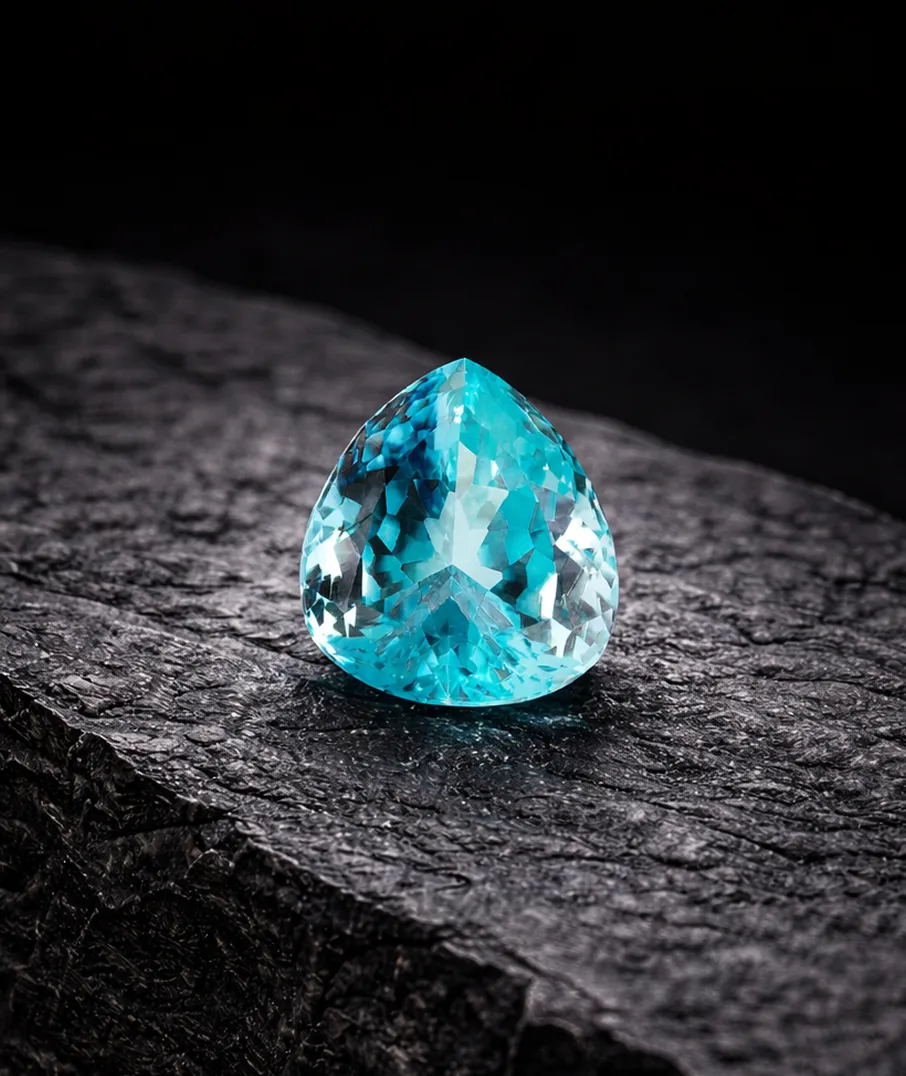
A one-of-a-kind tourmaline necklace is planned from the stone outward: first color and variety, then cut and composition, finally metal and chain. With a Mohs hardness of 7 to 7.5, tourmaline is well suited for the neck, but it does not tolerate heat. A large Paraíba tourmaline is rarer than several small stones, but only impresses with strong color.
At a glance
- Mohs hardness
- 7 to 7.5, toughness fair according to GIA
- Colors
- Rubellite, indicolite, Paraíba, chrome tourmaline, parti-colored, watermelon
- Particularity
- Strongly pleochroic: color changes with the viewing direction
- Typical shape
- Often long rectangles, because the crystals grow elongated
- Paraíba size
- According to GIA, rarely over one carat
- Care
- Warm soapy water, no ultrasonic, no steam
Tourmaline is well placed at the neck
A necklace is a favorable place for a tourmaline. The stone rests protected against the body and is knocked less often than on the hand. GIA gives tourmaline a hardness of 7 to 7.5 on the Mohs scale and rates its toughness as fair. Scratches from dust are therefore unlikely, but the stone cannot withstand hard blows indefinitely. A setting that protects edges and points is therefore sensible at the neck as well.

Tourmaline is sensitive to heat. According to GIA, strong heat can alter the color, and sudden temperature changes can cause fractures. For a necklace, this means: repairs with an open flame near the stone only with caution, and no cleaning in an ultrasonic or steam device. GIA recommends warm soapy water. Knowing this from the start, you plan the setting and chain so that later work remains possible.
One mineral, a great many colors
Tourmaline is a mineral group with an exceptionally broad range of colors, and the trade uses its own names for individual colors. GIA calls red to pink stones rubellite and dark blue to greenish blue stones indicolite. Intensely green stones are called chrome tourmaline, even though their color usually comes from vanadium. Multicolored crystals are described as parti-colored. In watermelon tourmaline, the core is pink and the rim green, and it is usually cut into slices.
For a one-of-a-kind necklace, this variety is the real appeal. A single stone in strong red looks entirely different from a slice of watermelon tourmaline showing its color pattern. According to GIA, color is the most important value factor in tourmaline, as long as inclusions do not interfere. With red tourmalines, dealers tolerate visible inclusions more readily when the color is strong. What defines tourmaline as a mineral is described on the Tourmaline page.
Cut and viewing direction determine the color
Tourmaline is strongly pleochroic. This means that, according to GIA, it shows different colors in different directions of the crystal. Cutters use this: if the table lies across the length of the crystal, light material looks darker. If it lies parallel, dark material becomes lighter. Which color you see on the necklace is therefore also a decision of the cutter. For a pendant seen mainly from the front, the color through the table is what counts.
Because many tourmaline crystals grow elongated, they are often cut as long rectangles, according to GIA. A cut parallel to the length of the rough crystal saves material. For the necklace, this results in a natural shape: an elongated stone, hung vertically, follows the line of the neck. An oval cut looks softer, an emerald cut calm and graphic. What matters is that the shape and color of the stone are considered together.
One large Paraíba or several small stones
With Paraíba tourmaline, the balance shifts. GIA writes that Paraíba tourmalines rarely occur larger than one carat, and at the same time stresses that with them, color counts and not size. A large stone in an oval cut is therefore rare, but only convinces if its color is saturated. A pale large stone looks weaker than a small one with vivid color. For a collection, the quality of the color decides first.

Several small stones create a line or surface of color at the neck. Their challenge is matching: hue and lightness must fit together across all stones. A large single stone is a statement about this one stone, a necklace of many stones a statement about the composition. Both can be one of a kind. How to weigh color and size in Paraíba is explored in Paraíba: size or color.
| Criterion | One large Paraíba in an oval | Several small stones |
|---|---|---|
| Rarity | High, rare over one carat | Single stone more common, matching demanding |
| Effect at the neck | A clear focal point | A line or surface of color |
| Decisive | Saturation and brilliance of the one stone | Same hue across all stones |
| Report | Report on the individual stone | Clarify in advance which stones receive a report |
Neither option is better in itself. It follows the character of the collection.
Paraíba: what the name on the report means
Laboratories name copper-bearing tourmalines differently. According to the definition of the Laboratory Manual Harmonisation Committee, LMHC for short, a Paraíba tourmaline is a blue to green tourmaline of medium to high saturation whose color is caused mainly by copper and manganese, regardless of geographic origin. In its reports, SSEF calls only Brazilian stones "Paraiba tourmaline." Stones of other origin with matching color and chemistry are called tourmaline there, with a comment on the trade name.
Both views are common in practice. For a necklace as a collector's piece, it is therefore worth reading not only the word Paraíba in the report, but also the statement on origin. SSEF stresses that an origin determination is an expert opinion, based on inclusions, trace elements, and spectra. What such a report can provide is explained in the glossary under origin report.
Disclose treatment, plan for care
According to LMHC and SSEF, Paraíba tourmalines are often heated, and in some cases the heating cannot be detected. SSEF then states in the report that it currently cannot be determined whether the stone was heated, and considers the color stable. GIA points out that treatments must be disclosed when a gemstone changes owners. For every stone in the necklace, therefore ask what is known about its treatment.
- Looking only at size: with tourmaline, and especially with Paraíba, color counts first.
- Forgetting the viewing direction: a pleochroic stone can look different in light from the side.
- Combining many stones without matching: different tones make a necklace look restless.
- Reading the name Paraíba without the statement on origin: laboratories use it differently.
- Not considering care: heat, ultrasonic, and steam are not suitable for tourmaline.
Tourmalines in the in-house atelier of Vikar Ahmed
Paraíba tourmaline is the heart of the house. In the pieces shown, Vikar Ahmed works with Brazilian Paraíba tourmaline, Lagoon tourmaline, Namibian tourmaline, and rubellite. Paraíba high jewelry is created as one-of-a-kind pieces in 18 karat gold, platinum, and with diamonds. The house has no location in Morbach; consultations take place in Idar-Oberstein, more under Jeweler for Morbach. Vikar Ahmed works with heated and unheated Paraíbas and states the treatment in writing on the certificate, the expert report, and the invoice; the laboratory finding then reads “heated” or “no indications of heating”.
Frequently asked questions
Which goldsmith in Morbach makes one-of-a-kind necklaces with tourmalines?
Vikar Ahmed has no location in Morbach and makes one-of-a-kind pieces in its in-house atelier in Idar-Oberstein, including with tourmalines. For a one-of-a-kind necklace, what counts is a workshop that explains the color and cut of the stone, discloses treatment, and makes the design visible before production.
For my collection, I am torn between one large oval-cut Paraíba tourmaline and several small stones in a necklace. Which is the stronger choice?
For a collection, usually the large stone, if its color is saturated, because Paraíba tourmalines over one carat are rare. A pale large stone, on the other hand, is the weaker choice. Several small stones convince when they match each other precisely in hue and lightness.
Why does a tourmaline look different from the side than from the front?
Because tourmaline is strongly pleochroic and shows different colors in different crystal directions. When cutting, the cutter determines which color becomes visible through the table. From the side, you see other directions of the crystal and therefore often a different tone.
Which tourmaline color is suitable for a necklace?
Any color that suits you, because hardness and toughness are similar across all tourmaline colors. Rubellite looks warm and strong, indicolite cool, chrome tourmaline a rich green. Watermelon tourmaline in slices shows its color pattern. What matters is a strong color that suits the skin and the metal.
May a Paraíba tourmaline from Mozambique be called Paraíba?
That depends on the laboratory. According to the LMHC definition, a copper- and manganese-bearing tourmaline of matching color is called Paraíba, regardless of where it comes from. In its reports, SSEF uses the name only for Brazilian stones and notes the trade name in a comment for other origins.
How do I clean a necklace with tourmaline?
With warm soapy water and a soft brush, then rinse well and dry. GIA does not recommend ultrasonic and steam cleaners for tourmaline, because heat and sudden temperature changes can damage the stone. At the same time, check the clasp and the setting.
Private consultation
Which tourmaline and which composition suit your necklace is best clarified in a conversation about color and proportion. Vikar Ahmed advises by appointment in the showroom in Idar-Oberstein or in a virtual appointment. Request an appointment for a private consultation.
Further reading
- Gemstone: Tourmaline
- The Paraíba necklace as a collector's piece
- How tourmalines are treated
- Glossary: Collier
- Jeweler for Morbach
Sources
- GIA: Tourmaline Description, accessed 2026-11-17
- GIA: Tourmaline Quality Factors, accessed 2026-11-17
- GIA: Tourmaline Care and Cleaning Guide, accessed 2026-11-17
- GIA: Gem Treatment, accessed 2026-11-17
- SSEF: Paraiba Tourmaline, accessed 2026-11-17
- LMHC Information Sheet 6: Paraiba Tourmaline (2023), accessed 2026-11-17
- Vikar Ahmed: Collections, accessed 2026-11-16
- Vikar Ahmed: Paraíba, accessed 2026-11-16
- GIA: Gem Laboratory, accessed 2026-11-17
- SSEF Swiss Gemmological Institute, accessed 2026-11-17

A personal conversation starts here.
At the showroom in Idar-Oberstein or by video. Vikar Ahmed discusses your ideas, stones and designs with you and answers your questions calmly and in confidence.


Thank you for your request.
Your request will be handled with the utmost attention and discretion. Vikar Ahmed will get back to you.
Your details
Request
–
Occasion
–
Consultation
–
Contact
–
In the meantime
Insights: What is a Paraíba tourmaline? · Engagement ring to your own design: how does it work?
Confidential and without obligation
Back to the pagePrivate consultation
A personal conversation starts here.
- Time for your questions, wishes and ideas
- In the showroom in Idar-Oberstein or by video
- Confidential, discreet and without obligation
Vikar Ahmed · Hauptstraße 111 · 55743 Idar-Oberstein, Germany