

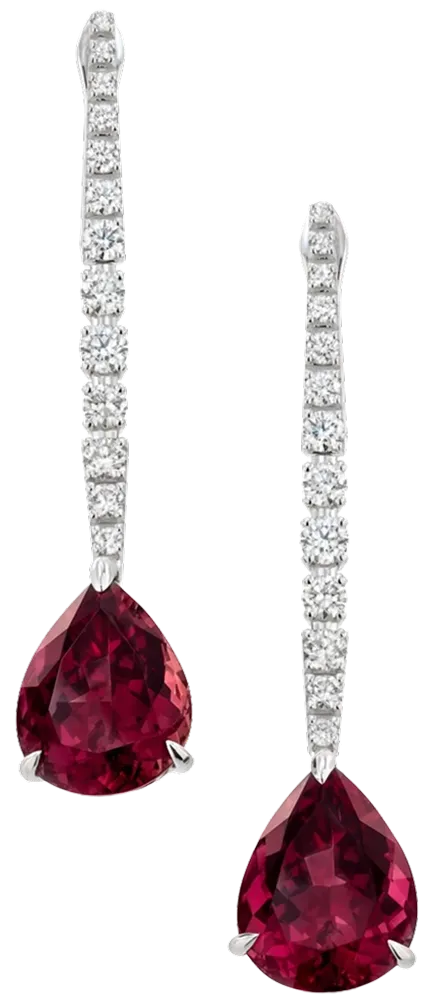
A rubellite masterpiece is best judged in direct comparison: first the color, saturated and without dark zones, then the setting, which must protect the tourmaline next to the harder diamonds. Visible inclusions are not unusual in rubellite. Ask for a report on species and treatment, and look at the pieces under different light.
At a glance
- Rubellite
- Trade name for pink to red tourmaline, including purplish or orangy red
- Cause of color
- According to GIA mainly manganese
- Hardness
- 7 to 7.5 on the Mohs scale, toughness fair according to GIA
- Inclusions
- In pink and red often visible to the naked eye
- Most important criterion
- Color: saturated, without dark zones
- Care
- Warm soapy water, no ultrasonic, no steam
What makes a rubellite masterpiece
According to GIA, rubellite is a trade name for pink, red, purplish red, orangy red, or brownish red tourmaline. Some in the trade want the name to apply only to the red tones, not to pink. The color arises mainly from manganese. A rubellite masterpiece is a piece of jewelry in which this stone plays the leading role and design, setting, and accent stones are oriented toward it. More on the stone in the glossary under Rubellite.
The term masterpiece is not a protected quality grade. It says that a house considers the piece particularly successful. Whether that is true can be checked by three things: the color of the main stone, the craftsmanship of the execution, and the records. This page shows how to view finished pieces with rubellite and diamonds systematically at an appointment. Whether a finished piece or a commission suits you better is compared in the guide Finished masterpiece or custom one-of-a-kind piece?.
The first look is at the color
With tourmaline, color is the most important quality factor according to GIA. Most valuable are strongly saturated colors without dark, almost black areas. According to GIA, rubellite is among the most sought-after colors of tourmaline, and its tone can approach ruby and pink sapphire. Therefore look at the stone from above first and pay attention to whether the color glows evenly across the entire surface or darkens in parts.

Then tilt the piece slowly. Tourmaline is strongly pleochroic: it shows different colors in different crystal directions. Along the length of the crystal, it often absorbs more light than across it. Cutters therefore orient light rough stones differently from dark ones. According to GIA, a well-cut rubellite reflects light lively and evenly across the entire stone. How the choice of cut influences color is explored in the guide Which cut suits rubellite?.
Inclusions play a different role in rubellite than in diamond. According to GIA, it is not unusual for pink and red tourmalines to have inclusions visible to the naked eye, while the opposite is expected of green tourmalines. A visible inclusion is therefore not a reason for exclusion. However, it should neither disturb the brilliance nor lie in a place where it weakens durability. Details are explained in How important is clarity in rubellite?.
Comparing several pieces properly
A single piece almost always looks good at an appointment. The impression becomes meaningful only in comparison. Anyone viewing several pieces should therefore keep to a fixed order and take notes. This prevents the last piece seen from tipping the balance simply because the impression is fresh.
- Place all pieces side by side under the same light, then take them into daylight together.
- First compare only the color of the rubellites: saturation, brightness, dark zones.
- Tilt and turn each piece to see color shifts and liveliness.
- Then look at the diamonds: do they match one another and the main stone in color and luster?
- Finally check the setting, back, and clasp, and only then the effect when worn.
Size is a topic of its own. According to GIA, the price per carat of tourmaline rises significantly with size, especially from about five carats. A large rubellite is therefore not simply more of the same. When you compare two pieces with stones of different sizes, pay attention to whether the larger stone also has the better color, or whether a smaller, more intense stone makes the more impressive piece.
Rubellite and diamond in one piece
Diamonds frame the rubellite, but they are considerably harder than it. According to GIA, tourmaline reaches 7 to 7.5 on the Mohs scale, and its toughness is considered fair. A hard knock that would not harm a diamond can damage the rubellite. A good setting takes this into account: it protects the edges of the tourmaline, especially on rings and bracelets, which are more likely to be knocked than earrings or necklaces.
At the appointment, pay attention to how the rubellite is held. According to GIA, a bezel setting, that is, a closed metal rim, protects the edge of the stone very well. Prongs reveal more of the stone, but should sit cleanly against it and not protrude. With a halo of diamonds, the distance to the main stone should be even. How to set a rubellite securely is described in the guide The right setting for rubellite.
Checkpoints at a glance
| Checkpoint | How you can see it | Why it matters |
|---|---|---|
| Color | Saturated, even, without black zones | Most important value factor in tourmaline |
| Cut | Lively, even light across the entire stone | Poor cuts look dull and patchy |
| Inclusions | Visible is acceptable, but not distracting or at the edge | Can reduce brilliance and durability |
| Diamonds | Uniform in color and luster | Mismatched accent stones distract from the rubellite |
| Setting | Edges of the rubellite protected, prongs sitting flush | Tourmaline is softer and less tough than diamond |
| Records | Written details on species and treatment | Treatments are not always detectable |
Criteria according to GIA. On the piece, how the color looks on your skin and in your light also decides.
What a report documents and what it does not
A laboratory report on a rubellite describes what the stone is, not how good it is. GIA examines tourmalines but does not assign quality grades. An identification report states the species, whether the stone is natural or laboratory-grown, and detectable treatments. According to GIA, the two most important treatments for tourmaline are heating and irradiation.

One limit that GIA names explicitly is important: color changes from heating are stable in tourmaline and not detectable. A report can therefore neither confirm nor rule out heating. Color changes from irradiation, by contrast, can fade with heat or strong light. Therefore ask which details on treatment the provider gives in writing. The terms are explained in the glossary entries Treatment and GIA report.
Typical mistakes when viewing
- Judging only under the display case lighting and never seeing the piece in daylight.
- Taking a dark stone for particularly intense, although it looks black in parts.
- Choosing the largest stone without comparing its color with smaller stones.
- Overlooking the setting, although the rubellite is softer than the diamonds beside it.
- Reading a report as proof of an untreated stone, although heating is not detectable.
For care: according to GIA, warm soapy water is the best way to clean, and ultrasonic and steam cleaners are not recommended. High heat can change the color, and sudden temperature changes can cause fractures. Tourmaline, by contrast, generally tolerates light and chemicals well. Anyone wearing a piece with rubellite therefore takes it off before the sauna and the kitchen and cleans it by hand.
Rubellite at Vikar Ahmed
Rubellite is among the stones that Vikar Ahmed works with in the pieces it shows, alongside Paraíba tourmaline, Colombian emerald, and diamonds. The stones are set in 18k (750) white and rose gold in the in-house atelier in Idar-Oberstein, and gemstone setting and polishing are done by hand. The house states every treatment in the consultation and in writing on the certificate and invoice. The showroom receives clients by appointment. It is best to name the pieces you would like to see side by side when you make your request. For clients from Kirn, it is located in Idar-Oberstein; in Kirn itself, the house has no location.
Frequently asked questions
Where in Kirn can I view and compare finished masterpieces with rubellite and diamonds?
Vikar Ahmed has no location in Kirn. The showroom is in Idar-Oberstein and receives clients by appointment. For the comparison, you should there, as anywhere, view several pieces side by side under the same light and in daylight, and check the color first, then setting and records.
Are visible inclusions in a rubellite a flaw?
Not in principle. According to GIA, pink and red tourmalines often have inclusions visible to the naked eye, unlike green ones. An inclusion becomes a problem only when it clearly disturbs the brilliance or lies at an edge, where it can weaken the stone during wear.
Can a laboratory confirm that a rubellite has not been heated?
No. According to GIA, color changes from heating are stable in tourmaline and not detectable. A report can state species, natural origin, and detectable treatments, but can neither confirm nor rule out heating. Here, rely on the written details provided by the provider.
Why does a rubellite next to diamonds need a protective setting?
Because it is considerably softer and less tough. According to GIA, tourmaline reaches 7 to 7.5 on the Mohs scale, while diamond is the hardest gemstone. A knock that the diamonds survive undamaged can chip the rubellite. Bezel settings or well-fitting prongs protect its edges.
How do I clean jewelry with rubellite and diamonds?
With warm soapy water and a soft brush. GIA does not recommend ultrasonic or steam cleaners for tourmaline. Also keep the piece away from high heat and rapid temperature changes, because both can harm the color and the stone.
Private consultation
If you would like to see rubellite in comparison, plan time and daylight for it. Vikar Ahmed offers consultations in the showroom in Idar-Oberstein by appointment, virtually first on request, and discusses stone, setting, and design there. Request an appointment for a private consultation.
Further reading
- Judging masterpieces with colored stones
- Rubellite: origin, color, and care
- Can an untreated rubellite be proven?
- Rubellite or ruby compared
- Showroom appointment in Idar-Oberstein
Sources
- GIA: Tourmaline Description, accessed 2026-11-17
- GIA: Tourmaline Quality Factors, accessed 2026-11-17
- GIA: Tourmaline Care and Cleaning, accessed 2026-11-17
- GIA: Tourmaline Buyer's Guide, accessed 2026-11-17
- GIA 4Cs: Complete Guide to Engagement Ring Settings, accessed 2026-11-17
- Vikar Ahmed: Collections, accessed 2026-11-16
- Vikar Ahmed: Bespoke, Fertigung, accessed 2026-11-16

A personal conversation starts here.
At the showroom in Idar-Oberstein or by video. Vikar Ahmed discusses your ideas, stones and designs with you and answers your questions calmly and in confidence.


Thank you for your request.
Your request will be handled with the utmost attention and discretion. Vikar Ahmed will get back to you.
Your details
Request
–
Occasion
–
Consultation
–
Contact
–
In the meantime
Insights: What is a Paraíba tourmaline? · Engagement ring to your own design: how does it work?
Confidential and without obligation
Back to the pagePrivate consultation
A personal conversation starts here.
- Time for your questions, wishes and ideas
- In the showroom in Idar-Oberstein or by video
- Confidential, discreet and without obligation
Vikar Ahmed · Hauptstraße 111 · 55743 Idar-Oberstein, Germany