

How to Recognize a Paraíba Jeweler
Paraíba tourmalines demand more expertise than most colored gemstones. Name, treatment and origin need explaining, and this is where the quality of a house's advice shows.
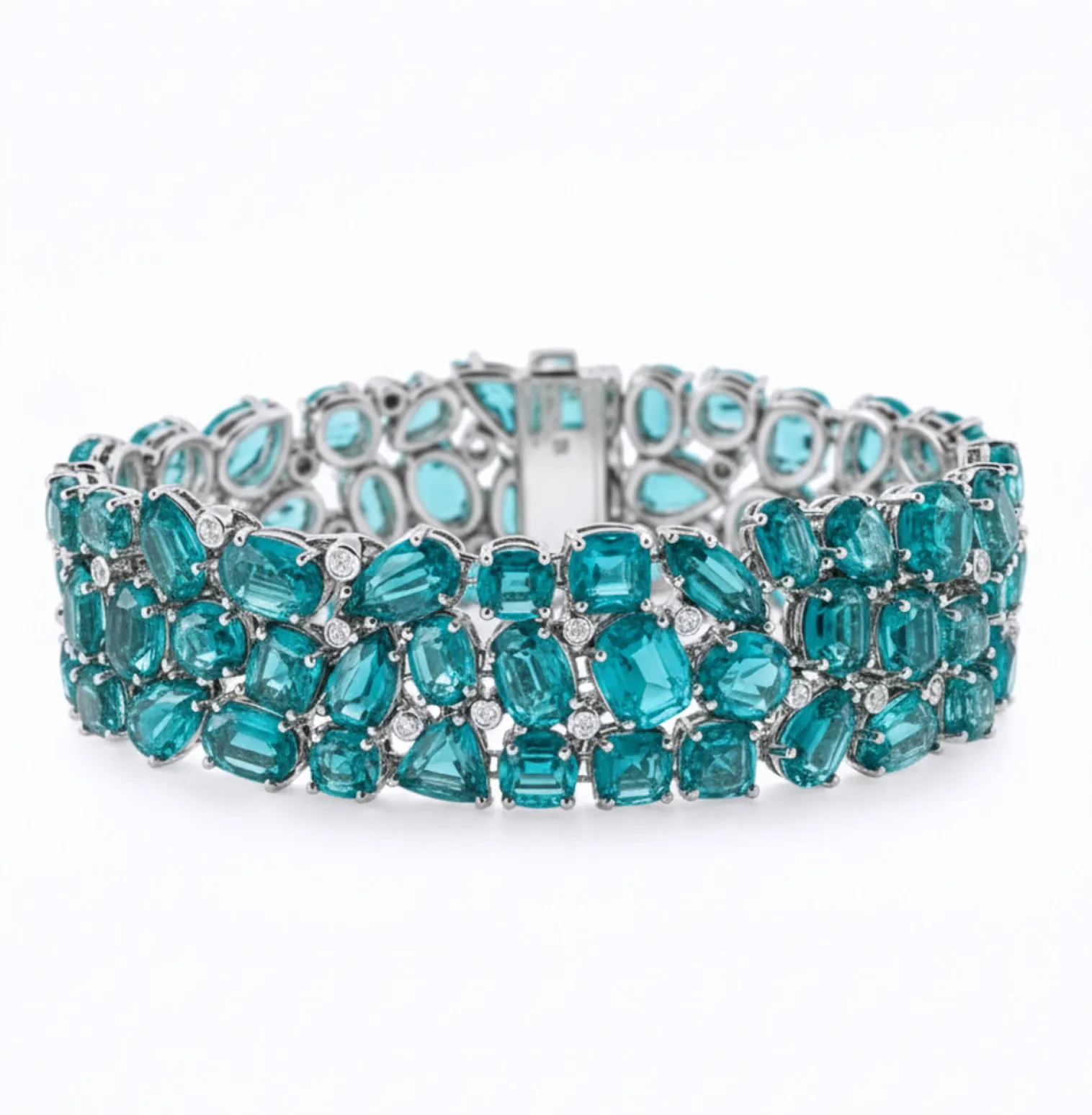
You recognize a jeweler who knows Paraíba tourmaline by the explanations and documents provided. Such a jeweler explains the cause of color, presents a laboratory report for important stones, discloses treatments openly, knows the differing naming rules of the laboratories and plans the setting around the stone. You can compare this by asking every house the same questions.
At a glance
- Expertise
- Copper and manganese as the cause of color, source countries, naming rules of the laboratories
- Documents
- Laboratory report on the stone, an origin report where origin is stated
- Treatment
- Disclosed openly, even where it cannot be detected
- Terms
- Neon or Electric Blue are trade names, not laboratory grades
- Craftsmanship
- Protection of edges and corners, tourmaline has a hardness of 7 to 7.5
- Comparison
- The same questions to every house, stones under different light
Expertise shows in the explanations
A jeweler who knows Paraíba tourmalines can explain why they glow the way they do. According to the definition of the laboratory association LMHC, their color is caused mainly by copper and manganese. GIA notes that copper acts as a coloring agent in no other tourmaline. The stones were discovered in the late 1980s in the Brazilian state of Paraíba, later followed by finds in Nigeria and Mozambique. Anyone who explains these relationships with confidence has studied the stone.
A second sign is how the name is handled. LMHC calls copper-bearing tourmalines of matching color Paraíba tourmaline regardless of the source country. The laboratory SSEF uses the name on its reports only for Brazilian stones and calls others tourmaline with a note on the trade name. A knowledgeable jeweler knows both views and presents neither as the only valid one. What the name means is explained in the glossary under Paraíba tourmaline.
Which documents a good house presents
A significant Paraíba tourmaline should come with a laboratory report. GIA describes its identification report as a document that identifies and describes the stone and lists detectable treatments. For Paraíba tourmalines, GIA additionally offers a report stating the country of origin. A house that names an origin should be able to confirm it with such a report. What an identification report contains in detail is explained in the guide What Is an Identification Report for Paraíba Tourmaline?.

What is said verbally matters just as much. According to LMHC, Paraíba tourmalines are frequently heated, and this cannot be detected in every case. A reputable jeweler does not conceal this and does not promise an untreated stone when the report cannot say anything about it. SSEF states fillings of fissures in the report together with their extent. How treatments in Paraíba are disclosed is described in the guide Disclosing Treatment in Paraíba.
| Document or claim | What it documents | What to look for |
|---|---|---|
| Identification report | Identity of the stone and detectable treatments | Ask for the laboratory and report number |
| Report with country of origin | Origin as the laboratory's assessment | Accept an origin only with a report |
| Statement on heating | Common for Paraíba according to LMHC, not always detectable | No promise of “untreated” without proof |
| Statement on fillings | SSEF states fillings and their extent in the report | Check the extent in the report |
Based on GIA, LMHC, and SSEF information on reports and treatments of Paraíba tourmaline.
A list of questions for comparison
Houses can be compared most fairly when all of them answer the same questions. The answers quickly show how much expertise and how much openness lie behind the advice. Write down the answers and ask to be shown where each statement appears in the report. A good house does not regard such questions as mistrust.
- Which laboratory examined the stone, and may I see the report in advance?
- Does the report state Paraíba tourmaline as the variety or only as a trade name in the comment?
- Is the origin confirmed by a report or merely stated?
- What does the report say about heating and fillings?
- How will the stone be set, and how are edges and corners protected?
- Can I see the stone in daylight and in artificial light?
- What should be considered for cleaning and later work on the piece?
How to compare stones fairly
According to GIA, tourmaline is strongly pleochroic, showing different colors depending on the viewing direction. A stone may therefore look different from above than from the side. Look at every stone from several angles and under several light sources. GIA also describes that inclusions are far more noticeable in light, less saturated stones. A light stone therefore needs to be cleaner to look as calm as a strongly colored one.
Where possible, compare stones side by side rather than one after another. Photos help only to a limited extent: SSEF points out that color, clarity and size may differ in the report photo. Trade terms are no yardstick either, because SSEF does not use words such as neon blue on its reports. How color and clarity are weighed against each other is shown in the comparison Color or Clarity in Paraíba Tourmaline?.
How to recognize careful craftsmanship
Tourmaline has a Mohs hardness of 7 to 7.5, and GIA rates its toughness only as fair. A good setting therefore protects the vulnerable areas. GIA describes that a bezel setting protects the edges of a stone very well, while prongs show more of the stone. An experienced jeweler explains why a particular setting is proposed for a particular stone and piece of jewelry.

Heat is also a concern. GIA warns that heat can damage tourmaline and that sudden temperature changes can cause fractures. It does not recommend ultrasonic or steam cleaners. For any later work on the piece, such as resizing a ring, the workshop must know that a tourmaline is set in it. A house that knows Paraíba tourmalines raises these points on its own. More on the ring under The Paraíba Tourmaline Ring.
Warning signs in conversation
- A stone is described as guaranteed untreated, although heating in tourmaline is not detectable.
- Neon or Electric Blue is presented as if it were a laboratory quality grade.
- An origin is named, but no report confirms it.
- The report is shown only after the decision.
- Questions about treatment are answered evasively.
None of these signs on its own proves that something is wrong with a stone. Together, however, they give a picture of how carefully a house works. Anyone who wants to check stones for authenticity and designation will find the relevant criteria in the guide How Can You Recognize a Genuine Paraíba Tourmaline?. What matters in the end is that every statement about the stone can be documented.
The design is planned around the stone
With Paraíba tourmaline, an experienced house begins with the stone and not with the setting. Shape, dimensions and color effect determine which piece of jewelry suits it. Ask, therefore, whether you can see the stone in the planned design before it is made. A three-dimensional visualization shows how size, setting and metal work together. At this stage, mistakes can still be corrected without consequences for the stone.
At Vikar Ahmed, a bespoke project follows three steps: design by in-house designers, visualization with CAD and realization as a one-of-a-kind piece in the in-house atelier. For Paraíba, Vikar Ahmed prefers platinum or 18k white gold, usually with open prongs, often with a halo of small white diamonds, and for everyday wear a bezel that protects the edges. What the path from the first conversation to the finished piece looks like is described in the guide How a Paraíba Tourmaline Piece Is Created.
Idar-Oberstein and Vikar Ahmed
Idar-Oberstein has a long tradition of working with gemstones. GIA, for example, shows a bluish green tourmaline cut in his own style by the well-known Idar-Oberstein gem cutter Bernd Munsteiner. Vikar Ahmed is based here, has stood for High Jewelry since 2004, sees itself as rooted in the town's goldsmithing tradition and calls Paraíba tourmaline the heart of the Maison. Its specialty is original Brazilian Paraíbas, along with stones from Mozambique and Nigeria. More on the location under Jeweler in Idar-Oberstein.
By its own description, the showroom is not a sales room but a place of selection, and visits take place by appointment. Idar-Oberstein itself lies in the Naheland. Vikar Ahmed has no location in Morbach, consultations take place in Idar-Oberstein or virtually. For a first conversation, it helps to note the occasion, a preferred date, and your ideas on stone and style beforehand and send them with your request.
Frequently asked questions
How can I tell whether a jeweler knows Paraíba tourmalines?
By whether the jeweler explains the cause of color, the naming rules and treatment with confidence and can document every statement with a laboratory report. Such a jeweler distinguishes between the designation according to LMHC and according to SSEF, openly names the common heating and plans the setting so that the tourmaline is protected.
Should every Paraíba tourmaline have a laboratory report?
Every significant stone should have one, above all a center stone. The report confirms that the stone is a natural tourmaline and whether it is designated Paraíba tourmaline. For very small stones, such as those in a halo, a report for each stone is unusual.
What does it mean when a stone is called a neon Paraíba?
Neon is a trade term for particularly vivid stones, not a laboratory grade. SSEF does not use such terms on its reports and describes the color with words such as blue or greenish blue. Whether a stone glows in this way is best judged with your own eyes.
How do I compare Paraíba jewelry from different houses meaningfully?
By asking every house the same questions: laboratory, designation in the report, proof of origin, treatment, setting. You should see the stones under several light sources and from different angles, because tourmaline looks different depending on the direction. Photos and trade names are not a reliable yardstick for this.
What should a jeweler say about the treatment of a Paraíba tourmaline?
The jeweler should state openly that Paraíba tourmalines are frequently heated and that this cannot be detected in tourmaline. Fillings of fissures should be named on the basis of the report. A promise that the stone is certainly untreated cannot be substantiated with regard to heating.
Why is the setting so important for Paraíba tourmaline?
Because tourmaline, with a hardness of 7 to 7.5 and fair toughness, is more delicate than a diamond. The setting must protect edges and corners from knocks without concealing the color. According to GIA, a bezel protects the edges particularly well, while prongs show more of the stone.
Private consultation
Ask your questions about the stone, the report and the setting in a personal conversation. Vikar Ahmed advises by appointment in the showroom in Idar-Oberstein or in a virtual appointment. Inquiries are handled with attention and discretion. Request an appointment for a private consultation.
Further reading
- What is an identification report for Paraíba?
- Understanding and assessing Paraíba jewelry
- Origin of Paraíba tourmaline
- Glossary: Neon quality
- Jeweler in Idar-Oberstein
Sources
- LMHC Information Sheet 6: Paraiba Tourmaline (Version 8, 2023), accessed 2026-11-17
- SSEF: Paraiba Tourmaline, Erläuterung zum Bericht, accessed 2026-11-17
- GIA: Tourmaline Quality Factors, accessed 2026-11-17
- GIA: Tourmaline Care and Cleaning Guide, accessed 2026-11-17
- GIA: Colored Stone Reports, accessed 2026-11-17
- GIA, Gems & Gemology Winter 2019: Paraíba Tourmaline Geographic Origin Determination, accessed 2026-11-17
- GIA 4Cs: Complete Guide to Engagement Ring Settings, accessed 2026-11-17
- Vikar Ahmed: Über uns, accessed 2026-11-16

A personal conversation starts here.
At the showroom in Idar-Oberstein or by video. Vikar Ahmed discusses your ideas, stones and designs with you and answers your questions calmly and in confidence.


Thank you for your request.
Your request will be handled with the utmost attention and discretion. Vikar Ahmed will get back to you.
Your details
Request
–
Occasion
–
Consultation
–
Contact
–
In the meantime
Insights: What is a Paraíba tourmaline? · Engagement ring to your own design: how does it work?
Confidential and without obligation
Back to the pagePrivate consultation
A personal conversation starts here.
- Time for your questions, wishes and ideas
- In the showroom in Idar-Oberstein or by video
- Confidential, discreet and without obligation
Vikar Ahmed · Hauptstraße 111 · 55743 Idar-Oberstein, Germany