

Paraíba Tourmaline: Verifying Name, Treatment, and Origin
Paraíba is a name with clear professional rules. Knowing them, you can read a laboratory report and know which questions may remain open.
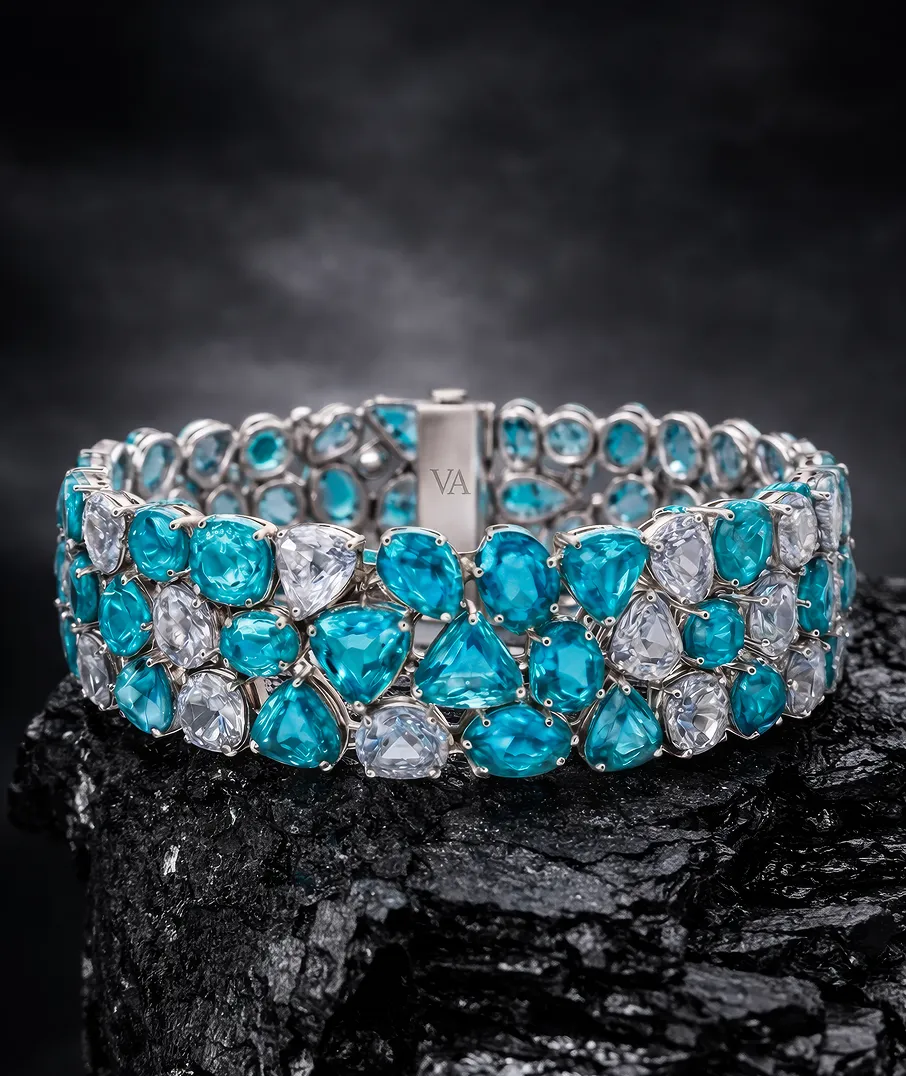
Paraíba tourmaline is the name for a blue to green tourmaline whose color is due mainly to copper and manganese, regardless of where it was found. Whether a stone bears the name is clarified by a laboratory report. Paraíba tourmalines are often heated, which frequently cannot be detected. Origin from Brazil, Nigeria, or Mozambique is an expert opinion.
At a glance
- Definition (LMHC)
- Blue to yellowish green tourmaline, colored mainly by copper and manganese
- First discovery
- State of Paraíba, Brazil, late 1980s
- Other source countries
- Nigeria and Mozambique, finds from the early 2000s
- Treatment
- Often heated, frequently undetectable, color considered stable
- Origin determination
- Trace elements by laser mass spectrometry, an opinion
- Usual size
- Rarely over one carat (GIA)
Paraíba is a variety, not a statement of origin
The name goes back to the Brazilian state of Paraíba, where these tourmalines were first found in the late 1980s. Today it designates a variety. The laboratory committee LMHC, in which GIA, SSEF, Gübelin, the German DSEF, and other laboratories align their report language, defines Paraíba tourmaline by color and chemistry: blue, greenish blue to yellowish green, of medium to high saturation, colored mainly by copper and manganese, regardless of geographic origin.

In the early 2000s, tourmalines of similar color were discovered in Nigeria and Mozambique. According to Gems & Gemology, material from Mozambique was first mined in 2001, but its copper content was recognized only in 2003. Since then, a Paraíba tourmaline no longer automatically implies a Brazilian origin. Anyone who means Brazil must say so explicitly and prove it. How laboratories do this is described in the guide Origin of Paraíba tourmaline.
When a tourmaline may not be called Paraíba
Copper alone is not enough. The LMHC excludes tourmalines that contain only traces of copper, show low saturation, or lie outside the defined color range. Also excluded are iron-rich, copper-bearing tourmalines whose absorption spectrum shows a certain iron band more strongly than the copper band. Both can be measured only in a laboratory. A pale blue tourmaline with some copper therefore remains a tourmaline, even if the trade likes to call it something else.
- Color outside blue, greenish blue, green, or yellowish green.
- Saturation too low or tone too light for this variety.
- Only traces of copper that do not carry the color.
- Iron-rich stone in which iron dominates the color.
- Without a laboratory finding, the name remains a claim, not a confirmed variety.
A related trade name is lagoon tourmaline. It describes tourmalines in light blue-green and is not a gemological term. Whether such a stone also counts as Paraíba tourmaline depends solely on whether copper and manganese carry the color and the definition is met. This therefore belongs in the report. How the two stones differ is described in the guide Lagoon tourmaline or Paraíba.
How laboratories use the name in the report
Laboratories do not handle the name entirely uniformly. According to the LMHC, the report may state the variety as Paraíba tourmaline and add that the name goes back to the Brazilian locality, but that the stone today may come from various deposits. Alternatively, the report states only tourmaline, with the note that the copper- and manganese-bearing stone is also called Paraíba tourmaline in the trade.
The Swiss laboratory SSEF, by its own account, applies a narrower practice. It calls stones from Brazil Paraíba tourmaline. Stones of other origin that meet the color and chemistry criteria are called tourmaline in the report, with a reference to the trade name. SSEF does not use trade terms such as Electric Blue or Neon Blue; it describes the color simply as blue, greenish blue, or green. What the term neon quality means in the trade is explained in the glossary.
| Statement in the report | What it means |
|---|---|
| Variety: Paraíba tourmaline | Color and chemistry meet the definition, origin is not stated by this |
| Tourmaline, called Paraíba in the trade | Definition met, laboratory uses the name only as an addition |
| Origin: Brazil, Nigeria, or Mozambique | Expert opinion of the laboratory |
| Origin not determined | No opinion possible or not requested |
| Customarily heated | Heating widespread, not detectable in the stone |
Wordings according to LMHC Information Sheet 6 and SSEF, translated in substance. The wording of the individual report is authoritative.
Heating: common and often undetectable
According to the LMHC, Paraíba tourmalines are often heated, and in some cases the treatment cannot currently be detected. GIA describes heated color in tourmaline as stable and undetectable. SSEF distinguishes three cases: no indications of heating, indications of heating, or a note that the color may have been modified by heating, that this cannot be determined, and that the color is considered stable.

For assessment, this means: heating is not a flaw in Paraíba tourmaline, and the color is retained. It becomes problematic only when a stone is described as unheated without a reliable finding. Fillings in fissures, by contrast, are detectable. SSEF names oil or artificial resin in the report and grades the amount as minor, moderate, or significant. When an unheated stone is worth it is covered in the guide Untreated Paraíba tourmaline.
Good to know
According to Gems & Gemology, heating can change the color and is not always recognizable. The color of a stone therefore says nothing reliable about its origin or treatment. Only the laboratory can clarify both.
How origin is determined
The origin of a Paraíba tourmaline cannot be determined with standard gemological tests. In 2019, Gems & Gemology described GIA's approach: laser ablation and mass spectrometry are used to measure trace elements such as copper, zinc, gallium, strontium, tin, and lead. Brazilian stones contained on average considerably more copper than African ones. No single element is sufficient; only the combination separates the source countries. If a stone lies between the reference fields, the result is: inconclusive.
SSEF explicitly calls origin determination an expert opinion, based on inclusions, trace elements, spectra, and comparison with its own reference collection. At GIA, Paraíba tourmaline is one of the few colored gemstones for which the institute offers an origin report at all. If a report contains no origin, the LMHC provides for the note that it was not determined. This is a correct statement, not an indication of a defect.
How to verify a Paraíba tourmaline
- Request a report from an independent laboratory on the individual stone.
- Check whether the variety is stated as Paraíba or appears only as an addition.
- Read what is noted about heating and fillings in fissures.
- Clarify whether an origin was determined and by which laboratory.
- Check the weight and measurements in the report against the stone.
- Verify the report number with the issuing laboratory.
In terms of quality, color counts above all. GIA writes that with Paraíba, color is the decisive factor, not size, and that blue and violet are the most sought after. According to GIA, stones over one carat are rarely seen. A small stone in a strong blue can therefore rank higher than a large, pale stone. How to weigh color and clarity against each other is described in the guide Paraíba: color or clarity.
Paraíba tourmaline at Vikar Ahmed
Paraíba tourmaline is the heart of the house. Vikar Ahmed's website describes its discovery in the late 1980s in the state of Paraíba and attributes its luminosity to the natural copper content. The house specializes in original Brazilian Paraíbas, complemented by stones from Mozambique and Nigeria. Reports come from Gübelin, SSEF, GRS, or the DGemG. Both heated and unheated stones are used, and the treatment is stated in writing on the certificate, the expert report, and the invoice. More on the Paraíba page.
Frequently asked questions
Which jeweler near Kaiserslautern tells me openly whether a Paraíba tourmaline is treated?
The information is open when a laboratory report is available for the stone that names heating and fillings or explicitly notes that heating cannot be determined. Vikar Ahmed has no location in Kaiserslautern and offers consultations in Idar-Oberstein. More on this on the page Jeweler for Kaiserslautern.
Is every Paraíba tourmaline from Brazil?
No. According to the definition of the laboratory committee LMHC, the name designates a variety determined by color and by copper and manganese content, regardless of origin. Besides Brazil, Nigeria and Mozambique are considered source countries. A Brazilian origin must be determined separately and stated in the report.
Why does the report say only tourmaline and not Paraíba?
Some laboratories use the name Paraíba only as an addition. SSEF, for example, calls stones from Nigeria or Mozambique tourmaline and notes that the copper- and manganese-bearing stone is also called Paraíba tourmaline in the trade. The variety is thus confirmed; only the wording in the report differs.
Can heating be detected in Paraíba tourmaline?
Not always. Paraíba tourmalines are often heated, and a laboratory frequently cannot detect the treatment. The report then notes that the color may have been modified by heating. According to SSEF and GIA, the color is considered stable. Fillings in fissures, by contrast, are generally recognizable.
How can you recognize a Paraíba tourmaline with the naked eye?
Not reliably at all. Blue and green tourmalines with little copper or light blue-green lagoon tourmalines can look similar. Only a laboratory can measure whether the color is due to copper and manganese and the definition is met. Origin cannot be read from the color either, because the color ranges of the source countries overlap.
What does "origin not determined" mean for a Paraíba tourmaline?
The note means that the laboratory states no origin, because it was not requested or because the measurements do not allow a clear attribution. The LMHC explicitly provides for this wording. It says nothing about the authenticity or quality of the stone. The variety can still be confirmed.
Private consultation
A Paraíba tourmaline should be assessed both in the stone and in the report. Vikar Ahmed offers consultations in the showroom in Idar-Oberstein by appointment, and on request also in a virtual appointment. Your inquiry is treated with discretion. Request a private consultation.
Further reading
- Gemstone Knowledge: Paraíba Tourmaline
- How Paraíba treatments are disclosed
- Brazilian Paraíba tourmaline
- Glossary: Origin report
- Glossary: SSEF and Gübelin
Sources
- LMHC Information Sheet 6: Paraíba Tourmaline (Februar 2023), accessed 2026-11-17
- SSEF: Paraiba Tourmaline, accessed 2026-11-17
- Gems & Gemology (Winter 2019): Paraíba Tourmaline Geographic Origin Determination, accessed 2026-11-17
- GIA: Tourmaline Quality Factors, accessed 2026-11-17
- GIA: Tourmaline Care and Cleaning Guide, accessed 2026-11-17
- GIA: Colored Stone Reports, accessed 2026-11-17
- Vikar Ahmed: Paraíba, accessed 2026-11-17
- Vikar Ahmed: Collections, accessed 2026-11-17
- GIA: Gem Laboratory, accessed 2026-11-17
- SSEF Swiss Gemmological Institute, accessed 2026-11-17
- CIBJO: Introduction to the Blue Books, accessed 2026-11-17

A personal conversation starts here.
At the showroom in Idar-Oberstein or by video. Vikar Ahmed discusses your ideas, stones and designs with you and answers your questions calmly and in confidence.


Thank you for your request.
Your request will be handled with the utmost attention and discretion. Vikar Ahmed will get back to you.
Your details
Request
–
Occasion
–
Consultation
–
Contact
–
In the meantime
Insights: What is a Paraíba tourmaline? · Engagement ring to your own design: how does it work?
Confidential and without obligation
Back to the pagePrivate consultation
A personal conversation starts here.
- Time for your questions, wishes and ideas
- In the showroom in Idar-Oberstein or by video
- Confidential, discreet and without obligation
Vikar Ahmed · Hauptstraße 111 · 55743 Idar-Oberstein, Germany