

Paraíba Tourmaline or Rubellite as the Center Stone of a Bespoke Ring
In a bespoke ring, the center stone stands at the beginning of the design. Paraíba tourmaline and rubellite are both tourmalines, but lead to very different rings.
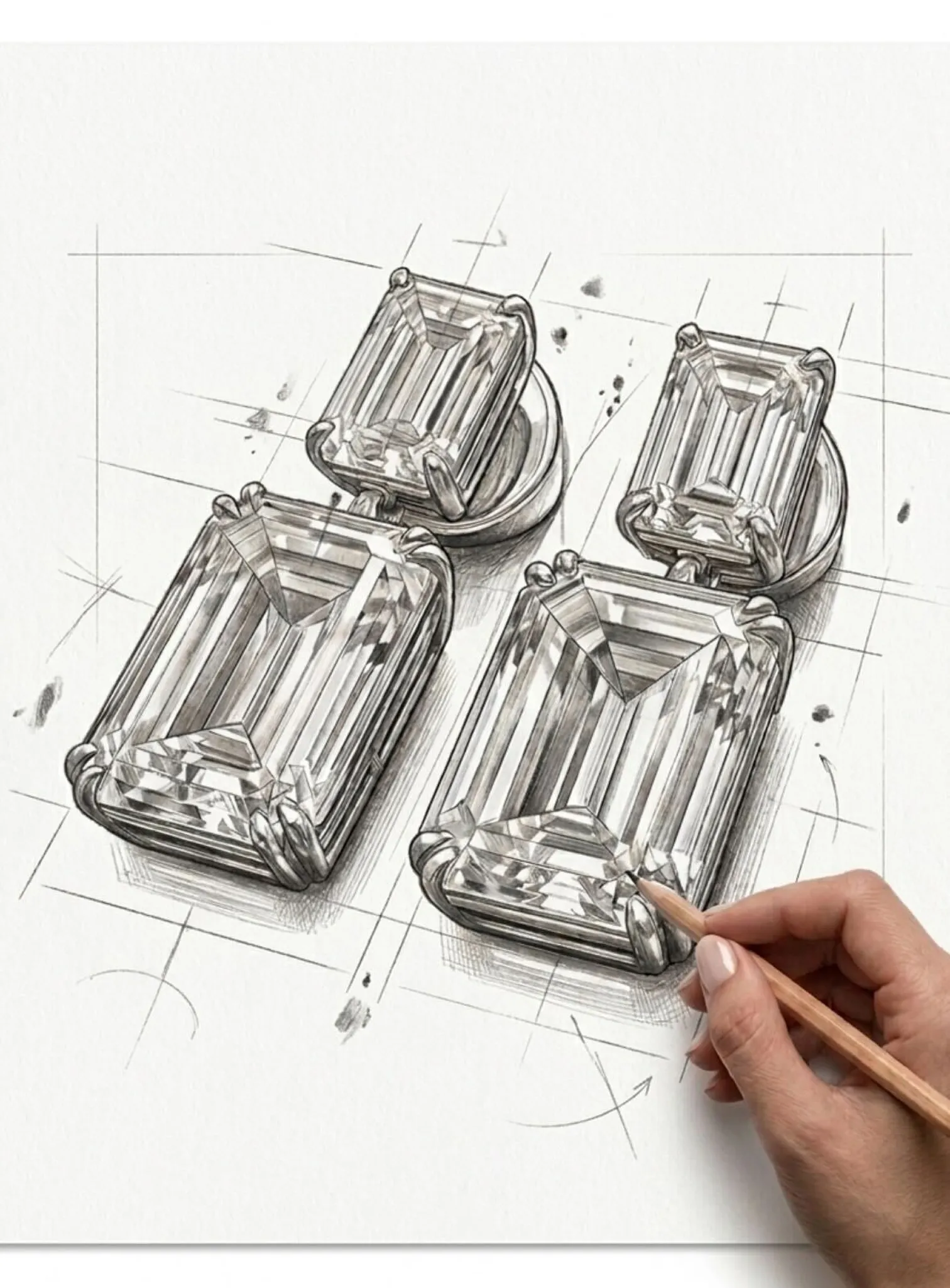
Paraíba tourmaline suits when a glowing blue to green and great rarity are at the center. It is usually small and rare above one carat. Rubellite suits when a strong red to pink and a larger stone are desired. Both have a hardness of 7 to 7.5 and need a protective setting. The stone determines the design.
At a glance
- Mineral
- Both tourmalines, Mohs hardness 7 to 7.5
- Cause of color, Paraíba
- Mainly copper and manganese
- Cause of color, rubellite
- Manganese
- Typical size, Paraíba
- According to GIA, rarely above one carat
- Origin report
- Possible at GIA for Paraíba tourmaline, not for rubellite
- Treatment
- Heating common in both, often not detectable in tourmaline
The choice depends on color, size and report
In a ring of your own design, the center stone is not an ingredient but the starting point. Its color determines the metal, its size the proportion of the shank, its sensitivity the setting. Paraíba tourmaline and rubellite have the same hardness and the same toughness, because both are tourmalines. They differ, however, in three points that shape the ring: color and luminosity, available size, and the documents a laboratory can issue for them.

No ranking follows from this. Paraíba tourmaline is rarer, rubellite allows larger stones. Anyone looking for a ring with intensely glowing color in a small format is more likely to end up with the one. Anyone looking for a large, warm red stone with presence is more likely to end up with the other. The decision is best made when both stones are viewed side by side under daylight and artificial light.
Two tourmalines with different causes of color
Paraíba tourmaline owes its blue, blue-green or green mainly to copper and manganese. According to GIA, copper colors no other tourmaline. It was discovered in the late 1980s in the Brazilian state of Paraíba, later also in Rio Grande do Norte and, at the beginning of the 21st century, in Nigeria and Mozambique. According to the laboratories' definition, the name applies regardless of the country of origin, and what is decisive are color and cause of color.
Rubellite is a tourmaline in pink, red, purplish red, orangy red or brownish red. Its color is due to manganese. GIA describes it as one of the most sought-after and at the same time readily available tourmaline colors, whose tone and depth can approach those of ruby and pink sapphire. Part of the trade uses the name only for strongly red stones. What exactly distinguishes it is described in the glossary under rubellite.
Size and availability shape the design
With Paraíba tourmaline, according to GIA, color counts for more than size. Dealers only rarely see stones over one carat, and almost all are cut individually to retain as much weight as possible from the rough. For the design, this means the ring is built around a rather small stone with very strong color. A narrow shank or a halo of small diamonds can give the stone more presence on the finger.
Rubellite can also be found in larger stones. With tourmaline, however, the value per carat rises with weight, according to GIA particularly from around five carats with comparable color and clarity. A large rubellite demands a stable setting and a shank that carries the weight without the ring tilting. Because of their long crystals, tourmalines often have no standard dimensions, so the setting is created around the individual stone.
The two stones compared
| Criterion | Paraíba tourmaline | Rubellite |
|---|---|---|
| Color | Glowing blue, blue-green or green | Pink to red, also purplish red |
| Cause of color | Copper and manganese | Manganese |
| Usual size | Rarely above one carat | Larger stones also available |
| Inclusions | Color counts more than clarity | Visible inclusions tolerated with strong color |
| Treatment | Frequently heated, according to SSEF | Heating or irradiation possible |
| Origin in the report | Usually determinable at GIA and SSEF | Not offered by GIA |
| Durability | Hardness 7 to 7.5, toughness fair | Hardness 7 to 7.5, toughness fair |
Classification based on information from GIA and SSEF. Each stone must be assessed individually.
The table shows that durability is no argument for one stone or the other. Both are well equipped against scratches, but only fairly tough against hard knocks. The differences lie in color, size and documentation. For a ring intended as a collector's piece, the origin report for Paraíba tourmaline can be a reason. For a ring with great presence, the availability of larger rubellites speaks in its favor.
Treatment and laboratory report
According to the Swiss laboratory SSEF, Paraíba tourmalines are frequently heated. SSEF notes in the report whether there are indications of heating, no indications, or whether it cannot be determined. If the stone comes from Brazil, SSEF calls it Paraíba tourmaline. For other sources with matching color and chemistry, the designation is tourmaline, with the addition that the stone may also be called Paraíba tourmaline in the trade.
With rubellite, the situation is different. Heating changes the color permanently and, according to GIA, is not detectable, while irradiation can fade under heat or strong light. GIA does not offer a report stating the country of origin for rubellite, but it does offer an identification report with gemstone type and detectable treatments. What can be said about origin statements in principle is explained in the glossary under origin report.
What the center stone means for setting and metal
Because both stones are only fairly tough, the same basic rule applies to both: protect edges and corners. A bezel encloses the stone completely, and V-shaped prongs secure the points of pear or marquise shapes. When the ring size is changed, the stone is usually removed from the setting because of its sensitivity to heat. What settings for a Paraíba tourmaline look like in detail is described in the guide Setting a Paraíba tourmaline.

When it comes to metal, the paths diverge. A Paraíba tourmaline looks cool and clear in a white setting of white gold or platinum with diamonds, and its glow remains undisturbed. A rubellite can look warm and soft in rose gold, and richer in contrast in white gold. Small diamonds as accent stones suit both. This is a question of taste that can be checked well in a three-dimensional visualization before production.
Typical mistakes in choosing the center stone
- Choosing a Paraíba tourmaline by carat, although with this stone color determines its standing.
- Choosing a large rubellite and not designing the shank for its weight.
- Expecting an origin report for rubellite, which GIA does not offer for it.
- Not having the treatment recorded in writing.
- Deciding on the metal first and then looking for a stone that has to match it.
Behind most of these mistakes lies the same confusion: rules that apply to diamonds are transferred to colored gemstones. With diamonds, weight, color, clarity and cut determine the standing according to fixed scales. With tourmalines, color is in the foreground, and laboratories describe above all gemstone type, treatment and, for some varieties, origin. Anyone who takes this into account early plans the ring from the stone outward.
Center stones at Vikar Ahmed
By its own account, Paraíba tourmaline is the heart of the house. Vikar Ahmed crafts Paraíba High Jewelry as one-of-a-kind pieces, set in 18k gold, platinum and diamonds. The house works with heated and unheated Paraíbas, and the treatment is stated in writing on the certificate and invoice. With rubellite, Vikar Ahmed accepts fine inclusions as long as they do not dull the brilliance of the color. A bespoke ring is created in three steps: design by in-house designers, three-dimensional visualization with CAD, and realization as a one-of-a-kind piece in the in-house atelier.
If you want to see both stones side by side, it is best to say so in your appointment request. For the chosen center stone, ask for the laboratory and the report number. Anyone undecided between the two colors will find a comparison on the ear in the guide Paraíba earrings or rubellite and background on the ring under Paraíba ring as a one-of-a-kind piece.
Frequently asked questions
Paraíba tourmaline or rubellite as the center stone for a bespoke ring?
Paraíba tourmaline if glowing blue to green and great rarity are in the foreground, usually in a smaller format. Rubellite if a strong red to pink and a larger stone are desired. Both are equally hard and need a setting that protects their edges.
Why are Paraíba tourmalines usually so small?
Because rough stones of gem quality are rare and are almost always cut individually to retain as much weight as possible. GIA describes how dealers only rarely see Paraíba tourmalines over one carat. With this stone, color determines its standing more than size.
Is a Paraíba tourmaline from Mozambique a genuine Paraíba tourmaline?
According to the laboratories' definition, the name applies to copper- and manganese-bearing tourmalines in the typical colors, regardless of the country of origin. SSEF designates only Brazilian stones as Paraíba tourmaline in its report and notes for other origins that the trade may call them so.
Is a rubellite suitable as the center stone for a ring worn every day?
Yes, if the setting protects its edges and the ring is taken off for rough work. With a hardness of 7 to 7.5, it resists scratches in everyday life. Against hard knocks, like all tourmalines, it is only fairly tough. A bezel or V-shaped prongs provide the necessary security.
Which of the two stones tolerates more inclusions?
According to GIA, the trade accepts visible inclusions in rubellite as long as the color is strong. Whitish, conspicuous inclusions, however, reduce the value with any color. With Paraíba tourmaline, color is likewise in the foreground. How much clarity you need depends on the cut and the size of the stone.
Can Paraíba tourmaline and rubellite be combined in one ring?
In terms of design this is possible, for example as a pair of two stones side by side. Because both are tourmalines, they have the same hardness and need the same care in setting and cleaning. The strong color tension between blue and red should be deliberately planned in the design and checked in the visualization.
Private consultation
Which center stone suits your ring is decided at the stone and in the conversation about the design. Vikar Ahmed advises in the showroom in Idar-Oberstein by appointment or in a virtual appointment. Request an appointment for a private consultation.
Further reading
- Gemstone: Paraíba Tourmaline
- Rubellite in an engagement ring
- Paraíba tourmaline or diamond in an engagement ring
- Which setting protects a rubellite?
- Glossary: Bespoke
Sources
- GIA: Tourmaline Quality Factors, accessed 2026-11-17
- GIA: Tourmaline Description, accessed 2026-11-17
- GIA: Tourmaline Care and Cleaning Guide, accessed 2026-11-17
- GIA Gems & Gemology: Paraíba Tourmaline, Geographic Origin Determination (Winter 2019), accessed 2026-11-17
- SSEF: Paraiba Tourmaline, accessed 2026-11-17
- GIA: Colored Stone Reports, accessed 2026-11-17
- GIA 4Cs: Complete Guide to Engagement Ring Settings, accessed 2026-11-17
- Vikar Ahmed: Paraíba, accessed 2026-11-16
- Vikar Ahmed: Collections, accessed 2026-11-16
- Vikar Ahmed: Bespoke, Designprozess, accessed 2026-11-16

A personal conversation starts here.
At the showroom in Idar-Oberstein or by video. Vikar Ahmed discusses your ideas, stones and designs with you and answers your questions calmly and in confidence.


Thank you for your request.
Your request will be handled with the utmost attention and discretion. Vikar Ahmed will get back to you.
Your details
Request
–
Occasion
–
Consultation
–
Contact
–
In the meantime
Insights: What is a Paraíba tourmaline? · Engagement ring to your own design: how does it work?
Confidential and without obligation
Back to the pagePrivate consultation
A personal conversation starts here.
- Time for your questions, wishes and ideas
- In the showroom in Idar-Oberstein or by video
- Confidential, discreet and without obligation
Vikar Ahmed · Hauptstraße 111 · 55743 Idar-Oberstein, Germany