

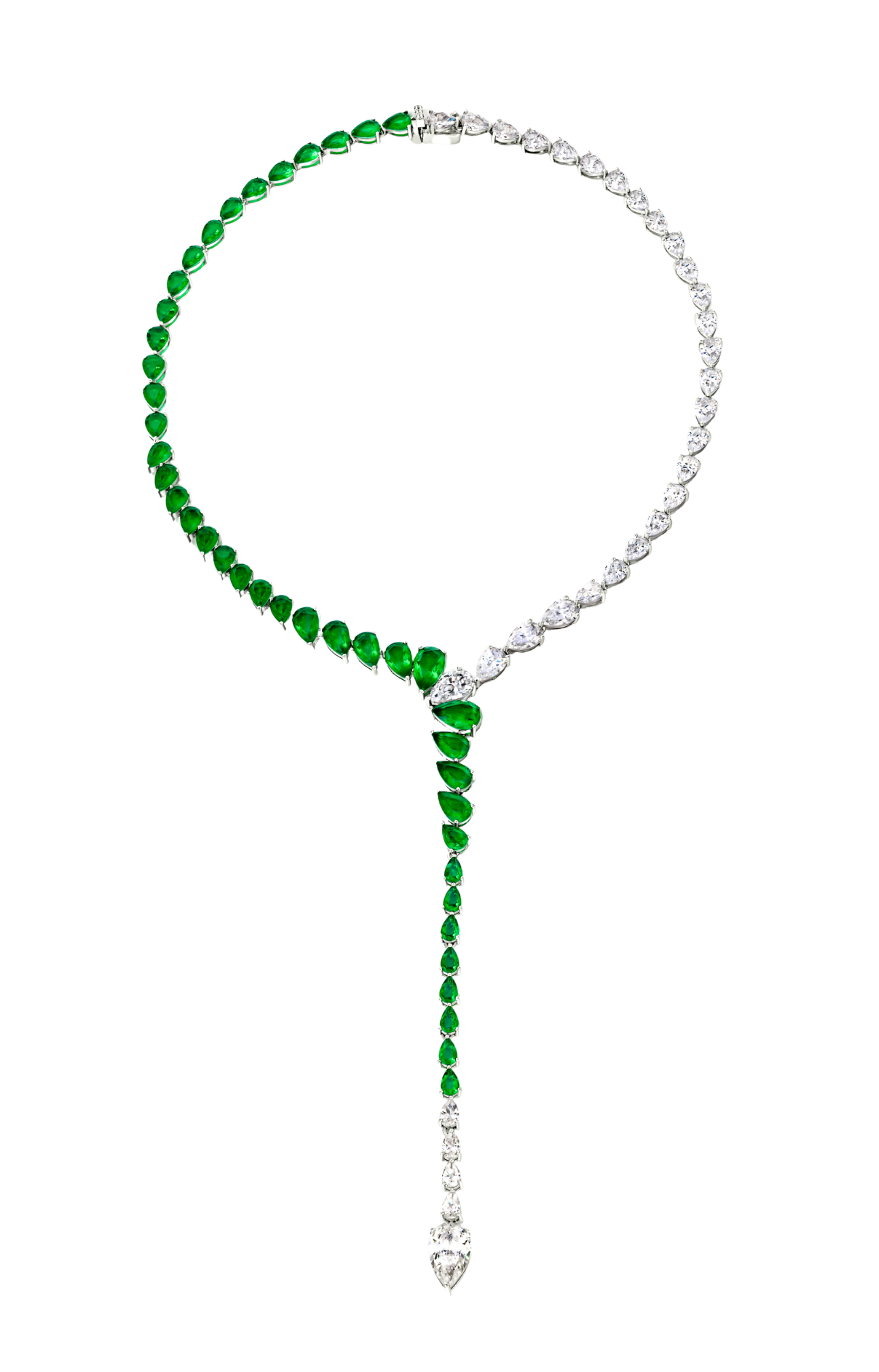
A bespoke emerald bracelet is made by a workshop that keeps design, setting, and production in one hand. Because emerald is more brittle than ruby or sapphire, what counts is a setting that protects corners and edges, a suitable size, and a report that discloses the fissure filling of each main stone. The stones in a line must match in color.
At a glance
- Hardness of emerald
- 7.5 to 8 on the Mohs scale
- Toughness according to GIA
- Fair to good, more brittle than ruby and sapphire
- Protective settings
- Bezel setting and channel setting protect the edges best
- Common treatment
- Filling of fine fissures with oil, wax, or resin
- Fit
- One finger should fit between wrist and bracelet
- 18k (750) gold
- 750 parts per thousand gold, marked under the German Hallmarking Act (Feingehaltsgesetz)
- Cleaning
- Warm soapy water, no ultrasonic, no steam
Why the wrist calls for special planning
A bracelet knocks against table edges, door frames, and bags. Emerald reaches 7.5 to 8 on the Mohs scale and is therefore hard enough to resist scratches in daily wear. Its toughness, meaning its resistance to breaking and chipping, is rated by GIA as only fair to good, however. It is more brittle than ruby and sapphire. A blow to an unprotected corner is more likely to damage it than a hard object grazing the table.
Then there is the inner life of the stone. Most emeralds have fine fissures visible to the naked eye. Heat can widen such fissures, and light and chemicals can alter the fillers within them. A bespoke emerald bracelet therefore begins with two questions: how heavily will the piece be worn, and which stones can withstand that. Only then do shape and design follow. The page Emerald offers basic knowledge about the stone.
Constructions and what they demand of the stone
The construction determines how much movement and how many knocks the stone receives. A link bracelet drapes closely, each link moving against the next. A rigid bracelet, explained in the glossary as a bangle, sits more calmly but rests firmly at the wrist joint. A single large emerald on a band draws every glance and every knock. The guide Diamond bracelet or bangle explores the differences between flexible and rigid.

| Construction | Effect | Stress on the emerald |
|---|---|---|
| Continuous line of stones | Even line around the wrist | Many stones, each set and checked individually |
| Link bracelet with accent stones | Flexible, stones at intervals | Moderate, links absorb knocks |
| Bangle with center stone | Calm, graphic | High on the top side, the setting must protect |
| Band with a single emerald | The stone stands on its own | High, the stone is exposed |
The stress also depends on stone size, setting height, and wearing habits.
A continuous line of individually set stones is familiar from the tennis bracelet. According to GIA, the name became known in the 1980s after the tennis player Chris Evert lost her diamond bracelet during a match at the US Open. The construction also works with emeralds. It requires, however, many stones of the same color and a setting that secures every edge.
The setting protects the brittle stone
In a bezel setting, a metal rim surrounds the stone fully or partially. GIA writes that it protects the edges of the stone excellently and holds it securely. It covers more of the girdle and lets somewhat less light into the stone. In return, nothing catches, which is worth a great deal on the wrist. In a channel setting, the stones sit in a row between two parallel metal walls and are likewise protected at the edges.
Prongs, small metal claws, show more of the stone and let more light in. They protect the edges less, however, can catch on fabrics, and according to GIA should be checked from time to time. With the emerald cut and its beveled corners, prongs find a secure hold. For a bracelet that is worn often, a bezel or channel setting is usually the calmer choice. More background in the guide Settings for colored gemstones.
Good to know
Care is needed when setting an emerald, because pressure on existing fissures can damage the stone. According to GIA, the cutter must already ensure during cutting that the stone is not harmed in cutting, setting, or wearing.
Selecting stones that belong together
A bracelet with several emeralds only works if the colors match. GIA values bluish to pure green with strong saturation and a tone that is not too dark most highly. In a line, a single stone that is lighter, more yellowish, or darker stands out immediately. During selection, the stones are therefore laid side by side and compared under different light. This takes time and is the core of the work.
Inclusions belong to emerald and, because of their mossy appearance, are called jardin. They become critical when they noticeably reduce transparency or reach the surface. In a bracelet, the second point weighs more heavily, because fissures near the surface can give way under knocks. For the main stones, a report that grades the fissure filling is worthwhile: at SSEF as none, minor, moderate, or significant. The guide Emerald and treatment explains what the report states.
The cut also depends on the purpose. According to GIA, the emerald cut is the most common cut for emeralds because the beveled corners are less vulnerable. For lines, stones of equal size in the same shape are often chosen so that the line stays calm. The guide Emerald cut shows how the cut guides the color and effect of an emerald.
Metal, weight, and fit
The mark 750 on gold means 750 parts per thousand gold. The German Hallmarking Act (Feingehaltsgesetz) requires that a stated fineness on jewelry be given in parts per thousand and limits the permitted deviation. Vikar Ahmed works with 18k (750) gold in white, rose, and yellow as well as platinum 950. White gold and rose gold make the same green appear differently warm. This effect can be checked on the stone before the metal is decided.

The size determines comfort and security. For tennis bracelets, GIA recommends that one finger should fit between wrist and bracelet. Too loose, and the bracelet knocks against edges. Too tight, and it presses. The clasp needs a safety catch that does not open by itself.
From conversation to finished bracelet
At Vikar Ahmed, a bespoke bracelet follows the process of the house: design, visualization, execution. In-house designers develop the concept, and personal wishes are incorporated. A 3D design in CAD makes the piece visible before production. It is crafted as a one-of-a-kind piece in the in-house atelier. Custom projects are reviewed on request, and work begins only after acceptance.
- Conversation and wearing habitsHow often, for which occasion, and on which arm the bracelet will be worn.
- DesignSketches of construction, setting, and sequence of stones, tailored to the desired effect.
- VisualizationThree-dimensional model in CAD, review of proportion and seating of the stones.
- Stones and settingSelection and matching of the emeralds, then setting in the in-house atelier.
- HandoverCheck of size, clasp, and setting on the wrist.
As a guide, Vikar Ahmed gives about four to six weeks for more elaborate custom pieces and about one to three months for High Jewelry projects. If you have a fixed date, such as an anniversary, you should mention it at the outset. The guide Bespoke jewelry with emerald describes the general path of a commission with emerald.
Common mistakes and proper care
- High prongs on a bracelet for every day: they leave edges exposed and catch on fabrics.
- Selecting stones individually by report without seeing them side by side: color differences only show in the line.
- Not clarifying the fissure filling of the main stones: it determines care and later reworking.
- Estimating the size instead of measuring it: a bracelet that is too loose knocks, one that is too tight presses.
- Cleaning the bracelet in an ultrasonic bath: vibrations weaken fissured stones and drive oil out of the fissures.
For care, GIA recommends warm soapy water and gentle cleaning. Ultrasonic and steam are risky for emerald, because hot steam can force oil or uncured resin out of the fissures. Perfume, creams, and cleaning agents are best kept away from the stone. Setting and clasp should be checked at intervals. Vikar Ahmed advises wiping the emerald only with a soft, slightly damp cloth, having it re-oiled in the workshop when needed, and having the setting checked about every two years.
Frequently asked questions
Is an emerald suitable for a bracelet?
Yes, if construction and setting protect the stone. GIA considers emeralds suitable for all types of jewelry but calls for more care in wear than with ruby or sapphire. A bezel or channel setting and a suitable size reduce the risk from knocks considerably.
Which setting is the most secure for an emerald bracelet?
A bezel setting, in which a metal rim surrounds the stone. It protects the edges, holds the stone firmly, and does not catch on clothing. For a line of small stones, the channel setting achieves something similar. Prongs show more of the stone but require regular inspection.
Why must the emeralds in a bracelet be matched in color?
Because in a line, the eye notices every difference immediately. A lighter or more yellowish stone disturbs the line more than in a single ring. The stones are therefore compared side by side and under different light before they are set.
How snugly should an emerald bracelet fit?
So that one finger fits between wrist and bracelet. GIA gives this rule of thumb for tennis bracelets. If the bracelet sits too loosely, it knocks against edges. If it sits too tightly, it presses and strains the clasp and links.
How do you clean an emerald bracelet properly?
With warm soapy water and a soft brush, then rinse well and dry. Ultrasonic and steam are unsuitable because they can weaken fissured stones and loosen fillers from the fissures. Setting and clasp are briefly checked for a secure fit at the same time.
What does 750 mean on a gold bracelet?
The number states the fineness in parts per thousand: 750 parts of 1,000 are gold. The German Hallmarking Act (Feingehaltsgesetz) requires this statement in parts per thousand when a fineness is marked on jewelry and limits the permitted downward deviation.
Private consultation
How your emerald bracelet should be constructed becomes clear in a conversation about your wearing habits and your vision. Vikar Ahmed advises in the house's showroom in Idar-Oberstein by appointment or virtually. Your inquiry is handled discreetly. Request an appointment for a private consultation.
Further reading
- Glossary: Emerald
- Tourmaline bracelet
- Emerald or tourmaline for a one-of-a-kind piece
- Fineness in a one-of-a-kind piece
- Glossary: Bespoke
Sources
- GIA: Emerald Care and Cleaning, accessed 2026-11-17
- GIA: Emerald Quality Factors, accessed 2026-11-17
- SSEF: Emerald, accessed 2026-11-17
- GIA 4Cs: Guide to Ring Settings, accessed 2026-11-17
- GIA 4Cs: Tennis Bracelet Buying Guide, accessed 2026-11-17
- Gesetz über den Feingehalt der Gold- und Silberwaren, accessed 2026-11-17
- Vikar Ahmed: Bespoke, Designprozess, accessed 2026-11-17

A personal conversation starts here.
At the showroom in Idar-Oberstein or by video. Vikar Ahmed discusses your ideas, stones and designs with you and answers your questions calmly and in confidence.


Thank you for your request.
Your request will be handled with the utmost attention and discretion. Vikar Ahmed will get back to you.
Your details
Request
–
Occasion
–
Consultation
–
Contact
–
In the meantime
Insights: What is a Paraíba tourmaline? · Engagement ring to your own design: how does it work?
Confidential and without obligation
Back to the pagePrivate consultation
A personal conversation starts here.
- Time for your questions, wishes and ideas
- In the showroom in Idar-Oberstein or by video
- Confidential, discreet and without obligation
Vikar Ahmed · Hauptstraße 111 · 55743 Idar-Oberstein, Germany