

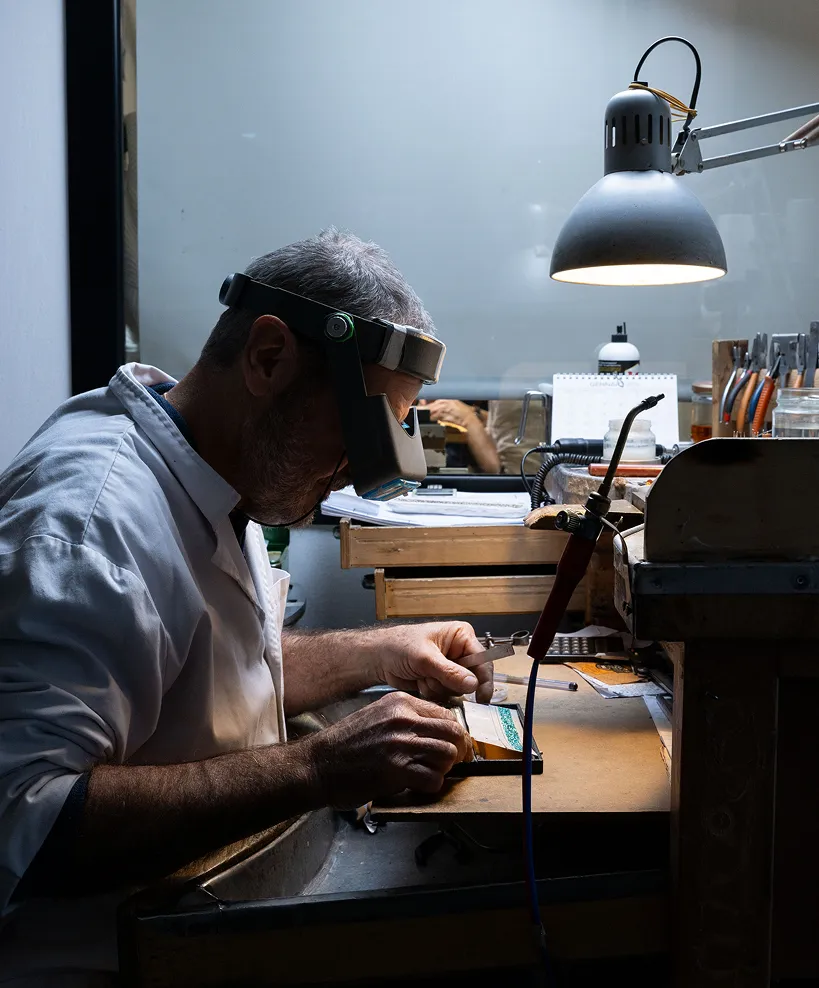
Stones whose quality can be clearly assessed and documented in writing are suitable for a collection. Ruby, sapphire, and emerald are the classic starting stones, because established standards and laboratory reports with origin determination exist for them. Tourmalines, including Paraíba, extend the color palette. What matters is color, report, treatment disclosure, and storage that protects the stones.
At a glance
- First standard
- Color, for ruby and sapphire the most important value factor according to GIA
- Classic starting point
- Ruby, sapphire, emerald
- Mohs hardness
- Ruby and sapphire 9, emerald 7.5 to 8, tourmaline 7 to 7.5
- GIA origin report
- Among others for emerald, ruby, sapphire, Paraíba tourmaline, red spinel
- Loose or mounted
- Laboratories examine loose stones more comprehensively than mounted ones
- Storage
- Each stone individually, with report and notes
What makes a stone worth collecting
A stone is worth collecting when its quality can be named and documented. That sounds sober, but it is the core of every collection. A stone whose type, treatment, and origin no one has confirmed remains a claim. A stone with a report can be compared with others, classified later, and passed on. Then there is color: for ruby and sapphire, GIA calls it the most important factor for value, and the same is broadly true for emerald.

Rarity alone does not make a good collection. Many collectors begin with one type of stone and build depth within it, such as sapphires in different colors or tourmalines from different deposits. Others collect across types by one color. Both paths work if each stone is good in itself. Which stones are considered particularly rare in High Jewelry is described in Which colored gemstones are truly rare.
Ruby, sapphire, and emerald compared
The three classic colored stones differ less in rank than in character. Ruby and sapphire belong to the same mineral species, corundum, and according to GIA are very resistant with a hardness of 9. According to GIA, sapphire has excellent toughness and no cleavage. Emerald, at 7.5 to 8, is somewhat softer and according to GIA has only fair to good toughness. It requires more care but rewards it with a green that no other stone shows in the same way.
| Criterion | Ruby | Sapphire | Emerald |
|---|---|---|---|
| Mohs hardness | 9 | 9 | 7.5 to 8 |
| Inclusions | Almost always present | Usually cleaner than ruby | Usually visible to the naked eye |
| Size | Fine stones over 1 carat very rare | Large stones more common than with ruby | Price rises markedly with size |
| Common treatment | Heating, diffusion, glass filling | Heating, diffusion, glass filling | Fracture filling with oil or resin |
| Care | Robust; filled stones are sensitive | Robust; filled stones are sensitive | No ultrasonic, no heat |
Based on GIA information on quality and care. Individual stones may differ.
For a starting point, this means: if you also want to wear your stones, ruby and sapphire are the more robust partners. If you are looking for green, with emerald you accept inclusions that according to GIA are usually visible to the naked eye and are often described as a garden. According to GIA, eye-clean emeralds are particularly rare. More on the individual stones can be found under Ruby, Sapphire, and Emerald.
Color first, then clarity and size
For each of the three stones, GIA describes a preferred color. For ruby, it is a vivid red; a slight purplish tint is acceptable. Too dark costs brightness, too light moves the stone toward pink sapphire. For blue sapphire, velvety blue to violetish blue in medium tones is considered the most valuable. For emerald, bluish green to pure green with strong saturation and high transparency is sought after.
Clarity is measured differently for each type of stone. For ruby, according to GIA, inclusion-free stones practically do not exist, but visible inclusions under the table greatly reduce the value. Blue sapphires are usually cleaner; very clean pieces are rare. As for size: according to GIA, fine rubies over one carat are very rare, while large blue sapphires are more common. For emerald, the price rises markedly with size at the same quality.
Tourmalines as the second line of the collection
Tourmalines offer a range of colors that hardly any other type of stone achieves, from red through green to blue. At 7 to 7.5 on the Mohs scale and with fair toughness according to GIA, they are somewhat more sensitive than corundum. For a collection, they are appealing because many colors and deposits within one species can be placed side by side. The intensely red rubellite and the green-blue Lagoon tourmaline are two examples.

Paraíba tourmaline holds a special position. Its color is based on copper and manganese, and according to GIA it is only rarely seen over one carat. There are two views on the name: the definition of the Laboratory Manual Harmonisation Committee cited by GIA uses it independently of origin for suitably colored copper- and manganese-bearing tourmalines, while SSEF writes it into the identification only for Brazilian stones. If you collect Paraíba, you should therefore know which laboratory issued the report.
Loose stones or mounted pieces
Whether you collect stones unmounted or in jewelry is also a question of how well they can be examined. SSEF explicitly prefers unmounted stones for examinations. It examines colored stones in jewelry only as far as the setting allows. For a color grading of ruby and sapphire, the stones must be loose there. SSEF issues a Gemstone Report only for a single loose stone; mounted stones receive a Test Report.
Many collectors combine both: they have a stone examined unmounted first and then set in a piece of jewelry designed for exactly this stone. That way the report is complete, and the stone is still worn. How an existing stone becomes a piece of its own is described in Designing around a loose stone. What matters is having the report before setting, not afterward.
Reports, treatment, and storage
A report is the memory of a collection stone. At GIA, the identification report describes the material and detectable treatments. GIA offers an additional origin report for a limited list of stones, including emerald, ruby, sapphire, Paraíba tourmaline, and red spinel. According to SSEF, origin is an expert opinion based on inclusions, trace elements, and spectra, not irrefutable proof. More on this under Origin report.
Treatments are part of the picture; they simply have to be known. With emerald, fracture filling is the rule according to GIA. For ruby and sapphire, GIA names heating, diffusion, and fillings with lead glass. Filled stones need more protection: according to GIA, glass-filled rubies and sapphires can be damaged even by mild acids such as lemon juice. Each stone is stored individually so that harder stones do not scratch softer ones, together with its report and a note on its origin and when it entered the collection.
Typical mistakes when building a collection
- Choosing by size instead of by color.
- Adding stones without a report and postponing the documentation until later.
- Not asking about treatment because the stone looks beautiful.
- Deriving origin from color instead of from a report.
- Storing stones loose together in one box.
- Cleaning an emerald like a sapphire.
In the house's pieces shown, Vikar Ahmed works with Brazilian Paraíba tourmaline, Lagoon tourmaline, Namibian tourmaline, rubellite, and Colombian emerald, among others. For a collection, a stated origin only counts once a laboratory report records it. For high-quality emeralds, rubies, sapphires, and Paraíbas from 1 carat, such a report is standard at the house. Consultations take place in the showroom in Idar-Oberstein by appointment. The house has no location in Trier; collectors from there come to Idar-Oberstein for an appointment or choose a virtual appointment.
Frequently asked questions
Which loose gemstones are best suited for a collection?
Stones whose color is convincing and whose type, treatment, and, where needed, origin a laboratory has confirmed. Ruby, sapphire, and emerald are good starting points, because established standards and origin reports exist for them. Tourmalines extend the collection with many colors.
How do emerald, ruby, and sapphire compare as loose stones for starting a colored stone collection?
Ruby and sapphire, with a hardness of 9 and good toughness, are more robust; sapphire is usually cleaner than ruby. Emerald is softer, almost always fracture-filled, and needs gentle care. For all three: color decides first, and a report makes the stone reliable for the collection.
Should I keep collection stones loose or mounted?
For examination, loose stones are better, because laboratories such as SSEF examine mounted stones only to a limited extent. If you want to wear a stone, have it examined unmounted first and then set. Loose stones are stored individually so that harder stones do not scratch softer ones.
Is a treated stone unsuitable for a collection?
No. Treatments are widespread; with emerald, fracture filling is the rule according to GIA. For the collection, what counts is that the treatment is known and recorded in the report. Untreated stones are rarer and are valued differently, but a treated stone with clear disclosure remains a proper collection stone.
Why does the laboratory issuing the report matter for Paraíba tourmaline?
Because laboratories assign the name differently. According to the LMHC definition cited by GIA, suitably colored copper-bearing tourmalines are called Paraíba regardless of where they come from. SSEF writes the name into the identification only for Brazilian stones. Two stones of the same color can therefore be named differently.
Private consultation
If you would like to wear a collection stone in a piece of jewelry or have questions about reports and treatments, please talk to us. Vikar Ahmed advises in the showroom in Idar-Oberstein by appointment or in a virtual appointment. Request an appointment for a private consultation.
Further reading
- What determines the value of a colored stone?
- Choosing a colored stone
- Recognizing and assessing gemstone treatment
- Glossary: Untreated
- Gemstone: Paraíba Tourmaline
Sources
- GIA: Ruby Quality Factors, accessed 2026-11-17
- GIA: Sapphire Quality Factors, accessed 2026-11-17
- GIA: Emerald Quality Factors, accessed 2026-11-17
- GIA: Ruby Care and Cleaning, accessed 2026-11-17
- GIA: Sapphire Care and Cleaning, accessed 2026-11-17
- GIA: Emerald Care and Cleaning, accessed 2026-11-17
- GIA: Tourmaline Care and Cleaning, accessed 2026-11-17
- GIA: Tourmaline Quality Factors, accessed 2026-11-17
- GIA: Colored Stone Reports, accessed 2026-11-17
- SSEF: Understanding a SSEF Report, accessed 2026-11-17
- SSEF: Jewellery Testing, accessed 2026-11-17
- SSEF: Paraiba Tourmaline, accessed 2026-11-17
- GIA Gems & Gemology: Paraíba Tourmaline, Geographic Origin Determination (Winter 2019), accessed 2026-11-17

A personal conversation starts here.
At the showroom in Idar-Oberstein or by video. Vikar Ahmed discusses your ideas, stones and designs with you and answers your questions calmly and in confidence.


Thank you for your request.
Your request will be handled with the utmost attention and discretion. Vikar Ahmed will get back to you.
Your details
Request
–
Occasion
–
Consultation
–
Contact
–
In the meantime
Insights: What is a Paraíba tourmaline? · Engagement ring to your own design: how does it work?
Confidential and without obligation
Back to the pagePrivate consultation
A personal conversation starts here.
- Time for your questions, wishes and ideas
- In the showroom in Idar-Oberstein or by video
- Confidential, discreet and without obligation
Vikar Ahmed · Hauptstraße 111 · 55743 Idar-Oberstein, Germany